
English
Welcome to opelink.com
Technical Guide

Outdoor Fiber Optic Cable Types: GYTS, ADSS and OPGW Guide

Views : 677
Author : goodvin
Update time : 2026-09-22 11:27:21

Introduction: Why Choosing the Right Outdoor Fiber Cable Type Matters

Selecting the correct outdoor fiber optic cable type is one of the most consequential decisions in any fiber network deployment. The cable you choose directly impacts installation cost, long-term reliability, maintenance requirements, and total project ROI. A mismatch between cable type and deployment environment can lead to premature failure, costly re-installation, and extended network downtime — with 68% of fiber failures occurring in the first 100 meters from termination points, the stakes are high from the moment cable selection begins.
The global fiber optic cable market was valued at $3.08 billion in 2025 and is projected to reach $5.31 billion by 2032, growing at a compound annual growth rate (CAGR) of 8.09%. This growth is driven by 5G rollout, data center expansion, rural broadband initiatives, and power grid modernization — all of which demand different outdoor fiber optic cable types optimized for specific deployment scenarios.
Among the many outdoor fiber optic cable types available, three dominate large-scale infrastructure projects: GYTS, ADSS, and OPGW. Each serves distinct applications — from underground backbone routes to aerial power line retrofits to high-voltage transmission ground wires. Understanding the structural differences, installation requirements, and cost implications of GYTS, ADSS, and OPGW is essential for engineers, project managers, and procurement teams who must balance performance, budget, and timeline constraints.
This guide provides a comprehensive overview of outdoor fiber optic cable types, compares their key specifications, and offers a practical decision framework to help you select the optimal cable for your specific project requirements.
Outdoor Fiber Optic Cable Types: GYTS, ADSS & OPGW Guide

Quick Overview: Outdoor Fiber Cable Types at a Glance

The table below summarizes the five most common outdoor fiber optic cable types, comparing their structure, installation method, typical application, voltage range, span distance, and relative cost.
Cable Type Structure Installation Method Typical Application Voltage Range Max Span Distance Relative Cost
GYTS Steel wire armored, gel-filled, PE sheath Direct burial / duct Underground backbone, campus networks N/A (non-power) N/A (continuous) Low
ADSS All-dielectric, aramid yarn, PE/AT sheath Aerial self-supporting Power line retrofit, distribution Up to 500kV (AT sheath) Up to 1800m Medium
OPGW Aluminum-clad steel + optical unit Overhead on transmission towers HV ground wire + communication ≥110kV 1000m+ High
GYXTW Central tube, steel wire armored Aerial / duct Short-distance aerial links N/A Up to 200m Low
Submarine Multi-layer armored, double steel Submarine laying Underwater crossings, island links N/A Unlimited Very High
For most terrestrial projects, the decision narrows to GYTS, ADSS, or OPGW. The sections below examine each in detail.
→
how to read fiber optic cable specifications

GYTS Cable Overview

GYTS (GY = outdoor, T = filled, S = steel wire armored) is a layered stranded fiber optic cable designed for direct burial and duct installation. It is the workhorse of underground fiber infrastructure worldwide.

Structure

  1. Central strength member: A steel wire (typically 1.5–3.0mm diameter) provides primary tensile reinforcement
  2. Loose tube stranding: Fiber-containing loose tubes (filled with thixotropic gel for water blocking) are stranded helically around the central member
  3. Water-blocking gel: Flooding gel fills interstitial spaces to prevent water ingress along the cable length
  4. Steel wire armor: A layer of galvanized steel wires provides mechanical protection against crushing and rodent damage
  5. Outer sheath: Polyethylene (PE) jacket, typically black, UV-resistant, rated for -40°C to +70°C

Key Specifications

Parameter Value
Fiber count 2–144 cores
Diameter 8–20mm (varies with fiber count)
Tensile strength 600–3000N (short-term)
Temperature range -40°C to +70°C
Bend radius 10× diameter (installation), 20× diameter (long-term)
Water blocking Gel-filled + optional water-swellable yarn
Armor Galvanized steel wire

Typical Applications

GYTS excels in environments where cables are buried directly in soil or pulled through pre-installed ducts. Common use cases include:
  1. Telecom underground backbone: Long-haul routes between cities and central offices
  2. Campus and enterprise networks: Connecting buildings within a university, hospital, or industrial campus
  3. FTTH distribution: Feeder and distribution segments in fiber-to-the-home deployments
  4. Railway and highway corridors: Communication networks along transportation infrastructure
The steel wire armor makes GYTS resistant to crushing forces during burial and backfilling, while the gel filling ensures long-term protection against groundwater ingress. However, GYTS is not self-supporting — it requires a duct, trench, or messenger wire for aerial deployment, which adds infrastructure cost.
For a detailed guide on GYTS direct burial and duct installation practices, see our GYTS cable direct burial and duct installation guide.

ADSS Cable Overview

ADSS (All-Dielectric Self-Supporting) is a non-metallic fiber optic cable designed for aerial installation on existing power poles and transmission towers. Its key advantage is that it requires no separate support messenger wire and contains no metal components, eliminating electrical hazards.

Structure

  1. Central strength member: Fiber Reinforced Plastic (FRP) rod — non-conductive, lightweight
  2. Loose tubes: Stranded around the FRP center, gel-filled for water blocking
  3. Aramid yarn strength layer: Multiple layers of Kevlar (aramid yarn) provide the tensile strength needed for self-supporting spans — this is the defining feature of ADSS
  4. Outer sheath options:
  5. PE (Polyethylene) sheath: For installations on poles up to 110kV
  6. AT (Aramid Tracking-resistant) sheath: For installations on towers from 110kV to 500kV, resistant to dry-band arcing and electrical tracking

Key Specifications

Parameter Value
Fiber count 2–288 cores
Span distance Up to 1800m (typical: 100–600m)
Voltage compatibility Up to 500kV (with AT sheath)
Temperature range -40°C to +70°C
Tensile strength 600N–20kN (varies by design)
Conductivity None (all-dielectric)
Installation Live-line capable (no outage required)

Typical Applications

ADSS is the preferred choice when fiber needs to be deployed along existing power infrastructure without disrupting electrical service:
  1. Power line retrofit: Adding communication capacity to existing distribution and transmission lines
  2. Smart grid communication: SCADA, telemetry, and protection signaling for utility networks
  3. Railway signaling: Communication along electrified rail corridors
  4. Aerial distribution: FTTH aerial drops and distribution in areas where underground installation is impractical
The all-dielectric construction means ADSS can be installed on energized lines without requiring a power outage — a significant advantage for utilities that cannot interrupt service. However, on high-voltage lines (>110kV), the AT sheath is mandatory to prevent dry-band arcing damage, and careful attention must be paid to the installation position relative to phase conductors to manage electric field exposure.
For a comprehensive guide on selecting ADSS for power line installations, see our ADSS cable selection guide for power lines.

OPGW Cable Overview

OPGW (Optical Ground Wire) is a dual-function cable that serves simultaneously as a grounding wire and a fiber optic communication link on high-voltage transmission lines. It replaces the traditional bare overhead ground wire with a composite conductor that integrates optical fibers.

Structure

  1. Optical unit: Stainless steel tube (or sometimes aluminum tube) containing the optical fibers, gel-filled for water protection
  2. Stranded wires: Aluminum-clad steel (ACS) wires and/or aluminum alloy wires stranded around the optical unit
  3. Outer layer: The metallic strands form the outer conductor surface, providing both electrical conductivity and mechanical strength
  4. No separate sheath: The metallic wires are the outer layer — OPGW is a bare conductor, not a jacketed cable

Key Specifications

Parameter Value
Fiber count 12–144 cores
Diameter 10–20mm
Rated Tensile Strength (RTS) ≥100kN (varies by design)
Temperature range -40°C to +80°C
Voltage range ≥110kV (designed for transmission lines)
Short-circuit current 10–50kA (design-dependent)
Lifespan 30–40 years

Typical Applications

OPGW is the standard choice for new high-voltage transmission line construction where communication capacity is needed alongside the power infrastructure:
  1. New transmission lines: OPGW is installed at the top of the tower as the ground wire during line construction
  2. Substation interconnection: High-speed communication between substations for protection and control
  3. Utility backbone networks: High-capacity communication links along transmission corridors
  4. Renewable energy integration: Connecting wind farms and solar plants to the grid with embedded communication
The primary advantage of OPGW is its dual functionality — it eliminates the need for a separate ground wire and communication cable, reducing tower loading and installation complexity. However, OPGW installation requires either a line outage or installation during new line construction, which limits its applicability for retrofitting existing energized lines. Additionally, OPGW must be designed to withstand the short-circuit current of the transmission line, as excessive heating during fault conditions can damage the optical fibers.
For detailed guidance on OPGW selection for transmission line projects, see our OPGW cable selection guide for transmission lines.

Selection Decision Tree: Which Outdoor Fiber Cable Type Do You Need?

Use the following decision framework to quickly identify the right cable type for your project. Each recommendation links to a detailed spoke article for deeper guidance. →armored vs non-armored fiber cable
START: What is your deployment scenario?

├── New high-voltage transmission line (≥110kV)?
│   └── → OPGW — dual ground wire + fiber, installed during line construction
│       → See: OPGW Selection Guide (/article/opgw-cable-selection-guide-transmission-lines.html)
│
├── Existing power line retrofit (add fiber to energized line)?
│   └── → ADSS — all-dielectric, install live-line without outage
│       → See: ADSS Selection Guide (/article/adss-cable-selection-guide-power-lines.html)
│
├── Underground or duct installation?
│   └── → GYTS — steel armored, gel-filled, direct burial or duct
│       → See: GYTS Installation Guide (/article/gyts-cable-direct-burial-duct-installation.html)
│
├── Need detailed cost comparison across cable types?
│   └── → See: Fiber Optic Cable Cost & Price Analysis (/article/fiber-optic-cable-cost-price-analysis.html)
│
├── Special application (FTTH, mining, submarine, industrial)?
│   └── → See: Cable Selection by Application (/article/fiber-optic-cable-selection-by-application.html)
│
├── Want detailed type comparison (GYTS vs ADSS vs OPGW)?
│   └── → See: GYTS vs ADSS vs OPGW Comparison (/article/gyts-vs-adss-vs-opgw-cable-comparison.html)
│
└── Need installation best practices?
    └── → See: Outdoor Fiber Optic Cable Installation Guide (/article/outdoor-fiber-optic-cable-installation-guide.html)

Key Selection Factors

Beyond the deployment scenario, several technical factors influence cable type selection. Evaluate each factor against your project requirements:

1. Fiber Type: G.652D vs G.657A2

  1. G.652D: Standard single-mode fiber, optimized for long-haul transmission at 1310nm and 1550nm. Best for backbone and long-distance links.
  2. G.657A2: Bend-insensitive single-mode fiber, tolerates bend radii as low as 7.5mm. Best for FTTH, tight spaces, and aerial deployments where wind loading may cause bending. Current pricing: $33–35/km (March 2026).
Most outdoor cables can be specified with either fiber type. For aerial installations (ADSS, OPGW), G.657A2 is increasingly preferred due to its superior bend performance under wind and ice loading.

2. Fiber Count

Determine current and future capacity needs:
  1. 2–24 cores: Distribution, FTTH drops, small enterprise links
  2. 24–72 cores: Metro backbone, campus networks, utility communication
  3. 72–144 cores: Long-haul backbone, data center interconnect, major transmission corridors
  4. 144+ cores: High-capacity backbone, submarine systems

3. Environmental Conditions

Condition Consideration
Temperature extremes All three types rated -40°C to +70/80°C; verify for extreme climates
High humidity / water GYTS gel-filled; ADSS/OPGW use water-swellable materials
Lightning exposure OPGW designed to handle lightning; ADSS non-conductive but can be damaged by indirect strikes
Rodent/animal risk GYTS steel armor provides best protection; ADSS may need additional armor
Chemical exposure PE sheath on GYTS/ADSS resists most chemicals; verify for industrial sites
Wind/ice loading ADSS and OPGW must be specified for local wind and ice load conditions

4. Span Distance (Aerial Installations)

  1. ADSS: Designed for spans up to 1800m, but typical installations use 100–600m spans. Longer spans require higher tensile strength ratings and larger sag allowances.
  2. OPGW: Span lengths depend on tower spacing, typically 200–500m for transmission lines. The cable's RTS must exceed the calculated mechanical load under worst-case wind and ice conditions.

5. Voltage Level (Power Line Installations)

Voltage Level Recommended Cable Sheath Requirement
≤35kV ADSS PE sheath
35kV–110kV ADSS PE or AT sheath
110kV–500kV ADSS or OPGW ADSS requires AT sheath; OPGW for new lines
≥500kV OPGW (new lines) or ADSS (retrofit) AT sheath for ADSS; special OPGW design for UHV
 

6. Budget Constraints

  1. Lowest cost per meter: GYTS (but requires trench/duct infrastructure)
  2. Medium cost: ADSS ($0.90–1.60/ft installed, no separate support needed)
  3. Highest cost: OPGW ($2.10–3.50/ft, but replaces separate ground wire)
For a comprehensive cost analysis, see our fiber optic cable cost and price analysis.

Conclusion: Selecting the Right Outdoor Fiber Optic Cable Type

Choosing among GYTS, ADSS, and OPGW comes down to understanding your deployment scenario, environmental conditions, voltage requirements, and budget constraints:
  1. GYTS for underground and duct installations where mechanical protection and water blocking are paramount
  2. ADSS for aerial retrofit on existing power lines where live-line installation and non-conductive properties are essential
  3. OPGW for new high-voltage transmission lines where dual ground wire and communication functionality delivers the best long-term value
Each cable type has been engineered for specific conditions, and selecting the wrong type can lead to premature failure, costly rework, and extended outages. With fiber prices at $33–35/km for G.657A2 fiber (March 2026) and the market growing at 8.09% CAGR, now is the time to invest in the right cable infrastructure for your network's future.
For a detailed head-to-head comparison of these three cable types, read our GYTS vs ADSS vs OPGW comparison article. For installation best practices across all outdoor cable types, see our outdoor fiber optic cable installation guide.
→
fiber optic cable standards (IEC/TIA/ITU)

Ready to Specify Your Fiber Cable Project?

Contact OPELINK for expert guidance on selecting the right outdoor fiber optic cable type for your project. Our engineering team provides:
  1. Free cable type recommendation based on your deployment scenario
  2. Detailed technical specifications and datasheets for GYTS, ADSS, and OPGW
  3. Competitive pricing with G.652D and G.657A2 fiber options
  4. Custom fiber counts from 2 to 288+ cores
  5. Full project support from specification to delivery
Request a quote today and get a response within 24 hours from our fiber optic cable specialists.

OPELINK — Fiber optic cable manufacturer specializing in outdoor GYTS, ADSS, and OPGW cables for telecom, utility, and enterprise networks worldwide.


Frequently Asked Questions

What is GYTS cable?

GYTS is an outdoor fiber optic cable with a steel wire central strength member, gel-filled loose tubes stranded around it, and a galvanized steel wire armor layer beneath a PE outer sheath. The "GY" designation means outdoor use, "T" indicates gel-filled (water-blocked), and "S" denotes steel wire armor. GYTS is designed for direct burial and duct installation, supporting 2–144 fiber cores with tensile strength of 600–3000N. It is one of the most widely used cable types for underground fiber backbone infrastructure.

What is ADSS cable?

ADSS (All-Dielectric Self-Supporting) is a non-metallic fiber optic cable designed for aerial installation on power poles and transmission towers. It uses aramid yarn (Kevlar) as the primary strength member, enabling self-supporting spans up to 1800m without a separate messenger wire. ADSS contains no metal components, making it safe to install on energized power lines without an outage. It is available with PE sheath (for ≤110kV lines) or AT sheath (for up to 500kV lines) to resist electrical tracking damage.

What is OPGW cable?

OPGW (Optical Ground Wire) is a composite cable that combines the functions of a grounding wire and a fiber optic communication link on high-voltage transmission lines. It consists of a stainless steel optical unit (containing the fibers) stranded with aluminum-clad steel and aluminum alloy wires. OPGW is installed at the highest point on transmission towers (≥110kV) and provides both lightning protection and high-capacity data communication. It has a rated tensile strength of ≥100kN and a design lifespan of 30–40 years.

What is the difference between ADSS and OPGW?

The key differences are: (1) Function: ADSS carries only optical fibers; OPGW serves as both ground wire and fiber link. (2) Installation: ADSS can be installed on energized lines (live-line); OPGW requires an outage or new line construction. (3) Voltage: ADSS works up to 500kV with AT sheath; OPGW is typically used on ≥110kV lines. (4) Cost: ADSS is 30–50% cheaper initially ($0.90–1.60/ft vs $2.10–3.50/ft), but OPGW offers longer lifespan and dual functionality. (5) Position: ADSS is installed below phase conductors; OPGW is installed at the tower peak as the ground wire.

Which outdoor fiber cable type is cheapest?

GYTS is the cheapest per meter of cable, but total installed cost depends on infrastructure requirements. GYTS requires trenching or duct infrastructure, which adds significant civil works cost. For aerial installations, ADSS ($0.90–1.60/ft) is cheaper than OPGW ($2.10–3.50/ft). However, OPGW replaces a separate ground wire, so for new transmission line construction, the combined cost may be lower than installing both a ground wire and a separate communication cable.

Can ADSS be installed on high-voltage lines?

Yes, ADSS can be installed on high-voltage lines up to 500kV, but it requires an AT (Aramid Tracking-resistant) sheath instead of standard PE sheath. The AT sheath resists dry-band arcing caused by electric field contamination. The installation position must also be carefully calculated relative to phase conductors to minimize electric field exposure. On lines above 110kV, proper sag and tension calculations are critical to prevent the cable from sagging into the electric field zone. ADSS can be installed live-line (without de-energizing the line) on most voltage levels, which is a major advantage over OPGW.
 

Related Resources

Outdoor Fiber Optic Cable Installation & Selection
ADSS Fiber Cable Aerial Guide
Armored vs Non-Armored Fiber Cable
Single-Mode Fiber Optic Cable Complete Guide
Fiber Cable Installation Best Practices
How to Read Fiber Optic Cable Specifications

Related News
Read More >>
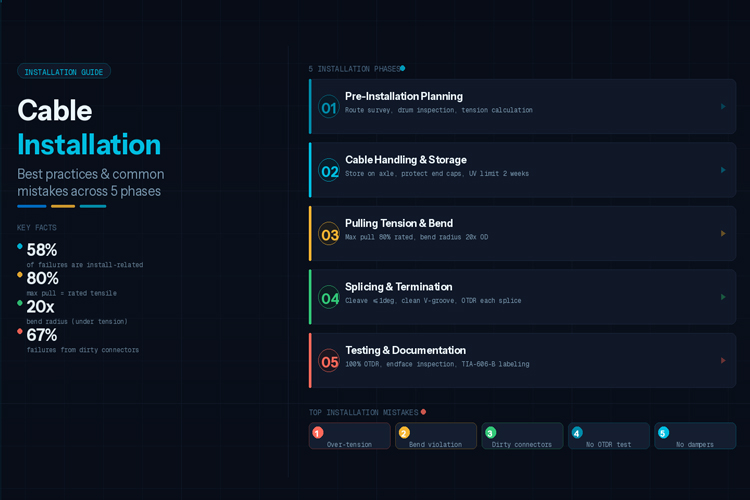
Outdoor Fiber Optic Cable Installation Guide: Aerial, Duct & Direct Burial Methods Outdoor Fiber Optic Cable Installation Guide: Aerial, Duct & Direct Burial Methods
Sep .29.2026
Step-by-step outdoor fiber optic cable installation guide covering aerial, duct and direct burial methods with best practices and safety requirements.
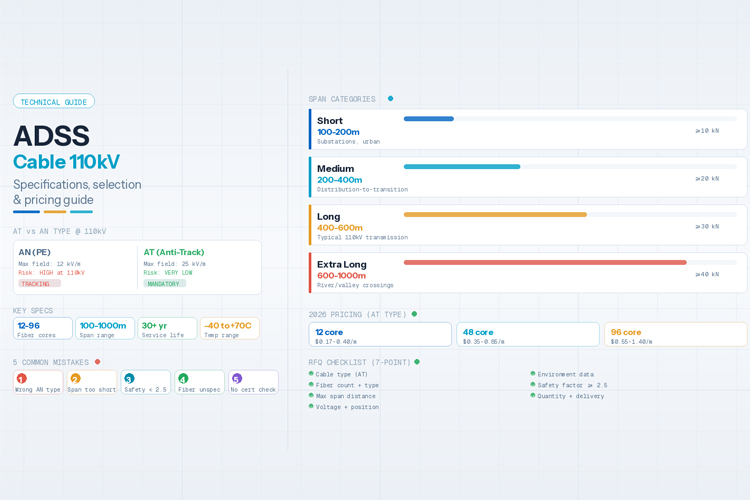
ADSS Cable for 110kV Power Line: Specifications, Selection & Pricing Guide ADSS Cable for 110kV Power Line: Specifications, Selection & Pricing Guide
Sep .15.2026
Complete guide to ADSS cable for 110kV power lines: AT type requirements, specifications, span calculations, 2026 price reference, RFQ checklist, and common mistakes to avoid.
Fiber Cable Installation Best Practices & Common Mistakes Fiber Cable Installation Best Practices & Common Mistakes
Sep .08.2026
Complete fiber optic cable installation guide: pre-installation planning, pulling tension limits, bend radius compliance, fusion splicing, OTDR testing, connector contamination prevention. Includes top 10 mistakes ranked by failure impact.
How to Read Fiber Optic Cable Specifications: Complete Guide How to Read Fiber Optic Cable Specifications: Complete Guide
Sep .01.2026
Master fiber optic cable specification reading: decode GYTS/GYTA codes, verify G.652.D fiber specs, interpret tensile/crush ratings, read OTDR traces, and check compliance certifications. Includes a 12-point acceptance checklist.