Key Takeaways
1. The single-mode fiber cable market reached $73.37 billion in 2025 and is projected to hit $78.12B in 2026 (CAGR 6.5%), driven by AI data center expansion (TBRC).
2. G.652.D standard fiber prices have surged 400-600% from ~20 RMB/km (early 2025) to 100-120 RMB/km (2026), while G.657.A2 prices exploded 557-714% to 230-240 RMB/km (CRU / China Post Securities).
3. Global fiber supply-demand gap reached 16.4% in 2026: total demand 577 million core-km vs effective supply 397 million. G.657 specialty fiber gap is as high as 46% (Guosheng Securities / Nomura Securities).
4. AI data center fiber demand grew 75.9% YoY (CRU 2026). AI training clusters consume 10x more fiber than traditional data centers. China's fiber exports surged 126.8% YoY in February 2026.
5. G.652.D remains the most versatile choice for general applications; G.657.A2 is mandatory for AI data center high-density cabling. Lead times now extend 6-12 months — procurement decisions require 2028 visibility.
From 20 RMB to 120 RMB — single-mode fiber is experiencing the largest price surge in its history. AI data centers consumed global fiber production capacity in 2025-2026, creating a 16.4% supply-demand gap. This is not a cyclical fluctuation; it is a structural pricing revolution driven by computing power.
1. Single-Mode Fiber Market 2026: A Market Transformed by AI
The single-mode fiber market has undergone a fundamental transformation in 2025-2026, shifting from a telecom-driven commodity to an AI-computing strategic resource.
According to The Business Research Company (TBRC), the single-mode fiber cable market was valued at $73.37 billion in 2025 and is projected to grow to $78.12 billion in 2026 at a CAGR of 6.5%, reaching $103.28 billion by 2030 at 7.2% CAGR. Future Market Insights (FMI) forecasts the bare single-mode optical fiber market to expand from $2.9 billion in 2025 to $13.0 billion by 2035, representing a robust CAGR of 16.2%.
The price explosion has been extraordinary. G.652.D standard single-mode fiber, which traded at approximately 20 RMB per core-km in early 2025, reached 83.4-120 RMB/km by March 2026 — an increase of 400-600% (CRU / China Post Securities). G.657.A2 bend-insensitive fiber surged from 30-35 RMB/km to 210-240 RMB/km, a staggering 557-714% increase.
The driver is unmistakable: AI data center fiber demand grew 75.9% year-over-year (CRU 2026). AI training clusters require 5-10x the fiber density of traditional data centers due to GPU-to-GPU interconnect topologies. The demand shift from “connecting people” to “connecting computing power” has fundamentally restructured the market.
2026 Single-Mode Fiber Price Trajectory
| Fiber Type |
Early 2025 Price (RMB/km) |
March 2026 Price (RMB/km) |
Increase (%) |
Application |
| G.652.D Standard |
~20 |
100-120 |
400-600% |
Telecom backbone, metro, FTTH |
| G.657.A1 Bend-Insensitive |
~23-25 |
115-135 |
~487% |
Indoor cabling, patch cords |
| G.657.A2 Max Bend-Insensitive |
~30-35 |
230-240 |
557-714% |
AI data centers, FTTH drop |
| G.657.A2 Preform (Raw Material) |
Base price |
Base + 550% |
~550% |
Optical preform upstream |
China dominates global fiber production with over 60% of total capacity. In February 2026, China's fiber optic cable exports increased 126.8% year-over-year, with leading manufacturers fully booked through 2028. Overseas customers have been willing to accept price premiums exceeding 50% to lock in production capacity (Securities Times, April 2026).
The global supply-demand gap stands at 16.4%: total 2026 demand of 577 million core-km against effective supply of only 397 million (Guosheng Securities, April 2026). For G.657 specialty fibers critical to AI data centers, the gap reaches 46%. Optical preform (the glass rod from which fiber is drawn) expansion cycles require 18-24 months, meaning supply relief will not arrive until 2027-2028 at the earliest.
Key Takeaway: The single-mode fiber market has shifted from a buyer's market of 20 RMB/km to a seller's market of 120+ RMB/km. AI computing demand, 18-24 month preform expansion cycles, and concentrated global supply (60%+ in China) have created a structural pricing regime that will persist through at least 2028. Procurement decisions made today must account for 6-12 month lead times and continued upward price pressure.
2. Q&A: Why Are Single-Mode Fiber Prices Surging 600% in 2026?
Q: What is driving the unprecedented 600% price surge in single-mode fiber?
A: Four structural forces are converging to create the largest price shock in fiber optic history:
1. AI Computing Reshapes Demand Structure. The demand paradigm has fundamentally shifted from “connecting people” (telecom, broadband) to “connecting computing power” (AI data centers). AI training clusters require 5-10x more fiber per square meter than traditional data centers due to dense GPU interconnect topologies. CRU reports 75.9% YoY growth in data center fiber demand for 2025.
2. Rigid Optical Preform Supply Constraints. Optical preform — the glass rod accounting for 70% of fiber cost — requires 18-24 months to expand capacity, with extremely high technical barriers. After a brutal price war in 2022-2024 drove many producers to losses, global leading manufacturers are operating at full capacity with no spare capacity.
3. Supply Shifting to High-Margin Specialty Fibers. Manufacturers are actively allocating limited preform capacity toward high-margin G.657 specialty fibers (230-240 RMB/km) rather than standard G.652.D (100-120 RMB/km), further tightening G.652.D supply. Nomura Securities data shows G.657.A2 preform prices alone have risen 550%.
4. Concentrated Global Supply Structure. China produces over 60% of global fiber, with the U.S. and Japan comprising much of the remainder. Overseas expansion has been extremely restrained. When AI demand exploded, this concentrated supply chain became the global bottleneck — Chinese exports surged 126.8% YoY in February 2026, and leading manufacturers are fully booked through 2028.
Key Takeaway: This is not a cyclical price fluctuation — it is a structural repricing driven by the fundamental mismatch between explosive AI-driven demand and rigid optical preform supply. Prices will remain elevated until new preform capacity comes online in 2027-2028, and G.657 specialty fiber premiums will persist even longer.
Explore OPELINK's single-mode fiber cable product line for competitive pricing and full IEC compliance documentation. [View SMF Products]
3. What Is Single-Mode Fiber? Technical Foundation
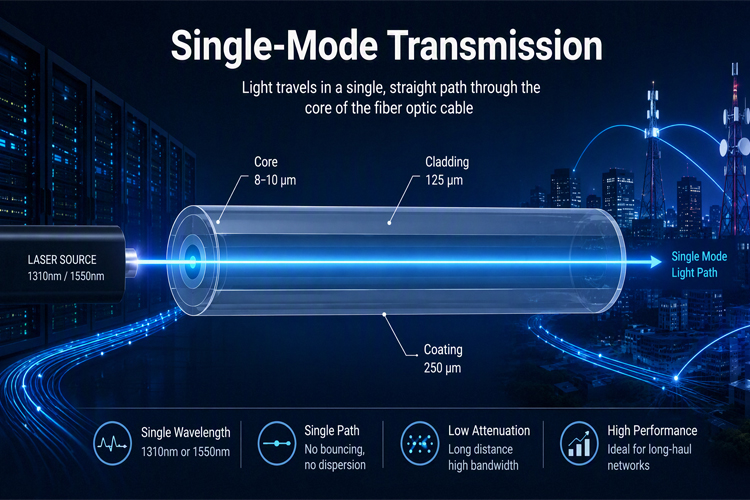
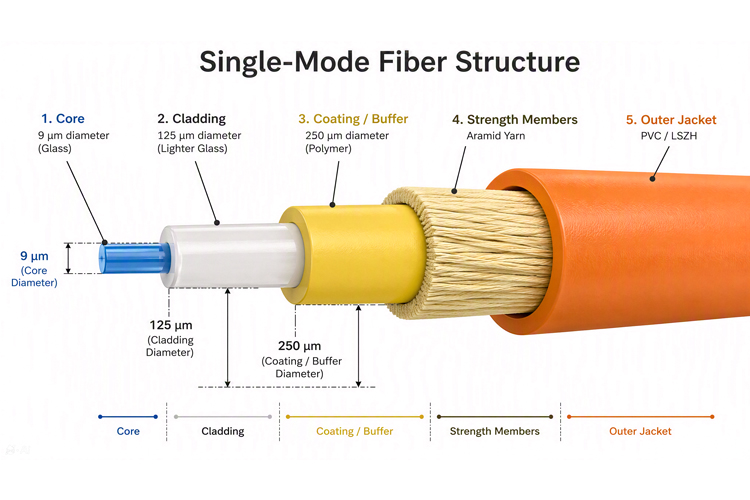
Single-mode fiber optic cable (SMF) carries a single ray of light directly down an 8-10 μm core, eliminating modal dispersion and enabling signal transmission over distances up to 100 km without regeneration.
Single-mode fiber accounts for approximately 74.95% of the global optical fiber market by value ($8.06B in 2025, per FMI). With a core diameter of just 8-10 micrometers — roughly one-tenth the thickness of a human hair — SMF transmits light along a single path, completely eliminating modal dispersion. This enables bandwidth-distance products that multimode fiber cannot approach.
Per TIA-492CAAA, single-mode fiber must exhibit a cutoff wavelength below 1260nm to qualify as SMF, ensuring single-mode operation across the telecommunications C-band (1550nm) and O-band (1310nm) windows.
Single-Mode vs. Multimode Fiber Comparison
| Parameter |
Single-Mode Fiber (SMF) |
Multimode Fiber (MMF) |
| Core Diameter |
8-10 μm |
50/62.5 μm |
| Cladding Diameter |
125 μm |
125 μm |
| Modal Dispersion |
Negligible |
Present |
| Typical Wavelength |
1310nm / 1550nm |
850nm / 1300nm |
| Maximum Distance |
Up to 100km (unamplified) |
550m (OM3) / 300m (OM1) |
| Bandwidth |
Unlimited (dispersion-limited) |
500-4700 MHz·km |
| Cost per Meter |
Higher (laser-grade source) |
Lower (LED/VCSEL source) |
| Typical Application |
Telecom, WAN, FTTH, AI Data Centers |
LAN, Data Center (short-reach) |
| 2026 Market Share |
74.95% ($8.06B) |
~25% ($2.7B) |
4. ITU-T G.652 — The Global Standard (Updated for 2026)
ITU-T G.652 is the world's most widely deployed single-mode fiber standard, defining four sub-categories with distinct water peak and dispersion characteristics.
The IEC 60793-2-50 standard classifies G.652.D as the “future-proof” variant due to its full-spectrum capability (1310-1625nm), enabling seamless upgrade to DWDM systems without fiber replacement. In 2026, G.652.D commands a market price of 100-120 RMB/km — a stark contrast to the sub-20 RMB/km pricing of early 2025.
G.652 Sub-Category Comparison
| Standard |
Key Feature |
Water Peak |
Optimal Wavelength |
Application |
2026 Price (RMB/km) |
| G.652.A |
Low water peak, optimized for 1310nm |
Standard |
1310nm |
Metro/access networks (legacy) |
90-105 |
| G.652.B |
Enhanced specifications, LWP at 1383nm |
Low (1383nm) |
1310nm + 1550nm |
Long-haul & access |
95-110 |
| G.652.C |
Full spectrum, 1310-1625nm transmission |
Zero |
1310-1625nm |
FTTH, GPON/XGS-PON |
98-115 |
| G.652.D |
Non-zero dispersion at 1550nm, zero water peak |
Zero |
1310-1625nm (full) |
All applications — most versatile |
100-120 |
"G.652.D fiber represents the most versatile single-mode fiber available today, supporting both current GPON networks and future 5G fronthaul applications."
The G.652.D advantage in 2026 is its “future-verifiable” positioning: it supports current GPON/XGS-PON deployments, emerging 5G fronthaul architectures, and can be upgraded to DWDM without fiber replacement. For procurement teams, this means a single G.652.D fiber plant can serve 15-20 year infrastructure lifecycles. See our outdoor cable selection guide for deployment recommendations.
5. ITU-T G.657 — Bend-Insensitive Fiber for FTTH and AI Data Centers
G.657 bend-insensitive fiber has become the critical material for AI data center high-density cabling in 2026, with supply gaps reaching 46% and prices surging past 240 RMB/km.
G.657.A1 vs G.657.A2 Comparison
| Parameter |
G.657.A1 |
G.657.A2 |
| Minimum Bend Radius |
10 mm |
7.5 mm |
| Macro-Bending Loss @ 1550nm (10mm, 1 turn) |
< 0.75 dB |
< 0.5 dB @ 7.5mm |
| Typical Applications |
Indoor cabling, patch cords, ODF |
FTTH drop cables, AI data center high-density |
| G.652.D Compatibility |
Fully compatible |
Fully compatible |
| 2026 Price (RMB/km) |
115-135 |
230-240 |
| Supply Gap (2026) |
Moderate |
46% deficit |
G.657.A2 provides the highest level of bend insensitivity, enabling installation in extremely tight spaces where conventional fibers would fail. In 2026, it is specifically critical for AI data center high-density cabling, where GPU cluster topologies demand fiber routing through spaces with bend radii as small as 7.5mm. The 46% supply gap makes G.657.A2 the most supply-constrained fiber category globally.
Bend Loss Comparison: G.652.D vs G.657.A2
| Bend Radius |
G.652.D Loss @ 1550nm |
G.657.A2 Loss @ 1550nm |
| 30 mm (1 turn) |
< 0.1 dB |
< 0.1 dB |
| 15 mm (1 turn) |
> 10 dB |
< 0.25 dB |
| 10 mm (1 turn) |
Fiber failure |
< 0.5 dB |
| 7.5 mm (1 turn) |
Fiber failure |
< 0.5 dB |
| 5 mm (1 turn) |
Fiber failure |
< 1.0 dB |
The dramatic difference at tight bend radii explains why G.657.A2 has become non-negotiable for AI data centers: at 10mm, G.652.D fails completely while G.657.A2 maintains <0.5dB loss. This performance delta is critical in high-density GPU clusters where cable routing must navigate extreme space constraints.
Explore OPELINK's G.657.A2 bend-insensitive fiber cables for AI data center and FTTH applications. [View G.657 Products]
6. Single-Mode Cable Types — Physical Construction
Five primary physical cable constructions serve distinct deployment environments, from aerial power corridors to direct burial in harsh terrain.
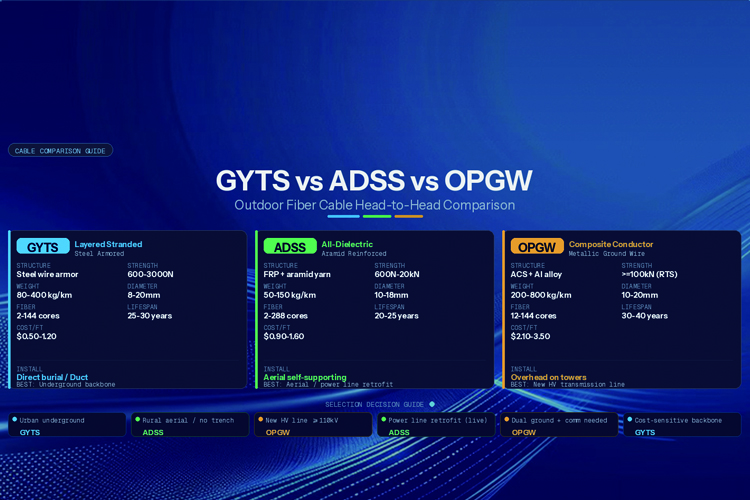
1. GYXTW — Central Loose Tube (Aerial/Duct). Single central loose tube with water-blocking yarn and PE sheath. Suitable for short-to-medium span aerial or duct installation. Tensile strength: 600N/1000N per IEC 60794-1-2.
2. GYTS/GYTA — Stranded Loose Tube (Duct/Aerial). Multiple jelly-filled buffer tubes stranded around central strength member. Supports up to 144 fibers, operating temperature -40°C to +70°C. Dominant choice for long-distance backbone and metro networks.
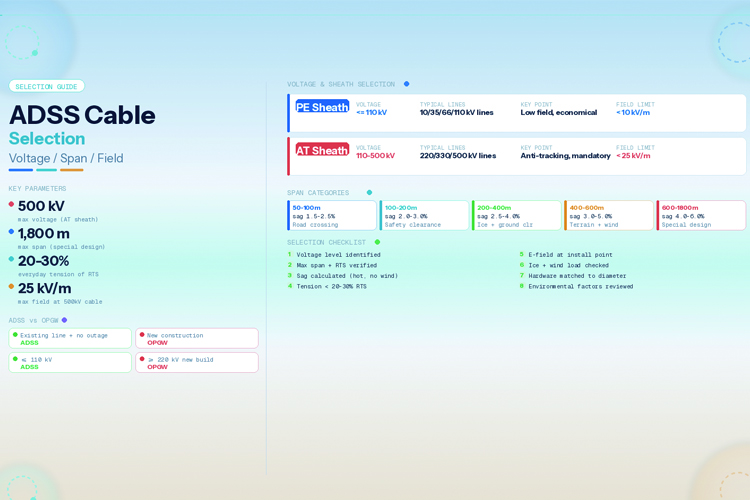
3. ADSS — All-Dielectric Self-Supporting. All-dielectric construction with high-modulus aramid yarn, no metal components. Designed for high-voltage power line corridors. AT type for up to 35kV, AN type for up to 110kV per IEC 60794-4.
4. GYFTZY — Non-Metallic Armored (Burial/Duct). Double PE sheath with glass yarn armoring and water-blocking gel. Crush resistance ≥ 1000N/100mm. Ideal for direct burial, harsh environments, and rodent-prone areas.
5. OPGW — Optical Ground Wire. Combines ground wire function with optical fibers in the cable core for overhead power transmission lines (132kV+). Lightning current rating ≥ 100kA per IEC 60794-4.
See also: [Outdoor Fiber Optic Cable Guide] | [Armored vs Non-Armored Selection Guide]
7. Core Specifications — Optical, Mechanical, Environmental
When evaluating single-mode fiber cable for procurement in 2026's price-sensitive environment, rigorous specification verification has never been more critical.
Optical Performance (per IEC 60793-1-40)
.Attenuation: ≤ 0.35 dB/km @ 1310nm; ≤ 0.22 dB/km @ 1550nm
.Chromatic Dispersion: ≤ 18 ps/(nm·km) @ 1285-1330nm; ≤ 22 ps/(nm·km) @ 1550nm (G.652.D)
.Polarization Mode Dispersion (PMD): ≤ 0.20 ps/√km (G.652.D, per IEC 60793-1-48)
.Zero-Dispersion Wavelength: 1300-1324nm (G.652.D)
.Mode Field Diameter: 9.2±0.4μm @ 1310nm
Mechanical Performance (per IEC 60794-1-21/22)
| Test |
Requirement |
| Tensile Strength |
600N / 1000N / 2000N / 3000N (cable type dependent) |
| Crush Resistance (Short-term) |
≥ 300N/100mm |
| Crush Resistance (Long-term) |
≥ 100N/100mm |
| Impact Resistance (Armored) |
≥ 25 impacts @ 1N·m |
| Min. Bend Radius (Installed) |
20× OD |
| Min. Bend Radius (During Installation) |
10× OD |
| Water Penetration |
≤ 1m in 1m water, 24h (IEC 60794-1-24) |
Environmental Temperature Ranges
.Operating Temperature: -40°C to +70°C (standard); -50°C to +70°C (extended range)
.Installation Temperature: -30°C to +60°C
.Storage Temperature: -40°C to +70°C
8. Q&A: G.652.D vs G.657 — Which Fiber Should You Choose in 2026?
Q: With G.657.A2 prices at 230-240 RMB/km versus G.652.D at 100-120 RMB/km, when does the premium justify the upgrade?
A: The decision hinges on your deployment environment and future capacity requirements. G.652.D remains the optimal choice for standard outdoor backbone, metro, and FTTH feeder applications where bend radius is not constrained — it delivers the best cost-per-km economics at 100-120 RMB/km. However, for AI data center deployments, FTTH drop installations, and any scenario with tight bend radii below 15mm, G.657.A2 is mandatory despite its 2x+ price premium. The failure cost of G.652.D at tight bends (complete signal loss at 10mm radius) makes the premium a non-negotiable insurance policy in these environments.
Decision Matrix: Application × Fiber × 2026 Price
| Application Scenario |
Recommended Fiber |
2026 Price Reference (RMB/km) |
Rationale |
| Telecom backbone (40-120km) |
G.652.D |
100-120 |
Best long-haul cost economics; no tight bends |
| Metro/access rings (1-40km) |
G.652.D |
100-120 |
Proven performance; widely available |
| FTTH feeder/distribution |
G.652.D |
100-120 |
Standard choice for loose-tube outdoor cables |
| FTTH drop (curb to home) |
G.657.A2 |
230-240 |
Tight bend environment; mandatory for MDU |
| AI data center interconnect (GPU clusters) |
G.657.A2 |
230-240 |
High-density routing; 7.5mm bend radius required |
| Data center inter-building (2-10km) |
G.652.D or G.657.A1 |
100-135 |
G.657.A1 if indoor routing is tight |
| Indoor distribution / patch cords |
G.657.A1 |
115-135 |
Balanced cost vs bend performance |
| Aerial (power corridor) |
G.652.D (ADSS/OPGW) |
100-120 |
ADSS/OPGW cable construction; no bend constraints |
| Direct burial (harsh terrain) |
G.652.D (GYFTZY/GYTA53) |
100-120 |
Armored construction with standard fiber |
Key Takeaway: In 2026, G.652.D is the default choice for 80% of outdoor applications at 100-120 RMB/km. G.657.A2 is mandatory for AI data centers and FTTH drop at 230-240 RMB/km. The upgrade decision is not about price — it is about whether your installation involves bend radii below 15mm. If yes, G.657.A2 is the only viable option regardless of cost.
9. How to Choose the Right Single-Mode Cable — Procurement Decision Framework
A systematic four-step procurement framework for 2026, incorporating the new price reality and extended lead times.
Step 1: Define Application → Recommended Cable → Distance
| Application |
Recommended Cable Type |
Fiber Type |
Typical Distance |
| FTTH Drop |
GYFXY / GJXFH |
G.657.A2 |
< 1 km |
| Access / Metro |
GYTS / GYTA |
G.652.D |
1-40 km |
| Long-Haul Backbone |
GYXTW / GYTS (armored) |
G.652.D |
40-120 km |
| Aerial (power corridor) |
ADSS |
G.652.D |
Up to 500m span |
| Overhead Power Lines |
OPGW |
G.652.D |
N/A (functional dual-use) |
| Direct Burial |
GYFTZY / GYTY53 |
G.652.D |
Any distance |
| AI Data Center Interconnect |
GYTA / Indoor Distribution |
G.657.A2 |
0.1-10 km |
Step 2: Verify Fiber Compliance
Ensure fiber complies with IEC 60793-2-50 and YD/T 769 (China standard). Verify G.652.D classification for maximum deployment flexibility. Require the following compliance documentation from suppliers: IEC 60793-1-40 attenuation test report, OTDR trace report for every drum (100% factory-tested), tensile test certificate (IEC 60794-1-21), crush test certificate (IEC 60794-1-22), and water penetration test (IEC 60794-1-24).
Step 3: Verify Environmental Requirements
.Outdoor aerial: UV-resistant PE sheath, ADSS or GYXTW
.Direct burial: Double-jacketed, corrugated steel tape armor (GYTA53)
.Harsh chemical environment: Gel-filled with anti-corrosion sheath
.High-voltage proximity: ADSS (AT type, up to 35kV) or OPGW
Step 4 (NEW): 2026 Procurement Cost Estimation
| Fiber Type |
Cable Construction |
Typical Project Quantity (km) |
Current Price Range (RMB/km) |
Estimated Project Cost (RMB) |
| G.652.D |
GYTS 48-core |
50 km |
100-120 |
5,000-6,000 (+cable premium) |
| G.652.D |
GYXTW 24-core |
20 km |
100-120 |
2,000-2,400 (+cable premium) |
| G.657.A2 |
GYFXY Drop 1-core |
100 km |
230-240 |
23,000-24,000 (+cable premium) |
| G.657.A2 |
Indoor Distribution 12-core |
10 km |
230-240 |
2,300-2,400 (+cable premium) |
| G.657.A1 |
Indoor Patch 2-core |
5 km |
115-135 |
575-675 (+cable premium) |
Note: Prices reflect bare fiber cost only. Cable construction (sheathing, armoring, stranding) adds 30-80% depending on complexity. Lead times are 6-12 months for standard orders; rush orders command 50%+ premiums. Budget with 2028 price and supply visibility.
10. Q&A: What Is the Difference Between OS1 and OS2 Single-Mode Fiber?
Q: OS1 vs OS2 — which classification should I specify for new deployments in 2026?
A: OS1 and OS2 differ fundamentally in construction and performance:
OS1: Uses tight-buffered construction designed exclusively for indoor applications. Maximum transmission distance is 2 km at both 1310nm and 1550nm. OS1 is a legacy classification — while still found in older indoor installations, it is no longer specified for new builds.
OS2: Uses loose-tube construction suitable for both indoor and outdoor installation. Supports distances up to 200 km with optical amplifiers (EDFA). OS2 is the current standard for all new FTTH, telecom backbone, and data center inter-building deployments. All G.652.D and G.657.A1/A2 fibers are classified as OS2 when deployed in loose-tube cables.
In 2026, OS2 is the universal specification for new deployments. OS1 should only appear in legacy retrofit or repair contexts where existing tight-buffered infrastructure must be matched.
Key Takeaway: Specify OS2 for all new deployments. OS1 is legacy. All G.652.D and G.657 fibers deployed in loose-tube cables are OS2-classified and support 200km+ distances with amplification.
11. Industry Applications — Telecom, Data Center, FTTH, AI
Single-mode fiber serves four critical infrastructure domains in 2026, each with distinct requirements and price sensitivities.
Telecom Backbone Networks
Single-mode fiber carries approximately 95% of global internet traffic (TeleGeography Global Bandwidth Research 2023). Submarine cable systems rely exclusively on G.652.D and G.655 fiber. The telecom sector remains the largest volume consumer, though its growth rate (mid-single digits) is now overshadowed by data center demand.
Data Center Interconnects
Hyperscale data centers deploy OS2 single-mode fiber for 400G/800G coherent pluggable optics over distances of 2-120km. Each fiber pair can carry 800Gbps using QSFP-DD800 modules. The transition to 800G coherent optics is accelerating SMF adoption in DCI scenarios.
AI Data Centers (NEW — 2026 Critical Domain)
AI training clusters represent the single largest demand driver in 2026. GPU-to-GPU interconnect topologies in clusters of 10,000+ GPUs (NVIDIA H100/H200, B200) require 5-10x the fiber density of traditional data centers. G.657.A2 bend-insensitive fiber is mandatory for these high-density environments, where cable routing must navigate 7.5mm bend radii between server racks. The 46% G.657 supply gap directly threatens AI infrastructure deployment timelines.
FTTH / Fiber to the Home
According to the Fiber Broadband Association (FBA Q3 2023), there were 860 million FTTH global subscriptions, with China leading at 480 million. G.652.D fiber in loose-tube central tube designs remains the dominant choice for feeder and distribution segments, while G.657.A2 is the standard for drop cables from curb to home.
12. Single-Mode Fiber Market Outlook 2026-2030
The single-mode fiber market is projected to grow from $73.37B (2025) to $103.28B by 2030 at a 7.2% CAGR. The structural price regime established in 2025-2026 will persist through at least 2028.
Short-Term (2026)
Supply-demand gap remains at 16.4%. G.652.D stabilizes at 100-120 RMB/km. G.657.A2 holds at 240+ RMB/km with 46% supply deficit. Optical preform capacity remains fully utilized. Lead times extend to 6-12 months.
Medium-Term (2027-2028)
New optical preform capacity begins to come online, modestly easing G.652.D supply. However, specialty fiber (G.657) supply remains tight as manufacturers prioritize high-margin production. AI data center demand continues growing at 50%+ annually. G.652.D prices may moderate to 80-100 RMB/km, but G.657.A2 premiums persist.
Long-Term (2029-2030)
Market reaches $103.28B (TBRC). G.657 bend-insensitive fiber becomes the dominant fiber type for new deployments. AI inference at the edge drives distributed fiber demand. G.652.D remains the backbone workhorse but gradually cedes new-build share to G.657 variants.
Regional Demand Forecast 2026-2030
| Region |
2026 Demand Drivers |
2026-2030 CAGR |
Key Trend |
| Asia-Pacific |
AI data centers (China, Singapore, Japan); FTTH expansion (India, SE Asia) |
8-10% |
China dominates supply AND demand; export growth 126.8% YoY |
| North America |
Hyperscale AI clusters (Google, Meta, Microsoft); BEAD program |
7-9% |
Heavily import-dependent; capacity locking at 50%+ premiums |
| Europe |
Submarine cable landings; data center buildout (Frankfurt, London, Amsterdam) |
5-7% |
Diversifying supply from China; local preform investment emerging |
| Middle East & Africa |
New submarine cable systems; smart city initiatives |
6-8% |
Greenfield FTTH; less exposed to G.657 supply constraints |
| Latin America |
FTTH expansion (Brazil, Mexico); data center growth |
5-7% |
Price-sensitive; G.652.D dominant |
Frequently Asked Questions
Q1: What is the difference between OS1 and OS2 single-mode fiber?
OS1 fiber uses tight-buffered construction for indoor applications, with a maximum distance of 2 km at 1310nm/1550nm. OS2 fiber uses loose-tube construction suitable for both indoor and outdoor installation, supporting distances up to 200 km with optical amplifiers. OS2 is the current standard for all new FTTH, telecom, and data center inter-building deployments; OS1 is largely legacy and should not be specified for new builds.
Q2: Why is G.652.D the most widely used single-mode fiber?
G.652.D (standard single-mode fiber, SSMF) supports full-spectrum transmission from 1310nm to 1625nm with zero water peak, making it compatible with current GPON/XGS-PON networks, 5G fronthaul architectures, and DWDM systems without fiber replacement. At 100-120 RMB/km in 2026, it remains the most cost-effective choice for all outdoor applications where bend radius is not constrained. Its “future-proof” capability to support multiple generations of optical transmission technology on the same fiber plant makes it the default choice for telecom backbone, metro, and FTTH feeder networks.
Q3: What connector types work with single-mode fiber?
Single-mode fiber is terminated with: SC/APC (8° angled, ≥65 dB return loss) — global FTTH standard, mandatory at OLT/ONT interfaces for bidirectional GPON/XGS-PON; LC/UPC — dominant in data centers for high-density patching; FC/UPC or FC/APC — test equipment, defense, and high-vibration environments; and MPO/MTP — 40G/100G/400G/800G parallel optics in data centers. For FTTH deployments, SC/APC is the mandatory choice at the OLT/ONT interface due to its superior return loss performance.
Q4: What is the practical difference between G.657.A1 and G.657.A2? Which should I choose?
G.657.A1 has a 10mm minimum bend radius with <0.75 dB loss at 1550nm and is suitable for indoor distribution cabling, patch cords, and optical distribution frames with moderate space constraints. G.657.A2 has a 7.5mm minimum bend radius with <0.5 dB loss and is designed for FTTH drop cables, in-home installations along baseboards, and AI data center high-density GPU clusters. In 2026, choose G.657.A1 for general indoor cabling at 115-135 RMB/km; choose G.657.A2 for FTTH drop and AI data center deployments at 230-240 RMB/km. The 46% supply gap for G.657.A2 means orders should be placed 6-12 months ahead.
Q5: What price signals and lead times should I monitor when procuring single-mode fiber in 2026?
Monitor three key indicators: (1) AI server shipment volumes and hyperscale data center CapEx announcements — directly reflect demand intensity and deployment timelines; (2) optical preform capacity utilization and new production line announcements — the only reliable indicator of future supply relief; (3) carrier bidding prices and volumes from China's three major telecom operators — sets the price floor for G.652.D globally. Current lead times are 6-12 months for standard orders; capacity-locking premiums exceed 50%. Budget planning should extend to 2028 visibility. For G.657.A2 specifically, the 46% supply gap means availability — not price — is the critical procurement risk.
Q6.What is the difference between single-mode and multi-mode fiber?
Single-mode fiber has an 8.2-10μm core transmitting one light mode at 1310/1550nm, supporting 10-200km links. Multi-mode fiber has a 50/62.5μm core transmitting multiple modes at 850/1300nm, limited to 300-600m at 10G. SMF is the standard for outdoor backbone, data center interconnect, and AI cluster links beyond 100m.
Q7.What wavelengths do single-mode fibers operate on?
1310nm (O-band, zero dispersion), 1550nm (C-band, lowest attenuation at ~0.2dB/km), and 1625nm (extended band). DWDM systems pack C-band 1530-1565nm channels; XGS-PON uses 1490nm downstream and 1310nm upstream. G.652.D covers the full spectrum from 1310nm to 1625nm.
Q8.How do G.652, G.655, and G.657 compare for cable selection?
G.652 (standard 9μm core SMF) is the universal backbone fiber. G.655 (non-zero dispersion shifted) is designed for submarine and ultra-long-haul DWDM to suppress nonlinear effects. G.657 (bend-insensitive, 7.5-10mm bend radius) targets FTTH and indoor high-density routing. For 2026 deployments, the G.652.D backbone plus G.657.A2 access combination covers the majority of network builds
Q9.What should I check when procuring single-mode fiber for AI data centers?
AI clusters use 400G/800G optics with parallel single-mode lanes — a single GB200 NVL72 rack can require ~2km of SMF for interconnect. Specify G.652.D for backbone and G.657.A2 for high-density patch fields; verify attenuation ≤0.40dB/km at 1310nm and ≤0.25dB/km at 1550nm; secure allocation 6-12 months ahead given the 2026 G.657.A2 supply gap and expect 50%+ capacity-locking premiums.
Sources and References
[1] TBRC — Single-Mode Fiber Cable Global Market Report 2026. Market size: $73.37B (2025) → $78.12B (2026) → $103.28B (2030).
[2] Future Market Insights — Single-Mode Optical Fiber Market 2025-2035. Bare fiber: $2.9B (2025) → $13.0B (2035), CAGR 16.2%.
[3] CRU — Global Fiber Optic Cable Price Index, March 2026. G.652.D: 83.4 RMB/km; price index 107.2.
[4] China Post Securities - Research Report on the Release of AI Data Center Demand in North America (March 2026). G.652.D: 85-120 RMB/km; G.657.A2: 210-230 RMB/km.
[5] Guosheng Securities — Global Fiber Optic Cable Industry Supply and Demand Analysis (April 2026). Global gap 16.4%; demand 577M core-km vs supply 397M.
[6] Nomura Securities — Research on the Correlation Between AI Computing Power and Fiber Optic Demand (May 2026). G.657.A2 price surge 557-714%; 46% specialty fiber gap.
[7] Securities Times - From "Traditional Cables" to "Computing Power Arteries" (April 2026). China exports +126.8% YoY; orders through 2028.
[8] ITU-T G.652 (11/2016), G.657 (2016) — International standards for single-mode and bend-insensitive optical fibers.
[9] IEC 60793-2-50 — Product Specifications for Single-Mode Fibers.
[10] TeleGeography — Global Bandwidth Research 2023. SMF carries ~95% global internet traffic.
[11] Fiber Broadband Association — FTTH Global Subscriptions Q3 2023. 860M global FTTH subscriptions.
Related Guides

 OPGW Cable Selection Guide for High-Voltage Transmission Lines
 GYTS vs ADSS vs OPGW: Outdoor Fiber Cable Comparison
 ADSS Cable Selection Guide for Power Lines: Voltage, Span & Environment
 Outdoor Fiber Optic Cable Installation Guide: Aerial, Duct & Direct Burial Methods


