Key Takeaways
- The global optical transceiver market is projected to reach $6–7 billion by 2025, with 800G overtaking 400G as the revenue leader for the first time — driven overwhelmingly by AI/ML cluster deployments (Dell’Oro Group, LightCounting).
- Single-mode fiber (OS2) now accounts for 65–70% of new hyperscale data center fiber deployments, up from ~53% in 2023, as AI GPU clusters demand duplex WDM optics that MMF cannot efficiently deliver at 400G/800G speeds.
- IEEE 802.3df (800G Ethernet) has completed technical definition and reached Sponsor Ballot as of 2025, with SR8, DR8, FR8, and LR8 PMDs frozen and commercial transceivers already shipping in volume.
- AI training clusters are reshaping cabling topology: East-West (server-to-server) traffic now dominates, requiring rail-optimized fat-tree architectures with factory-terminated MPO-16/MPO-24 trunk cables and APC single-mode connectors.
- 1.6T Ethernet (IEEE 802.3dj) is on track for ratification by late 2025/early 2026, with 8×200G DR8 OSFP modules sampling now — making OS2 SMF with MPO-16/24 connectivity the only future-proof cabling choice for new builds.
The Fiber Revolution in Data Centers
Data centers are the nerve centers of the digital economy. According to Cisco’s 2024 Data Center Infrastructure Readiness Report, global data center traffic has surpassed the zettabyte scale annually. The defining shift in 2025 is not just the volume of traffic, but its direction: East-West (server-to-server) traffic now dominates, driven overwhelmingly by AI/ML workload processing — GPU-to-GPU communication for distributed training, inference serving, and high-performance computing.
AI cluster traffic is growing at rates significantly higher than traditional cloud traffic. Hyperscale data centers operated by Google, Meta, Amazon, Microsoft, and emerging AI infrastructure providers now require fiber density up to 10× higher than enterprise data centers, with link distances from 1 meter to 40 kilometers and port speeds from 40G to 1.6T.
Single-mode fiber (OS2) now accounts for 65–70% of new hyperscale deployments — a dramatic shift from approximately 53% in 2023 (Dell’Oro Group) and roughly 20% in 2020. This transition is irreversible: AI GPU clusters demand duplex WDM optics at 400G/800G speeds, which multimode fiber cannot efficiently deliver. Enterprise data centers remain predominantly OM4/OM5 for the access layer, but the hyperscale blueprint is clear.
“The transition from 10G to 400G in the enterprise data center is no longer incremental — it is a phase transition. With AI workloads driving 800G deployment and 1.6T on the horizon, the physical layer architecture must be rethought simultaneously across connector density, fiber type selection, and cable management. Those who plan for 800G/1.6T today will avoid multi-million-dollar rip-and-replace projects within 3–5 years.” — Adapted from Cisco UCSI White Paper & 2025 Industry Analyst Consensus
Ethernet Speed Evolution: 10G → 400G → 800G → 1.6T
The IEEE 802.3 Ethernet standards roadmap continues to accelerate, driven by AI bandwidth demands. The table below traces the complete evolution from 10BASE-T to the emerging 1.6TbE standard.
| Ethernet Speed |
Standard |
Year |
Primary Media |
Max Distance |
| 10BASE-T |
802.3 Clause 14 |
1983 |
Cat5/Cat6 |
100m |
| 1GbE |
802.3ab |
1999 |
Cat5e/Cat6 |
100m |
| 10GbE |
802.3ae |
2002 |
OM3/OM4 MMF |
300m (MM) / 40km (SM) |
| 40GbE |
802.3ba |
2010 |
OM3/OM4 MMF / SMF |
100–160m (MM) / 10km (SM) |
| 100GbE |
802.3bj/ba |
2014 |
OM4 MMF / SMF |
100–150m (MM) / 40km (SM) |
| 200GbE |
802.3bs |
2017 |
SMF (CWDM4/LR4) |
2–10km |
| 400GbE |
802.3bs/cd |
2017–2020 |
SMF (DR4/FR4/LR4) |
0.5–10km |
| 800GbE |
802.3df |
2024–2025 |
SMF (DR8/FR8/LR8) |
0.5–10km |
| 1.6TbE |
802.3dj (draft) |
2025–2026 |
SMF (DR8/2×FR4) |
0.5–2km |
Note: IEEE 802.3df entered Sponsor Ballot in 2024–2025; technical PMD definitions (SR8, DR8, FR8, LR8) are frozen. IEEE 802.3dj (1.6T) is targeting ratification by late 2025/early 2026 with 8×200G per lane. Commercial 800G transceivers are already shipping in volume across both QSFP-DD800 and OSFP form factors.
AI’s Impact on Data Center Fiber Architecture
The Bandwidth Density Problem
Traditional cloud data centers use Clos (leaf-spine) topologies where servers connect to Top-of-Rack switches via cheap multimode fiber using SR optics. AI training clusters fundamentally break this model. A single NVIDIA DGX H100 node generates 3.2 Tbps of East-West traffic. Clusters of 10,000+ GPUs require rail-optimized fat-tree topologies where the ratio of inter-connect (spine) cabling to server cabling is dramatically higher than in traditional storage or compute clouds.
Why AI Clusters Demand Single-Mode
At 400G and 800G speeds, multimode fiber requires parallel optics: 400GBASE-SR8 uses 16 fibers (8 TX + 8 RX) per link over MPO-16 connectors. 800GBASE-SR8 uses the same 16-fiber MPO-16 approach. This creates massive cable bulk and unmanageable patch panel density at AI cluster scale.
Single-mode fiber solves this through Wavelength Division Multiplexing (WDM): 400GBASE-DR4 delivers 400G over just 4 fibers (MPO-12), while 400GBASE-FR4/LR4 uses only 2 fibers (LC duplex) by multiplexing four wavelengths onto a single fiber pair. At 800G, 800GBASE-FR8 achieves 800G over a duplex LC connection. The fiber count reduction — from 16 fibers to 2 fibers per link — is the driving force behind hyperscalers’ wholesale shift to OS2 single-mode.
Emerging Technologies: CPO, LPO, and APC Connectors
Co-Packaged Optics (CPO) moves the optical engine directly onto the switch ASIC package, eliminating the power-hungry electrical interface between chip and front-panel transceiver. CPO technology almost exclusively uses single-mode fiber interfaces. In 2025, CPO is transitioning from trial to limited deployment in hyperscale AI clusters, with broad adoption expected by 2027.
Linear-drive Pluggable Optics (LPO) removes the DSP from the transceiver module to save power and reduce latency — critical for AI/ML workloads where every nanosecond counts. LPO is gaining traction for 800G short-reach links and is expected to expand to 1.6T by 2026–2027.
APC (Angled Physical Contact) connectors are becoming the standard for single-mode AI links, replacing traditional UPC (Ultra Physical Contact). The 8° angled end-face reflects stray light into the cladding rather than back into the laser source — critical for the signal integrity of high-speed PAM4 modulation used in 400G and 800G optics.
Fiber Infrastructure for High-Speed Ethernet
40GbE (QSFP+): Migration from 10G
| Standard |
Fiber Type |
Fiber Count |
Connector |
Max Distance |
| 40GBASE-SR4 |
OM3 MMF |
8 fibers (4TX+4RX) |
MPO-12 |
100m |
| 40GBASE-SR4 |
OM4 MMF |
8 fibers |
MPO-12 |
150m |
| 40GBASE-PLRSM4 |
OM3/OM4 MMF |
2 fibers |
LC duplex |
220m |
| 40GBASE-LR4 |
OS2 SMF |
2 fibers (CWDM) |
LC duplex |
10km |
| 40GBASE-ER4 |
OS2 SMF |
2 fibers (CWDM) |
LC duplex |
40km |
Recommendation for New 40G Deployments: Short reach (< 150m): OM4 MMF + MPO-12 SR4. Campus/Metro (< 10km): OS2 SMF + LC duplex LR4. Per IEEE 802.3, 40GBASE-SR4 uses 4 parallel lanes (850nm VCSELs), requiring MPO-12 male connectors on both ends with Type B polarity (key-up to key-up) per TIA-568.3-D.
100GbE (QSFP28): The Current Default
| Standard |
Fiber Type |
Fiber Count |
Connector |
Max Distance |
| 100GBASE-SR4 |
OM4 MMF |
8 fibers |
MPO-12 |
100m |
| 100GBASE-SR10 |
OM4 MMF |
20 fibers |
MPO-24 |
100m |
| 100GBASE-PSM4 |
OS2 SMF |
4 fibers |
MPO-12 |
500m |
| 100GBASE-CWDM4 |
OS2 SMF |
4 fibers (CWDM4) |
LC duplex |
2km |
| 100GBASE-LR4 |
OS2 SMF |
4 fibers (LWDM) |
LC duplex |
10km |
| 100GBASE-ER4 |
OS2 SMF |
4 fibers |
LC duplex |
40km |
400GbE (QSFP-DD/OSFP): The 2025 Standard
400G Ethernet is the workhorse of AI backend networks in 2025. While 800G captures the revenue headlines, 400G DR4 and FR4 remain the dominant deployment for leaf-spine architectures in tier-2 cloud regions and enterprise data centers. The OSFP form factor is gaining preference over QSFP-DD in AI clusters due to superior thermal performance.
| Standard |
Fiber Type |
Fiber Count |
Connector |
Max Distance |
| 400GBASE-SR8 |
OM4/OM5 MMF |
16 fibers |
MPO-16 |
100m (OM4) / 70m (OM3) |
| 400GBASE-SR4.2 |
OM5 MMF |
8 fibers (SWDM4) |
MPO-12 |
100m |
| 400GBASE-DR4 |
OS2 SMF |
4 fibers |
MPO-12 |
500m |
| 400GBASE-FR4 |
OS2 SMF |
4 fibers (LWDM) |
LC duplex |
2km |
| 400GBASE-LR4 |
OS2 SMF |
4 fibers (LWDM) |
LC duplex |
10km |
| 400GBASE-ER8 |
OS2 SMF |
8 fibers |
LC duplex |
40km |
Multimode vs Single-Mode: Selection Framework
The cost and performance calculus between multimode fiber and single-mode fiber has shifted dramatically. Silicon Photonics and manufacturing scale have narrowed the transceiver cost gap, while AI-driven bandwidth demands expose MMF’s fundamental limitations at 400G and beyond.
| Consideration |
OM4/OM5 Multimode |
OS2 Single-Mode |
| Typical Reach (400G) |
100–150m |
500m–40km |
| Cost per meter (patch cord) |
$2–5 |
$3–8 |
| 400G optics cost (2025) |
$300–800 |
$500–1,500 |
| 800G optics cost (2025) |
$800–2,000 |
$1,200–3,000 |
| Bandwidth headroom |
Limited by modal BW |
Unlimited |
| Best for |
Legacy server-ToR, short-reach storage |
AI GPU clusters, spine/leaf, DCI |
| Connector |
MPO or LC |
LC duplex (APC preferred) |
| Power consumption |
Lower (VCSEL) |
Moderate (SiPh/EML) |
| 2025 Hyperscale Share |
~30–35% |
~65–70% |
Market Reality : According to Dell’Oro Group and LightCounting, 65–70% of new hyperscale data center bandwidth is now single-mode fiber, driven by 400G/800G AI cluster deployments. Within the remaining multimode share (~30–35%), OM4 dominates at ~85% while OM5 adoption has been lower than expected — hyperscalers increasingly skip OM5 entirely and deploy OS2 single-mode for all new builds.
Structured Cabling Architecture for 40G–800G
Two-Tier Architecture (Leaf-Spine, AI-Optimized)
Spine Switches (800G): OS2 single-mode, LC duplex or MPO-16, 100–500m Leaf Switches (400G/800G): OS2 single-mode (primary) or OM4 MMF (secondary), MPO/LC GPU Servers: 200G/400G NICs with OS2 single-mode or active optical cables (AOC)
Structured Cabling Design Rules (Per TIA-568.3-D)
| Parameter |
Requirement |
| Max MPO-to-MPO link |
300m (OM3) / 400m (OM4) |
| Max LC duplex link |
10km (SM) / 100m (MM) |
| Min. bend radius |
15mm (tight-buffered) |
| Connector IL |
≤ 0.3 dB (channel) |
| MPO polarity |
Type B recommended (key-up/key-up) |
| SM connector type (2025) |
LC/APC (angled) preferred for 400G+ |
| Labeling |
100% of ports labeled per ANSI/TIA-606-B |
Key Procurement Specifications for Data Center Fiber
For Multimode (OM3/OM4/OM5) Cables
- Fiber grade: OM4 (minimum for 40G+), OM5 for SWDM4 applications; WB-MMF for extended wavelength support
- Jacket: LSZH (recommended) or PVC for standard racks
- OFNP/plenum rating required for plenum spaces
- IL ≤ 0.15 dB per connector (factory-tested)
- RL ≥ 30 dB (MPO) or ≥ 45 dB (LC)
- 100% factory inspection per IEC 61300-3-35 (endface)
- TIA-455 (FOTP) OTDR test reports available
- MPO polarity: Type A/B/C confirmed on labeling
For Single-Mode (OS2) Cables
- Fiber: G.652.D (enhanced) or G.657.A1 for premises; G.657.A2 for tight-bend applications
- Jacket: Indoor LSZH/PVC; outdoor PE for building-to-building
- LC/APC (angled) preferred for all new 400G/800G deployments; verify switch SFP type
- IL ≤ 0.15 dB per connector
- RL ≥ 45 dB (UPC) or ≥ 60 dB (APC)
- Low-water-peak (LWP) fiber for DWDM compatibility
- Factory-terminated MPO-16/MPO-24 trunk assemblies for AI cluster deployments
Future-Proofing for 800G and 1.6T
The 800G and 1.6T Roadmap (2025–2027)
IEEE 802.3df (800G Ethernet): Entered Sponsor Ballot in 2024–2025. All PMDs (SR8, DR8, FR8, LR8) are technically frozen. Commercial transceivers in QSFP-DD800 and OSFP form factors are shipping in volume. Formal publication is expected by mid-to-late 2025.
IEEE 802.3dj (1.6T Ethernet): Task force targets ratification by late 2025/early 2026. Based on 8×200G per lane (200G-PAM4), the primary PMD is 1.6T-DR8 over OS2 single-mode with OSFP form factor. Initial 1.6T DR8 modules are sampling from major vendors (Coherent, Innolight, Eoptolink) as of 2025.
Coherent-Lite Pluggables (2026–2027): OIF 800ZR+ and emerging 1600ZR coherent pluggable optics will penetrate intra-data center links, enabling colorless WDM networking inside the data center. This allows a single fiber pair to carry multiple 800G/1.6T wavelengths, finally solving the fiber exhaust problem at AI cluster scale.
Future-Proof Checklist for 2026 New Builds
- Specify OS2 single-mode for all new structured cabling (mandatory for AI-ready infrastructure)
- Install MPO-16/MPO-24 cassettes (not MPO-12) in all new patch panels for 400G/800G/1.6T compatibility
- Plan 25–35% fiber count growth per year for AI cluster expansion
- OS2 SMF for any link > 50m (spine/aggregation/DCI); APC connectors throughout
- Maintain bend radius ≥ 15mm throughout; use G.657.A2 fiber for tight-bend installations
- Select factory-terminated trunk cables with custom lengths to minimize slack and optimize airflow
- Verify all single-mode assemblies support 200G-PAM4 signal integrity (IL, RL, and return loss budget validated to 1.6T)
Product Solutions
| Product |
Fiber |
Speed |
Reach |
Connector |
MOQ |
| OM4 LC-LC Duplex Patch |
OM4 |
10–100G |
100m |
LC/UPC |
10 pcs |
| OM4 MPO-8 Trunk |
OM4 |
40–400G |
100m |
MPO-8/UPC |
5 pcs |
| OM5 MPO-12 Trunk (SWDM) |
OM5 |
40–400G |
100m |
MPO-12/UPC |
5 pcs |
| OS2 LC-APC Duplex |
OS2 |
100–800G |
10km |
LC/APC |
10 pcs |
| OS2 MPO-16/MPO-24 Trunk |
OS2 |
400G–1.6T |
500m |
MPO/APC |
5 pcs |
| OS2 MPO-LC Harness |
OS2 |
400G–800G |
500m |
MPO to LC/APC |
5 pcs |
| OM3/OM4 Tight-Buffered |
OM3/OM4 |
Any |
≤300m |
Any |
10km |
| OS2 Loose Tube Outdoor |
OS2 |
Any |
Any |
Any |
10km |
Frequently Asked Questions
Q1: What is the recommended fiber infrastructure for 400G Ethernet data centers?
For 400G data centers in 2025: (1) OM4 multimode for links under 100m (400GBASE-SR8 over MPO-16, 100m); (2) Single-mode OS2 for 100m–2km (400GBASE-DR4/FR4, 500m/2km with LC duplex or MPO-12); (3) MPO-16/24 trunk cables from the start for 800G and 1.6T compatibility; (4) 80% initial fill with 20% spare capacity; (5) Factory-terminated assemblies with full OTDR test reports; (6) APC connectors for all new single-mode links to support PAM4 signal integrity at 400G and above.
Key Takeaway: Deploy MPO-16/24 infrastructure now. MPO-12 cannot support 800GBASE-SR8 and forces a costly re-cabling event within 2–3 years.
Q2: What is the difference between 400GBASE-SR8 and 400GBASE-DR4?
400GBASE-SR8 uses 8-lane parallel multimode (8×50G PAM4 over OM4, MPO-16 connector, 100m reach), offering lower transceiver cost for short intra-rack and inter-rack links. 400GBASE-DR4 uses 4-lane single-mode (4×100G PAM4 over OS2, MPO-12 or LC connector, 500m reach), delivering superior signal integrity, lower latency, dramatically reduced fiber count at scale, and a direct migration path to 800G DR8 by doubling lanes. In 2025 hyperscale AI clusters, DR4 is increasingly preferred over SR8 even for sub-100m links due to fiber management simplicity.
Key Takeaway: SR8 = 16 fibers + MPO-16 for 100m. DR4 = 4 fibers for 500m. At AI cluster scale, the 4× reduction in fiber count makes DR4 the default even at short reach.
Q3: What is the current state of 800G Ethernet deployment in data centers?
As of 2025, 800G Ethernet (IEEE 802.3df) is in final Sponsor Ballot with SR8, DR8, FR8, and LR8 PMDs technically frozen. Commercial transceivers in QSFP-DD800 and OSFP form factors are shipping in volume, primarily driven by NVIDIA Blackwell (B200/GB200) GPU cluster deployments. Key PMDs: 800GBASE-SR8 (8×100G, MPO-16, 100m OM4), 800GBASE-DR8 (8×100G, MPO-16, 500m SMF), 800GBASE-FR8 (8×100G WDM, LC duplex, 2km SMF), and 800GBASE-LR8 (CWDM8, LC duplex, 10km SMF). 800G coherent pluggables (800ZR+) for DCI are also commercially available. Dell’Oro Group projects 800G transceiver revenue will overtake 400G revenue for the first time in 2025.
Key Takeaway: 800G is not “coming” — it is here now. IEEE 802.3df technical content is frozen. Volume shipments are underway. The cabling decisions you make in 2025 must support 800G as the baseline.
Q4: Should new data center builds use single-mode or multimode fiber in 2025?
For hyperscale and AI-focused data centers, single-mode OS2 is the definitive choice. SMF now accounts for 65–70% of new hyperscale deployments, and this share is accelerating. OS2 supports 400G, 800G, and 1.6T over duplex LC with WDM — dramatically reducing cable bulk, improving airflow, and simplifying polarity management. Multimode OM4 remains viable for legacy server-to-ToR connections under 100m in enterprise data centers, but it has no upgrade path to 800G without deploying 16-fiber MPO-16 links. OM5 adoption has been lower than expected; hyperscalers are skipping OM5 entirely and deploying OS2 single-mode for all new spine-leaf architectures. The transceiver cost premium for single-mode has narrowed to the point where the total cost of ownership (including cable plant, density, and future-proofing) favors OS2 for any greenfield deployment.
Key Takeaway: New AI/hyperscale build = OS2 single-mode, no exceptions. Enterprise retrofit = OM4 acceptable for sub-100m ToR only. OM5 is being bypassed.
Q5: How are AI/ML clusters changing data center cabling requirements?
AI/ML clusters introduce five fundamental changes to cabling: (1) Massive East-West bandwidth dominates, requiring rail-optimized fat-tree topologies with far higher spine-to-leaf cabling ratios than traditional architectures. (2) Single-mode fiber becomes mandatory end-to-end to support 400G/800G with duplex WDM and reduce cable bulk. (3) Factory-terminated, custom-length MPO-16/MPO-24 trunk cables replace field-terminated assemblies to manage density, reduce slack, and optimize hot-aisle airflow. (4) APC (angled) connectors are becoming the standard for all SMF links to suppress back-reflection that degrades high-speed PAM4 signals. (5) Emerging technologies like LPO (Linear-drive Pluggable Optics) and CPO (Co-Packaged Optics) are reshaping the last-meter connectivity, with CPO using almost exclusively SMF interfaces for 1.6T+ speeds.
Key Takeaway: AI clusters are not just bigger data centers — they are architecturally different. Fiber topology, connector type, and factory termination strategy must all be rethought from first principles.
Related Guides

 Outdoor Fiber Optic Cable Installation Guide: Aerial, Duct & Direct Burial Methods
 Outdoor Fiber Optic Cable Types: GYTS, ADSS and OPGW Guide
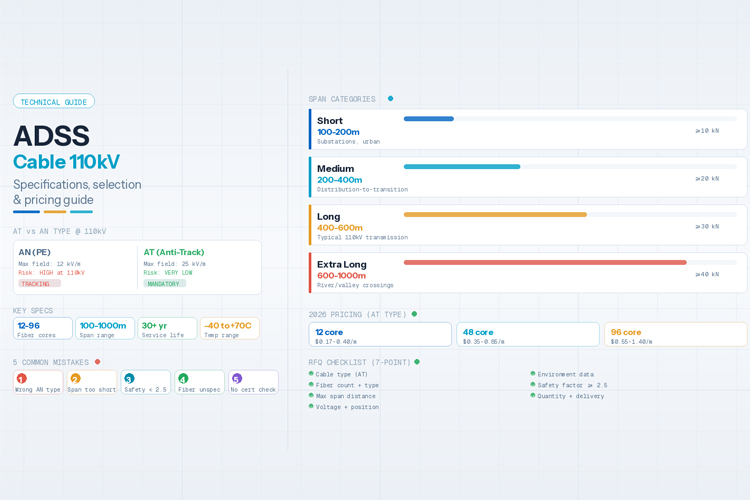 ADSS Cable for 110kV Power Line: Specifications, Selection & Pricing Guide
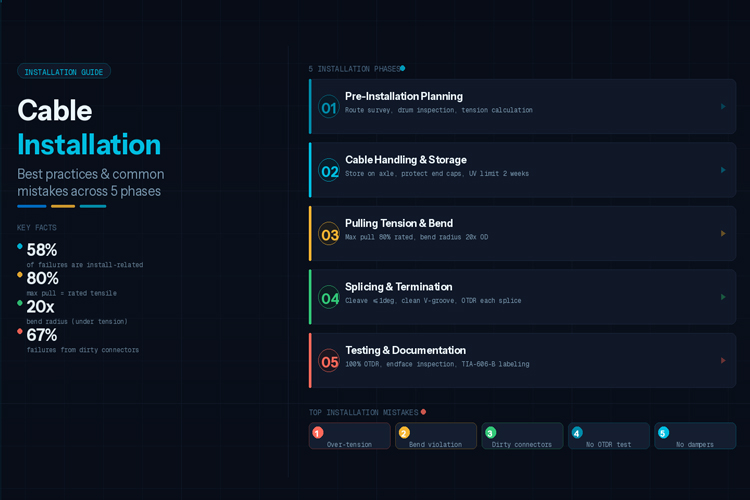 Fiber Cable Installation Best Practices & Common Mistakes


