English
Welcome to opelink.com
Technical Guide

Telecom Fiber Infrastructure Solutions | FTTH, 5G & Rural

Views : 1886
Author : goodvin
Update time : 2026-06-16 14:10:48

Key Takeaways

  1. $11.5B global fiber optic cable market in 2024, projected to reach $21B+ by 2030 at 9-12% CAGR — driven by 5G densification, AI data centers, and government broadband programs.
  2. 80-90% of 5G macro sites now require fiber backhaul in developed markets (up from ~60% in 2020); small cell deployments demand fiber to every street-level site at 200-500m spacing.
  3. BEAD’s $42.45B enters construction phase in 2025, converging with EU Gigabit Infrastructure Act and Asia-Pacific national broadband plans to create the largest coordinated fiber buildout in history.
  4. Rural FTTH costs drop 60% with ADSS aerial deployment on existing power poles; pre-terminated systems reduce skilled labor dependency by 40% — critical amid global fiber splicer shortages.
  5. XGS-PON (10G symmetric) is now the default standard for new FTTH builds, while 400ZR coherent pluggables slash long-haul backhaul costs by eliminating expensive line-card chassis.


The Telecom Fiber Opportunity: 2025 Market Reality

Global telecom operators invested approximately $340 billion in network infrastructure in 2024, with fiber optic cable representing roughly 30% of total capital expenditure — exceeding $100 billion annually for the first time. The broadband fiber race has entered an unprecedented acceleration phase across every major region.
According to the FTTH Council Europe’s 2024 Market Panorama, Europe surpassed 130 million FTTH/B homes passed, with connections growing 45% year-over-year. In Southeast Asia, FTTH/B connections exceeded 65 million, driven by national broadband mandates in Indonesia, Vietnam, and the Philippines. North America’s build cycle is poised to explode as the $42.45 billion BEAD program transitions from planning to construction in late 2025.
Three simultaneous demand vectors now converge to create what Analysys Mason terms a “fiber investment supercycle with no historical precedent”:
Growth Driver 2024 Market Impact 2030 Projection
5G Densification Small cells require fiber to every 200-500m in urban grids 10M+ small cells globally, 95% fiber-connected
AI & Cloud Data Centers 400G/800G transceivers driving high-count SM fiber demand AI cluster interconnects consuming 3× current fiber density
Government Broadband Programs BEAD ($42.45B), EU Gigabit Act (€2B+), BharatNet (India), PNBL (Brazil) Cumulative public fiber investment exceeding $200B by 2030
Edge Computing (MEC) Latency-sensitive apps require fiber mesh to street-side cabinets 5G-Advanced <1ms target forces direct fiber routing to every edge node
“We are at the beginning of a fiber investment supercycle. Every major economy has committed to fiber broadband as critical infrastructure — not a luxury, but an economic necessity. Suppliers who can deliver quality, compliance, and supply reliability at scale will capture generational market share.” — Analysys Mason, Global Fiber Infrastructure Investment 2024
The supplier positioning window is NOW. With global fiber supply chains strained by simultaneous demand from North America, Europe, and Asia-Pacific, operators are locking in long-term supply agreements with qualified manufacturers who demonstrate verified capacity, ISO-certified quality systems, and proven large-scale project delivery.

Types of Telecom Projects

1. FTTH / FTTB — Fiber to the Home / Building

Scope: End-to-end fiber access network from central office (OLT) to subscriber premises. FTTH remains the single largest fiber consumption segment, accounting for approximately 45% of global fiber-kilometer demand in 2024.
Network Architecture:
Central Office (OLT)
    ↓ [Feeder fiber: 144-432F loose tube, GYTS]
Optical Distribution Cabinet (ODC)
    ↓ [Distribution fiber: 12-48F, GYXTW]
Fiber Distribution Box (FDB)
    ↓ [Drop cable: GJXFH/GJYXFH, 1-4F]
Optical Network Terminal (ONT)
    ↓ [Indoor wiring: G.657.A2 patch cord]
End User
Key Cable Requirements:
Segment Cable Type Fiber Standard Key Property
Feeder GYTS, GYTA (144-432F) G.652.D Low attenuation, DWDM-ready
Distribution GYXTW (12-48F) G.652.D Crush-resistant, duct/aerial
Drop GJXFH, GJYXFH (1-4F) G.657.A2 Bend-insensitive (mandatory)
Indoor Tight-buffered patch cord G.657.A2 LSZH jacket, flexible
Technology Migration: GPON → XGS-PON → NG-PON2
The industry has decisively shifted from GPON (2.5G down / 1.25G up) to XGS-PON (10G symmetric) as the default standard for new FTTH builds. ITU-T G.9807.1-compliant XGS-PON delivers 10 Gbps both downstream and upstream — critical for symmetrical work-from-home, cloud upload, and video content creation use cases. Looking ahead, NG-PON2 (TWDM-PON, ITU-T G.989) enables 40 Gbps aggregate capacity through wavelength stacking, future-proofing ODN infrastructure for 2030+ demand.
Deployment Statistics (2024 Update):
Per CRU Group’s 2024 Optical Fiber Cable Report, the global FTTH/B sector consumed approximately 480 million fiber-kilometers of cable in 2024 — a 14% increase from 2023. Drop cable accounted for 38% of total kilometers deployed (182 million km), reflecting the intensifying last-mile connection race. China remains the largest single market (55% of global FTTH fiber consumption), but the fastest growth rates are now in India (32% YoY), Brazil (28% YoY), and Southeast Asia (24% YoY).

2. Mobile Backhaul / 5G Fronthaul

Scope: Connecting macro cell towers and small cells to the core network. 5G backhaul has become the fastest-growing fiber application segment, with demand projected to double between 2024 and 2028.
5G Network Architecture (C-RAN / O-RAN):
Core Network (5GC)
    ↓ [Backhaul: DWDM or IP/MPLS over SM fiber]
Metro Aggregation Node
    ↓ [Middlehaul/Backhaul: 96-144F loose tube]
Macro Cell Tower (4G/5G) + Small Cells (dense urban)
    ↓ [Fronthaul: G.657.A2 SM fiber, eCPRI protocol]
Distributed Unit (DU) / Central Unit (CU)
Why Fiber is Non-Negotiable for 5G-Advanced:
Per Ericsson’s June 2024 Mobility Report, 5G-Advanced (3GPP Release 18) imposes requirements that only fiber can satisfy:
5G Capability Requirement Why Only Fiber Works
eMBB (Enhanced Mobile Broadband) 1 Gbps+ per user Requires 25 Gbps backhaul per tower — microwave caps at ~10 Gbps
URLLC (Ultra-Reliable Low Latency) <1 ms latency Direct fiber path; microwave adds 2-5ms per hop
mMTC (Massive IoT) 1M devices/km² High-capacity fiber rings with DWDM overbuild
AI/ML at the Edge Real-time inference Dedicated dark fiber to MEC nodes; no shared medium
“Our analysis shows 80% of 5G macro sites and 100% of small cells require fiber backhaul. As operators deploy 5G-Advanced and prepare for 6G, this ratio trends toward 95%. Wireless is the antenna; fiber is the backbone.” — Ericsson Mobility Report, June 2024

Fiber Requirements for 5G Backhaul Segments:
Backhaul Type Distance Fiber Type Capacity Cable Recommendation
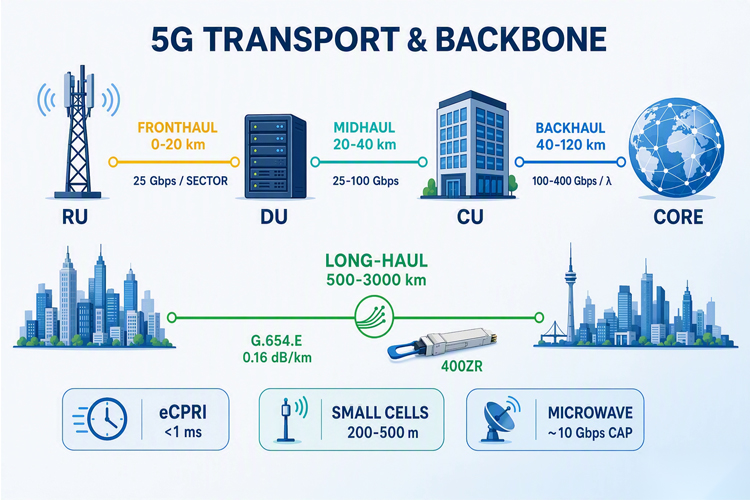
Fronthaul (eCPRI) 0-20 km G.657.A2 25 Gbps per sector GJXFH tight-buffered
Middlehaul 20-40 km G.652.D 25-100 Gbps GYXTW 24-48F
Backhaul 40-120 km G.652.D (DWDM) 100-400 Gbps per λ GYTS/GYTA 96-144F
The Open RAN Impact on Fiber Demand (2025 Trend):
The accelerating adoption of Open RAN (O-RAN) and virtualized RAN (vRAN) architectures is reshaping backhaul fiber requirements. In traditional RAN, baseband processing happens at the tower base. In vRAN, processing moves to centralized or distributed data centers, dramatically increasing fronthaul bandwidth demands. O-RAN’s split architecture (7-2x functional split) requires 25 Gbps eCPRI links between each RU and DU — effectively mandating dedicated fiber pairs for every antenna sector. This single architectural shift is projected to increase fronthaul fiber demand by 2.5-3× compared to traditional RAN deployments.
Recommended Cable Configurations:
  1. Tower to metro aggregation: GYTS/GYTA, 96-144F, G.652.D (DWDM-ready, 20% fiber overbuild for future capacity)
  2. Small cell (urban): GJXFH or micro-tight-buffered indoor/outdoor cable, G.657.A2
  3. Dense urban street furniture: Micro-duct with GYXTW 12-24F, pre-terminated for rapid deployment 

3. Long-Haul / Backbone Transmission

Scope: National and international fiber backbone connecting cities, countries, and continents. Long-haul transmission is experiencing a technology renaissance driven by 400ZR/ZR+ coherent pluggables and AI-driven traffic growth.
Network Tier Structure:
Tier Distance Application Fiber Type System 2025 Trend
Long-haul 500-3,000 km National backbone G.652.D / G.655.C DWDM 96-128λ 400G per λ (400ZR+)
Ultra Long-haul >3,000 km Submarine + terrestrial G.654.C / G.654.E DWDM 128-192λ 800G coherent trials
Metro Core 50-200 km City-to-city G.652.D DWDM 64-96λ 400ZR pluggable adoption
Metro Access 10-50 km Metro rings G.652.D CWDM/DWDM IP-over-DWDM convergence
The 400ZR Revolution:
The most significant cost-disruption in long-haul fiber since the EDFA amplifier is the emergence of 400ZR and 400ZR+ coherent pluggable optics. Historically, transmitting 400 Gbps over distances exceeding 80 km required expensive purpose-built line cards in large chassis systems. 400ZR pluggables — in QSFP-DD form factor — now deliver the same capacity directly from standard routers and switches, reducing per-wavelength equipment cost by 60-70%. This democratizes long-haul capacity and accelerates metro-to-long-haul convergence.
Fiber Selection Decision Matrix:
Scenario Recommended Fiber Key Advantage Trade-off
Universal backbone G.652.D Lowest cost, widest ecosystem Higher non-linear effects at >400G
Ultra long-haul (>2,000 km) G.654.E Ultra-low loss (0.16 dB/km), large effective area 30-50% premium over G.652.D
DWDM-dense metro G.655.C (NZ-DSF) Reduced non-linear effects in C+L band Limited to C+L band optimization
Submarine + terrestrial mix G.654.C Optimized for submarine spans + land extensions Specialized manufacturing, longer lead times

4. Rural Telecom Expansion

The fastest-growing but most challenging segment. Rural fiber deployment has shifted from “if we can afford it” to “how fast can we build it” — thanks to unprecedented government subsidy programs worldwide.
Why Rural FTTH Is Fundamentally Different:
According to the World Bank’s 2024 Digital Development Report, the global rural broadband gap means approximately 2.6 billion people remain unconnected. However, the economics have been transformed: government subsidies now cover 60-90% of deployment costs in major markets, making previously uneconomical builds commercially viable.
Rural Deployment Challenges & Proven Solutions:
Challenge 2025 Solution Cost Impact Adoption Rate
Long spans between poles ADSS aerial on existing power poles -60% vs. trenching 75% of new rural builds
Low subscriber density GPON 1:128 split ratios + XGS-PON overlay-ready CapEx per home reduced 35% Standard in BEAD-funded projects
Harsh environments GYXTW53 armored, UV-resistant jacket +20% material, -50% maintenance Required in tropical/coastal regions
Skilled labor shortage Pre-terminated plug-and-play systems -40% installation labor cost 45% adoption, growing rapidly
Scattered premises Star topology with multi-port distribution closures +15% fiber, -30% splice points Dominant in APAC rural builds
Major Government Subsidy Programs (2025 Status):
Program Region Budget Status (Mid-2025) Fiber Priority
BEAD USA $42.45B Subgrantee awards in progress; construction starts H2 2025 FTTH mandatory for unserved areas
CEF Digital EU €2B+ Active deployment; Gigabit Infrastructure Act enacted FTTH + 5G backhaul
BharatNet Phase III India $8.5B Tender evaluation phase FTTH to 600K villages
PNBL / Novos Projetos Brazil $3.2B Active build phase, 28% YoY fiber growth FTTH + middle-mile backbone
Palapa Ring + Rural Expansion Indonesia $1.5B Palapa Ring complete; rural distribution phase Submarine + terrestrial backbone
The Open Access Model Advantage:
A structural shift accelerated by BEAD is the adoption of Open Access networks — where one entity builds the physical fiber infrastructure and multiple ISPs compete on services. This model, pioneered by Australia’s NBN and Sweden’s Stokab, is now the default for publicly funded fiber projects. For suppliers, Open Access means larger, standardized orders with longer contract durations — but also more stringent compliance and interoperability requirements.

5. Data Center Interconnect & AI-Driven Fiber Demand (Emerging)

The newest and fastest-accelerating demand vector for telecom-grade fiber.
AI training clusters — such as those built around NVIDIA H100/H200 and B200 GPU pods — generate unprecedented east-west traffic within and between data centers. A single AI training cluster can consume 400-800 fiber pairs for GPU-to-GPU interconnect, driving demand for high-count single-mode fiber cables far beyond traditional data center requirements.
Key Fiber Requirements for AI Infrastructure:
Application Fiber Type Count Distance Key Specification
Intra-DC GPU Cluster G.657.A2 MM/SM hybrid 144-864F <2 km Ultra-low skew, tight-buffered
DCI (Campus-to-Campus) G.652.D 288-864F 10-80 km DWDM-ready, 400G/800G per λ
Edge-to-Core DCI G.652.D 96-288F 40-120 km 400ZR+ coherent
“AI is the single largest new source of fiber demand since the dot-com boom. Hyperscalers are consuming fiber at rates that rival national telecom operators, and this trend is just beginning.” — Omdia, Data Center Optical Interconnect Forecast 2024
This segment is projected to grow at 25%+ CAGR through 2030, making it a strategic priority for fiber suppliers who can offer high-count, low-latency, and DWDM-optimized cable solutions.

Fiber Infrastructure Standards for Telecom Projects

Standard Title Application Relevance (2025)
ITU-T G.984.x GPON Specifications FTTH GPON networks Still active; 70% of existing ODN
ITU-T G.9807.x XGS-PON Specifications 10G symmetric FTTH Default standard for new builds
ITU-T G.989.x NG-PON2 (TWDM-PON) 40G future FTTH Early adoption in Japan, Korea
ITU-T G.652 SM Fiber (standard) Universal SM fiber Most deployed fiber globally
ITU-T G.654.E Ultra-low-loss SM Fiber Ultra long-haul, submarine Growing for 800G coherent
ITU-T G.657.A2 Bend-insensitive SM Fiber Drop, indoor, fronthaul Mandatory for all new FTTH drops
IEEE 802.3 Ethernet for First Mile 10G-400G Ethernet Backhaul and DCI
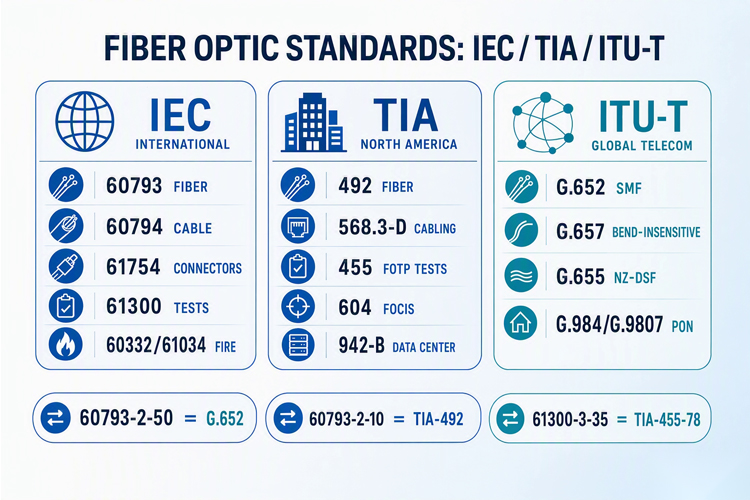
IEC 60793-2-50 SM Fiber Product Standards G.652, G.655, G.657 families Mandatory for type approval
IEC 60794-1-2 Mechanical Test Methods Cable qualification Factory audit requirement
IEC 60794-3-12 Outdoor Cable Specs Duct, aerial, direct-burial Project-specific compliance
TIA-568.3-D Premises Cabling Indoor fiber Indoor/enterprise deployments
YD/T 769 Chinese National Standard National equivalent to IEC Required for China-market projects

Cost Breakdown: Typical FTTH Project (2025 Reference)

Reference: 10,000-Home FTTH Deployment (Europe / Southeast Asia), XGS-PON Architecture
Cost Category Item Cost per Home Total (10K Homes) % of Total
Fiber Optic Cable Feeder (144F GYTS, G.652.D) $9 $90,000 4.3%
Distribution (24F GYXTW, G.652.D) $16 $160,000 7.6%
Drop cable(GJXFH G.657.A2, avg 150m) $22 $220,000 10.5%
Indoor wiring (G.657.A2 patch cord) $9 $90,000 4.3%
Active Equipment XGS-PON OLT + ONT $48 $480,000 22.9%
Passive Infrastructure Splitters, closures, ODF $42 $420,000 20.0%
Installation Labor Splicing, termination, testing $64 $640,000 30.5%
TOTAL   ~$210/home ~$2.1M 100%
“Cable and passive infrastructure represent approximately 27% of total FTTH deployment cost. The remaining 73% is active equipment, labor, and civil works. Reducing cable cost matters — but optimizing installation efficiency through pre-terminated systems and aerial deployment has 3-5× greater impact on project economics. The fiber cable itself is the smallest cost component; getting it wrong is the largest risk.” — FTTH Council Europe, FTTH Cost Analysis 2024
Cost Optimization Levers (Ranked by Impact):
Optimization Strategy Cost Reduction Risk Level Recommendation
Aerial (ADSS) vs. Trenching -60% civil cost Low Default for rural/suburban
Pre-terminated drop cable -40% labor cost Low Standardize for all projects
Higher split ratios (1:64 → 1:128) -15% OLT CapEx Medium Validate link budget first
Micro-trenching (urban) -35% civil cost Medium Municipality-dependent
Bulk cable procurement (project-scale) -8-12% cable cost Low Requires storage capacity

Supplier Capabilities: Telecom Project Portfolio

Project Type Cable Solutions Fiber Type MOQ Lead Time Key Certification
FTTH Feeder GYTS/GYTA, 48-432F G.652.D 2 km 15-20 days IEC 60793, ISO 9001
FTTH Distribution GYXTW, 4-24F G.652.D 2 km 10-15 days IEC 60794-3-12
FTTH Drop GJXFH/GJYXFH, 1-4F G.657.A2 500 m 10 days IEC 60793-2-50 B6
5G Backhaul GYTS/GYTA, 24-96F G.652.D 2 km 15-20 days DWDM-ready test report
Rural Aerial ADSS AN/AT, 4-48F G.652.D 1 km 20-30 days IEEE 1222, IEC 60794-4
Metro Ring GYTS/GYTA, 96-144F G.652.D (DWDM) 2 km 20-25 days PMD ≤0.1 ps/√km
Long-Haul Backbone GYTS/GYTS53, 48-144F G.655.C / G.654.E 2 km 20-25 days G.655/G.654 type test
DCI / AI Cluster High-count SM, 144-864F G.652.D / G.657.A2 1 km 25-30 days Low-skew, tight-buffered

Market Summary: Telecom Fiber by Segment (2025)

Project Type Primary Cable Key Fiber Est. Global Market 2025 5-Year CAGR
FTTH/B (new builds) GYTS/GYXTW/GJXFH G.652.D + G.657.A2 $32B 12%
5G Backhaul GYTS/GYTA, 24-96F G.652.D $15B 18%
Long-haul / Submarine GYTS/GYTS53 G.652.D / G.654.E / G.655.C $10B 9%
Rural Telecom ADSS/GYXTW/GYXTW53 G.652.D $8B 15%
Metro / DCI GYTS/GYXTW G.652.D (enhanced) $11B 14%
AI / Hyperscale DCI High-count SM MM/SM hybrid G.652.D / G.657.A2 $4B 25%+
Total Telecom Fiber     $80B 13%
 

Frequently Asked Questions

Q1: What fiber infrastructure does 5G fronthaul require?
5G fronthaul (C-RAN architecture) requires high-capacity fiber connectivity between Radio Units (RU) at the cell site and Distributed Units (DU) in the central office. Options include: (1) Direct fiber — dedicated fibers per cell site for maximum reliability; (2) WDM/PON — wavelength or PON-based sharing to reduce fiber count; (3) Active Ethernet — electrical switching at the cell site. With 5G-Advanced demanding 25 Gbps per cell site and sub-1ms latency targets, high-count fiber cables with G.657.A2 bend-insensitive fiber have become the industry standard for fronthaul deployments. Key takeaway: Fronthaul fiber selection directly determines 5G latency and throughput — G.657.A2 bend-insensitive fiber is now mandatory for all small-cell and C-RAN fronthaul links.
Q2: What is the difference between FTTA and FTTP in telecom infrastructure?
FTTA (Fiber-to-the-Antenna) delivers fiber directly to the base station antenna, replacing legacy copper coaxial cable. It supports massive MIMO antenna systems that require multiple fiber feeds per antenna at 4G LTE and 5G NR frequencies. FTTP (Fiber-to-the-Premise) delivers fiber to homes and businesses for residential and enterprise broadband services. Both share common ODN architecture principles, but FTTA requires ruggedized outdoor-rated cable with fire resistance and weatherproofing for tower installation, while FTTP prioritizes bend-insensitive drop cables for indoor/outdoor transitions. Key takeaway: FTTA cable must meet higher environmental specifications (UV resistance, temperature range -40°C to +70°C, fire rating); FTTP cable prioritizes flexibility and bend performance for in-home installation.
Q3: How do telecom operators manage fiber network capacity?
Operators employ multiple strategies: (1) Overbuild — installing 6-12 extra fibers per cable for future growth; (2) WDM expansion — adding wavelengths via 400ZR/800ZR coherent pluggables without laying new fiber; (3) Cable-in-duct — installing empty microducts for future fiber blowing; (4) Node splitting — deploying additional OLT ports and higher split ratios; (5) Spectral efficiency — upgrading from 10G to 100G/400G/800G per wavelength using coherent detection. With AI-driven traffic growing 40% annually, operators now prioritize DWDM-ready G.652.D fiber to future-proof backbone capacity. Key takeaway: The most cost-effective strategy is DWDM-ready fiber + 20% overbuild at initial deployment — it costs 5-8% more upfront but avoids 70%+ higher mid-life upgrade costs.
Q4: What fiber type is best for rural FTTH deployments?
For rural FTTH, ADSS (All-Dielectric Self-Supporting) aerial cable with G.652.D fiber is the dominant choice, reducing deployment cost by up to 60% compared to trenching by leveraging existing power pole infrastructure. In regions with extreme weather, armored GYXTW53 cable provides additional protection at roughly 20% higher material cost. For the drop segment, G.657.A2 bend-insensitive fiber is mandatory to handle tight installation bends in rural premises. The 2025 trend favors pre-terminated plug-and-play systems that reduce skilled labor requirements by 40% — critical given the global shortage of fiber splicers. Key takeaway: ADSS aerial + G.657.A2 drop + pre-terminated connectors is the proven rural FTTH formula — balancing cost, speed, and reliability for low-density deployments.
Q5: How does the BEAD program impact fiber optic supply chains in 2025?
The $42.45 billion BEAD program is transitioning from planning to construction in 2025, with states finalizing subgrantee awards and beginning permitting. This creates significant supply chain pressure: global fiber demand is converging as the EU Gigabit Infrastructure Act, India’s BharatNet Phase III ($8.5B), and Brazil’s PNBL ($3.2B) compete for manufacturing capacity. Manufacturers are prioritizing long-term contracts, and prices remain elevated. Suppliers with verified factory capacity, ISO-certified quality systems, and demonstrated large-scale project delivery track records — as validated through third-party audits (SGS, BV, TÜV) — hold a decisive competitive advantage in this constrained market. Key takeaway: BEAD’s construction phase creates a 2-3 year supply-demand tightness window — operators should lock supplier agreements in 2025 before the 2026-2027 demand peak.


Related Guides

Multimode fiber OM3/OM4
Fiber patch cord
Optical switch for enterprise network

Related News
Read More >>
Fiber Optic Cable Standards: IEC/TIA/ITU Complete Guide Fiber Optic Cable Standards: IEC/TIA/ITU Complete Guide
Aug .18.2026
2026 fiber optic cable standards reference: IEC 60793, TIA-568.3-D, ITU-T G.652-G.657 specifications for single-mode and multimode fiber, cable construction standards, connector interfaces, and testing methods.
Fiber Optic for CCTV & Security: Long-Distance Surveillance Guide Fiber Optic for CCTV & Security: Long-Distance Surveillance Guide
Aug .11.2026
2026 guide to fiber optic CCTV & security surveillance: long-distance architecture, 4K/8K bandwidth planning, fiber cable selection, city-wide deployment strategies, and NDAA-compliant equipment selection.
Railway & Mass Transit Fiber Communication Systems Guide Railway & Mass Transit Fiber Communication Systems Guide
Aug .03.2026
Railway fiber optic communication systems for CBTC/ERTMS train control, trackside GYTC8S cable installation, metro fiber backbones, and high-speed rail networks. Covers EN 50128 fire safety and UIC 303 standards.
Oil & Gas Fiber Optic: Explosive-Proof Cabling Solutions Guide Oil & Gas Fiber Optic: Explosive-Proof Cabling Solutions Guide
Jul .21.2026
ATEX/IECEx fiber optic cables for oil and gas hazardous areas: downhole DTS/DAS sensing, pipeline leak detection, offshore platform networking, and GYFTZY non-metallic cable selection. Explore OPELINK's 2026 explosive-proof fiber solutions guide.