Introduction
Whether you are planning a 10-kilometer FTTH backbone or a 500-kilometer transmission line communication upgrade, understanding outdoor fiber optic cable price per km is essential for accurate budget planning and meaningful vendor comparison. Fiber cable pricing is not a single number you can look up in a catalog. It fluctuates based on raw material markets, order volume, manufacturing location, certification requirements, and the specific cable architecture you select. A precise fiber optic cable cost estimation accounts for the bare cable, the hardware that supports it, the labor to install it, and the testing that proves it works.
This article breaks down every factor that drives pricing for the three dominant outdoor cable families — GYTS, ADSS, and OPGW — provides indicative price ranges per kilometer, compares total project economics, and gives you a practical framework for requesting accurate quotes. If you need a deeper understanding of what each cable type is designed for, start with our complete guide to outdoor fiber optic cable types.
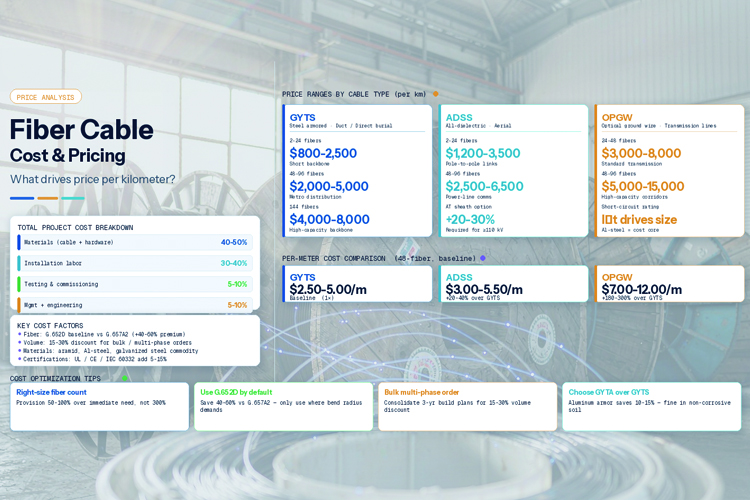
Key Cost Factors
Fiber Type
The optical fiber inside the cable is the single most significant cost component. The two dominant single-mode fiber standards for outdoor cables are:
| Fiber Type |
Characteristics |
Indicative Price (per km) |
| ITU-T G.652D |
Standard single-mode, widely deployed, suitable for most links |
$20–25/km |
| ITU-T G.657A2 |
Bend-insensitive, allows 7.5 mm bend radius, ideal for tight spaces |
$33–35/km |
G.657A2 fiber commands a 40–60% premium over G.652D because of its more complex glass geometry and reduced bend-loss sensitivity. For long-distance backbone links where bend radius is not a constraint, G.652D is the cost-effective choice. For FTTH drop cables, campus distribution, and any environment where cables follow tight corners, G.657A2 pays for itself in lower installation loss and fewer splicing failures.
Fiber Count
More fibers in a cable means a higher total price, but a lower cost per fiber — the metric that matters for capacity planning. A 48-fiber cable is not twice the price of a 24-fiber cable; the incremental cost of additional fibers is modest because the sheath, strength members, and armor are shared. This is why engineers often specify 96-fiber cables for 48-fiber immediate needs, banking the spare capacity for future expansion at a fraction of the cost of a second cable install.
Cable Type and Structure
The cable's physical architecture — armor type, strength member, and sheath material — drives a significant portion of cost:
- Armor: Steel wire armor (GYTS) adds material and manufacturing cost but provides mechanical protection for direct burial and duct installation. Aluminum tape armor (GYTA) is lighter and less expensive but offers less crush resistance.
- Strength member: Non-metallic FRP (fiber reinforced plastic) is lighter and lower cost; metallic steel wire provides higher tensile strength for aerial and long-span applications.
- Sheath material: Standard PE (polyethylene) is the baseline. AT (anti-tracking) sheath for ADSS on high-voltage lines adds 20–30% to sheath cost. Flame-retardant LSZH sheath for industrial and indoor-transition applications adds 15–25%.
Order Volume
Manufacturers price fiber cable on a sliding scale. Bulk orders for multi-phase projects typically receive 15–30% discounts over single-reel pricing. A 100-kilometer order will be priced per kilometer significantly lower than a 5-kilometer order because setup costs, production planning, and logistics are amortized across more output. When planning multi-year build-outs, consolidating orders into phase-based bulk purchases is one of the most effective cost reduction strategies available.
Raw Materials
Cable prices track commodity markets:
- Aramid yarn (Kevlar and equivalents): The primary tensile strength member in ADSS cable. Aramid prices fluctuate with global supply and can represent 15–25% of ADSS cable material cost.
- Aluminum-clad steel wire: Used in OPGW as both optical housing and electrical conductor. Aluminum and steel prices directly affect OPGW cost, which is why OPGW cable cost per km is the most volatile of the three cable types.
- Galvanized steel wire: Used in GYTS armor. Steel price movements affect GYTS, but less dramatically than OPGW because steel is a smaller fraction of total cost.
Manufacturing Location
Where the cable is produced affects landed cost through shipping, tariffs, and labor rates. Cable manufactured in China typically has the lowest ex-works price but may incur import duties (up to 25% in some markets) and longer lead times. Regional manufacturing in Southeast Asia, Europe, or North America reduces shipping cost and tariff exposure but carries higher base prices. For government-funded or critical infrastructure projects, domestic manufacturing requirements may eliminate the lowest-cost option entirely.
Certification Requirements
Project specifications often mandate specific certifications that add cost:
- UL (Underwriters Laboratories): Common in North American projects, adds 5–10% to cost
- CE marking: Required for European market, adds 3–8%
- CRU (Russian certification): Adds 5–10% for CIS market projects
- IEC 60332 flame retardant: Adds 5–15% depending on category (A, B, C, or D)
These costs reflect testing fees, documentation, and ongoing compliance audits that the manufacturer builds into certified product pricing.
Price Ranges by Cable Type
The following table provides indicative price ranges per kilometer for common configurations. All prices assume G.652D fiber and standard PE sheath unless otherwise noted.
GYTS — Stranded Loose Tube Steel Armored Cable
| Fiber Count |
Price Range (per km) |
Typical Application |
| 2–24 fibers |
$800–2,500/km |
Short backbone, campus links |
| 48–96 fibers |
$2,000–5,000/km |
Metro backbone, distribution |
| 144 fibers |
$4,000–8,000/km |
High-capacity backbone, data center interconnect |
ADSS — All-Dielectric Self-Supporting Cable
| Fiber Count |
Price Range (per km) |
Notes |
| 2–24 fibers |
$1,200–3,500/km |
Small pole-to-pole links |
| 48–96 fibers |
$2,500–6,500/km |
Power line communication backbone |
| ADSS with AT sheath |
+20–30% over PE |
Required for lines above 110 kV |
OPGW — Optical Ground Wire
| Fiber Count |
Price Range (per km) |
Notes |
| 24–48 fibers |
$3,000–8,000/km |
Standard transmission line communication |
| 48–96 fibers |
$5,000–15,000/km |
High-capacity transmission corridors |
Cost Comparison: GYTS vs ADSS vs OPGW
Comparing cable prices per meter is only the first step. The true comparison must include the infrastructure required to install each cable type.
Per-Meter Cable Cost (Indicative)
| Cable Type |
Cost per Meter |
Cost per Foot |
Relative Cost |
| GYTS (48f, duct) |
$2.50–5.00/m |
$0.75–1.50/ft |
Baseline |
| ADSS (48f, aerial) |
$3.00–5.50/m |
$0.90–1.60/ft |
+20–40% over GYTS |
| OPGW (48f, transmission) |
$7.00–12.00/m |
$2.10–3.50/ft |
+180–300% over GYTS |
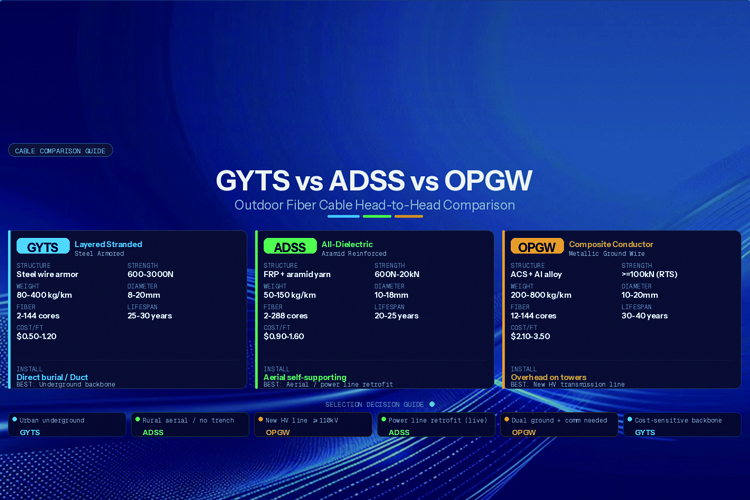
ADSS is 30–50% cheaper than OPGW on a cable-only basis. This is the foundation of the common recommendation to use ADSS rather than OPGW where the existing pole line can support it. For a full comparison of these two cable types, see our GYTS vs ADSS vs OPGW comparison article.
Total Installed Cost (Including Infrastructure)
The picture changes dramatically when you include the supporting infrastructure:
| Cable Type |
Cable Cost |
Infrastructure Adder |
Why |
| GYTS |
Lowest |
+$3–10/m |
Requires conduit or trenching — major civil works |
| ADSS |
Moderate |
+$2–5/m |
Needs pole hardware (brackets, suspension assemblies) |
| OPGW |
Highest |
Shared with line |
Installed during transmission line construction — hardware cost is shared |
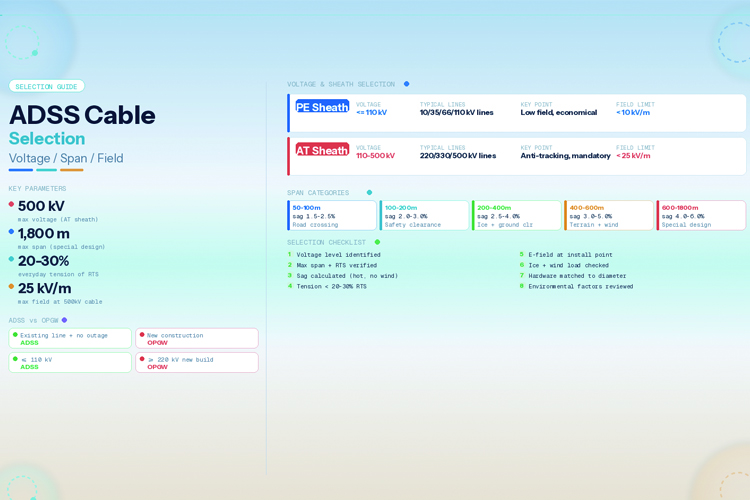
This is why OPGW, despite having the highest cable cost, can be the most economical choice for new transmission lines: the tower, hardware, and installation labor are required regardless, and adding optical fibers to the ground wire is a marginal cost on top of a large base. For existing lines where re-stringing the ground wire is not feasible, ADSS becomes the practical choice despite its separate hardware requirements. Learn more in our ADSS cable selection guide for power lines.
Total Project Cost Estimation
A complete fiber cable project budget breaks down into four cost categories:
| Cost Category |
Share of Total |
Description |
| Materials (cable + hardware) |
40–50% |
Cable, splice closures, termination boxes, suspension hardware |
| Installation labor |
30–40% |
Trenching, pulling, splicing, termination |
| Testing and commissioning |
5–10% |
OTDR testing, loss measurement, documentation |
| Project management + engineering |
5–10% |
Design, permitting, supervision, as-built drawings |
Worked Example: 10 km ADSS, 48-Fiber Project
| Line Item |
Estimated Cost |
| ADSS cable (48f, PE sheath, 10 km) |
~$35,000 |
| Hardware (suspension assemblies, dead-ends, splice closures) |
~$15,000 |
| Installation labor (10 km aerial, 4 splice points) |
~$25,000 |
| Testing and commissioning (OTDR, loss, continuity) |
~$5,000 |
| Project total |
~$80,000 |
This works out to approximately $8,000 per kilometer all-in — a useful benchmark for budgeting similar ADSS aerial projects. Your actual costs will vary based on terrain, labor rates, pole access conditions, and hardware specifications.
How to Get Accurate Quotes
Vague specifications produce vague quotes. To get pricing you can build a budget on, provide each manufacturer with:
- Cable type and designation (e.g., ADSS-48B1.3-PE-AT)
- Fiber count and fiber type (e.g., 48 × G.657A2)
- Total length and delivery schedule (including reel length preferences)
- Installation environment (aerial on 110 kV line, direct burial in rocky soil, etc.)
- Applicable standards and certifications (ITU-T, IEEE, UL, CE, IEC 60332)
Request quotes from at least three manufacturers and compare on:
| Comparison Criterion |
Why It Matters |
| Unit price per km |
Direct cable cost comparison |
| Minimum order quantity (MOQ) |
Affects small-project feasibility |
| Lead time |
Critical for project schedules |
| Warranty period and terms |
Risk allocation over project lifecycle |
| Certification documentation |
Compliance verification for acceptance |
| References for similar projects |
Proof of capability, not just price |
Always consider total cost of ownership, not just cable price. A cable that is 10% cheaper but requires 20% more splice points due to shorter reel lengths will cost more to install.
Cost Optimization Tips
Right-Size Fiber Count
Specify fiber count based on 3–5 year growth projections, not 20-year theoretical maximums. Dark fiber is cheaper to install than a second cable run, but over-provisioning by 4× ties up capital that could fund other network improvements. A common rule: provision 50–100% spare capacity over immediate need, not 300%.
Use Standard Fiber Type Unless Bend-Insensitive Is Required
G.652D fiber is 40–60% cheaper than G.657A2. Use G.657A2 only where bend radius constraints (FTTH drop, tight building corners, high ODF density) justify the premium. For long straight backbone runs, G.652D is the correct economic choice.
Leverage Bulk Ordering for Multi-Phase Projects
If you have a 3-year build plan totaling 150 km, order the full 150 km in a single purchase agreement with phased delivery. The 15–30% volume discount on cable cost typically more than offsets storage and cash-flow considerations.
Consider GYTA vs GYTS for Non-Corrosive Environments
GYTS uses steel wire armor; GYTA uses aluminum tape armor. In non-corrosive, non-waterlogged environments, GYTA provides adequate mechanical protection at a lower cost. The GYTS vs GYTA price difference is typically 10–15%, which compounds across large projects. However, in corrosive soil or water-logged ducts, the superior corrosion resistance of GYTS steel armor justifies the premium. For more on GYTS installation environments, see our GYTS direct burial and duct installation guide.
Conclusion
Accurate fiber optic cable cost estimation requires looking beyond the per-kilometer cable price to the full project economics: materials, installation, testing, and management. GYTS offers the lowest cable cost but may require expensive civil works. ADSS provides a middle ground with moderate cable cost and moderate hardware requirements. OPGW has the highest cable cost but can be the most economical choice for new transmission lines where installation infrastructure is shared.
The key to cost optimization is matching the cable type to the installation environment, right-sizing fiber count to realistic growth projections, leveraging volume discounts for multi-phase projects, and always comparing total installed cost rather than cable-only price. For guidance on selecting the right cable type for your specific application, see our fiber optic cable selection by application guide.
Ready to get a precise quote for your project? Contact OPELINK for a detailed quotation tailored to your exact specifications — cable type, fiber count, length, environment, and certification requirements. Our engineering team will help you optimize cable selection for both performance and cost.
Frequently Asked Questions
How much does outdoor fiber optic cable cost per kilometer?
Outdoor fiber optic cable prices range from approximately $800/km for a low-fiber-count GYTS cable to over $15,000/km for high-fiber-count OPGW on high-short-circuit-current transmission lines. The most common 48-fiber configurations range from $2,000–6,500/km depending on cable type and sheath material.
Why is OPGW more expensive than ADSS?
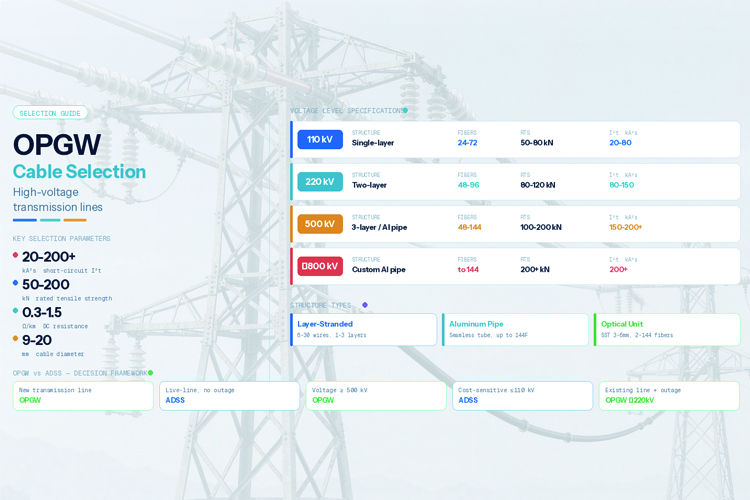
OPGW incorporates aluminum-clad steel wires that serve as both the optical fiber housing and the electrical ground conductor. The electrical requirements — particularly short circuit current rating — dictate the size and quantity of these metallic wires, which are the dominant cost component. ADSS uses non-metallic aramid yarn for strength, which is less expensive for equivalent fiber counts. See our OPGW selection guide for details on how electrical parameters drive cost.
How do I estimate the total cost of a fiber cable project?
Use the 40/35/10/15 rule as a starting point: 40% materials, 35% installation labor, 10% testing, 15% project management and engineering. Calculate your cable cost from the price ranges above, then divide by 0.40 to estimate total project cost. Refine with actual quotes as the design progresses.
Does bulk ordering really save 30%?
Volume discounts of 15–30% are achievable for orders exceeding 50–100 km of a single cable type, depending on the manufacturer. The discount reflects amortized setup costs, production efficiency, and reduced per-unit logistics costs. For orders under 10 km, expect minimal volume discount.
Related articles

 GYTS Cable: Direct Burial and Duct Installation Complete Guide
 OPGW Cable Selection Guide for High-Voltage Transmission Lines
 GYTS vs ADSS vs OPGW: Outdoor Fiber Cable Comparison
 ADSS Cable Selection Guide for Power Lines: Voltage, Span & Environment


