Key Takeaways
. The global outdoor fiber optic cable market reached $3.08 billion in 2025 and is projected to hit $5.31 billion by 2032 at a CAGR of 8.09% (360iResearch, 2026). The U.S. BEAD program’s $42.5 billion federal investment and 5G densification are the primary catalysts.
. Asia-Pacific dominates with 44.9% market share ($4.84B), driven by large-scale fiber rollouts across China, India, and Southeast Asia. Underground/duct deployment leads at 44.3% of global revenue ($4.76B).
. 68% of outdoor fiber failures originate in the first 100 meters from termination points (NTT 10-year reliability study). Proper installation practices — pulling tension control, bend radius management, and factory pre-termination — reduce early failures by up to 60%.
. Five major cable types serve distinct deployment scenarios: GYTS (universal backbone), ADSS (aerial self-supporting), OPGW (power transmission), GYXTW (short-span FTTH), and Submarine armored (water crossings). Selection must match installation method, fiber standard, and environmental threats.
. As of March 2026, G.657A2 bend-insensitive fiber prices reached $33-35/km amid persistent supply-demand imbalance. U.S. 2025 tariffs are accelerating localized manufacturing and regional distribution hub strategies.
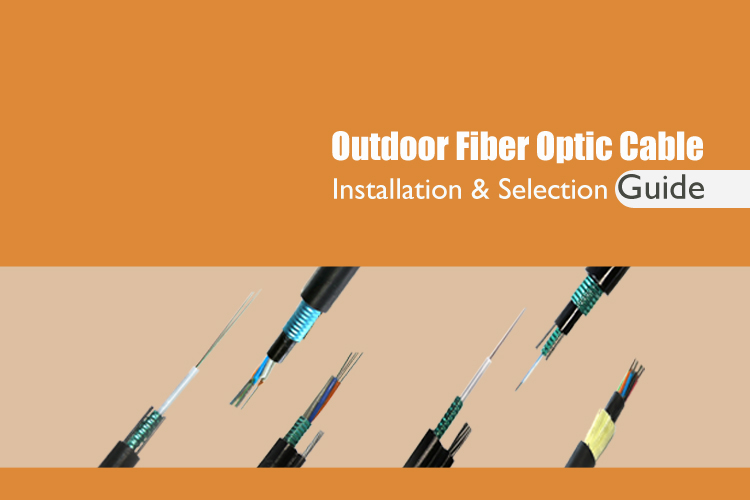
1. Outdoor Fiber Cable Market: A $3.08B Industry Entering a New Growth Cycle
The outdoor fiber optic cable market has entered a decisive growth phase, propelled by an unprecedented convergence of government funding, 5G network densification, and AI-driven data center expansion. According to 360iResearch’s Global Forecast 2026-2032, the market was valued at $3.08 billion in 2025, projected to reach $3.31 billion in 2026 and $5.31 billion by 2032 at a CAGR of 8.09%. Outdoor fiber cables now account for 62% of total optical fiber cable deployed globally each year, representing approximately 850 million fiber-kilometers annually. (Source: 360iResearch, January 2026; NTT Technical Review 2022)
Three Mega-Drivers Reshaping the Market
1. The BEAD Program ($42.5B Federal Catalyst). The U.S. Broadband Equity, Access, and Deployment program is entering its “decisive landing year” in 2026. Thousands of projects are launching simultaneously following rule revisions completed in late 2025. According to Panduit network experts, total U.S. fiber infrastructure investment will reach $96 billion in 2026, with private equity having already injected over $80 billion into U.S. fiber infrastructure over the past five years. Louisiana and Virginia are directing over 80% of BEAD funds to fiber deployments. Brightspeed alone secured $528 million in BEAD funding across 17 states, targeting 182,900 rural locations. (Sources: Panduit 2026 Broadband Trends; Light Reading, December 2025)
2. 5G Deepening Deployment. 5G backhaul fiber densification continues to demand high-count outdoor cables for metro access and fronthaul connectivity. Each 5G small cell requires fiber backhaul, multiplying outdoor cable demand in urban and suburban corridors.
3. AI Data Center Interconnect. AI workloads demand 10x the fiber density of traditional data centers. 800G optical modules are entering mass deployment in 2026 — dubbed the “breakthrough year” for fiber technology — enabling bandwidth doubling without replacing existing fiber. This drives demand for higher-spec outdoor cables (G.652.D enhanced, G.657.A2 bend-insensitive) for data center interconnect (DCI) applications. (Sources: Panduit 2026 Trends; PW Consulting, March 2026)
Regional Market Breakdown (2025)
| Region |
Value (USD Million) |
Market Share (%) |
Key Growth Drivers |
| Asia Pacific |
$4,838.83M |
44.9% |
Large-scale fiber rollout, urbanization, 5G densification across China, India, Southeast Asia |
| North America |
$2,690.48M |
25.0% |
BEAD program, data center modernization, 800G deployment, tariff-driven localization |
| Europe |
$2,153.20M |
20.0% |
Telecom backbone upgrades, regulatory frameworks, FTTH expansion in Germany, France, UK |
| Latin America |
$639.68M |
5.9% |
Targeted broadband programs, private last-mile investment, cost-efficient deployments |
| Middle East & Africa |
$438.17M |
4.1% |
Nascent fiber activity, smart city initiatives, submarine landing station connectivity |
Source: PW Consulting, Worldwide Outdoor Fiber Cable Market 2026; 360iResearch, Global Forecast 2026-2032.
By deployment method, underground/duct installation leads with 44.3% of global revenue ($4.76 billion), driven by urban safety, security, and conduit-sharing economics. Aerial deployment accounts for approximately 30%, with direct burial and submarine covering the remainder. (Source: PW Consulting, 2026)
For a deeper market perspective, see our comprehensive analysis: Global Fiber Optic Cable Market Analysis Report
KEY TAKEAWAY: The outdoor fiber cable market is transitioning from steady growth to accelerated expansion, fueled by a $96B U.S. investment wave in 2026. Asia-Pacific dominates with 44.9% share, but North America shows the strongest policy-driven momentum. Procurement teams should anticipate tightening supply for G.657.A2 fiber and plan order lead times accordingly.
2. Q&A: What Is Driving the Outdoor Fiber Cable Market in 2026?
Q: What Is Driving the Outdoor Fiber Cable Market in 2026?
The outdoor fiber cable market is being propelled by three reinforcing forces in 2026:
First, the BEAD program is transitioning from planning to execution. Following rule revisions in mid-2025 that removed “fiber-first” preferences in favor of “lowest-qualified-bid” mechanisms, states completed their revised proposals in Q4 2025. Thousands of projects are launching in 2026, with total U.S. investment projected at $96 billion. Private equity has contributed $80+ billion over five years, and industry consolidation continues with $45 billion in M&A during 2024-2025. (Sources: Panduit 2026 Broadband Trends; Light Reading, Dec 2025)
Second, 5G backhaul densification continues to require high-fiber-count outdoor cables for metro access rings and fronthaul links. Each 5G small cell deployment multiplies outdoor cable demand in urban corridors. Operators globally are densifying their fiber backhaul networks to support 5G-Advanced and future 6G readiness.
Third, AI data center interconnect is creating unprecedented demand for outdoor cables linking hyperscale data centers. AI workloads require 10x the fiber density of traditional data centers. The 2026 rollout of 800G optical modules enables bandwidth doubling over existing fiber infrastructure, but also drives demand for higher-specification outdoor cables (G.652.D enhanced, G.657.A2) to support longer reaches and higher capacities. (Source: Panduit 2026 Broadband Trends)
KEY TAKEAWAY: 2026 is the year BEAD moves from appropriation to construction. The combination of federal funding ($42.5B), private capital ($80B+ cumulative), 5G densification, and AI-driven DCI creates a demand environment unlike any previous cycle. For procurement professionals, the window for securing capacity at favorable pricing is narrowing as projects accelerate.
Product Recommendation: OPELINK’s [outdoor fiber cable product line] covers GYTS, GYTA, GYXTW, ADSS, OPGW, and submarine armored cables — all compliant with IEC 60794 and available with G.652.D and G.657.A2 fiber options. Contact our team for BEAD-compliant BABA certification.Explore Outdoor Cable Products
3. Understanding Outdoor Cable Environments
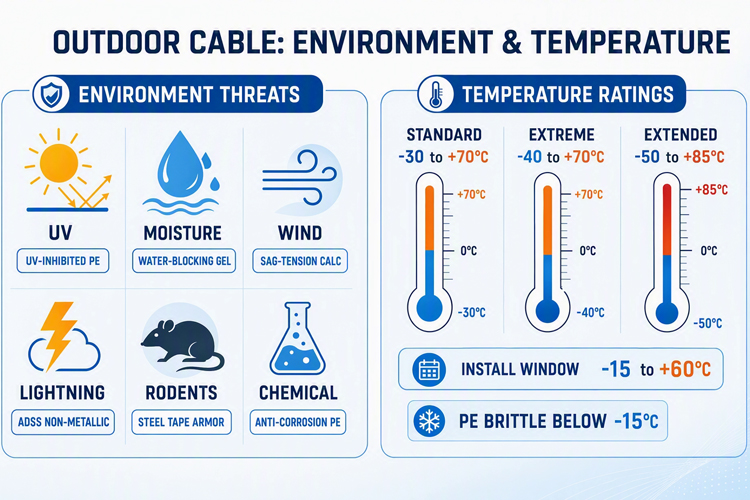 Outdoor fiber optic cable is engineered for environmental extremes that indoor cables are not designed to withstand. According to IEC 60794-1-2, outdoor cables must pass a defined suite of environmental, mechanical, and optical tests before deployment. A 10-year reliability study by NTT found that 68% of outdoor fiber failures originate in the first 100 meters from termination points, emphasizing the critical importance of environmental matching at the selection stage. (Source: NTT Technical Review, Fiber Optic Reliability Study 2022)
Environmental Threats Matrix
Outdoor fiber optic cable is engineered for environmental extremes that indoor cables are not designed to withstand. According to IEC 60794-1-2, outdoor cables must pass a defined suite of environmental, mechanical, and optical tests before deployment. A 10-year reliability study by NTT found that 68% of outdoor fiber failures originate in the first 100 meters from termination points, emphasizing the critical importance of environmental matching at the selection stage. (Source: NTT Technical Review, Fiber Optic Reliability Study 2022)
Environmental Threats Matrix
| Threat |
Mechanism |
Damage |
Protection Method |
Failure Rate Insight |
| UV Radiation |
Photo-oxidation of polymer |
Jacket brittleness, cracks |
UV-inhibitor PE sheath, carbon black additive |
31% of early failures (BICSI) |
| Temperature Cycling |
Thermal expansion/contraction |
Fiber stress, attenuation |
Temperature-stable gel, loose-tube design |
Highest in aerial deployments |
| Moisture / Water |
Hydrolysis, ice lens formation |
Corrosion, fiber brittleness |
Water-blocking gel, swellable tapes |
68% of failures within 100m (NTT) |
| Wind Load |
Dynamic mechanical stress |
Overbend, stress fractures |
Proper tensile rating, ADSS design |
Critical for span >200m |
| Rodents |
Teeth gnawing through sheath |
Fiber breakage |
Steel tape armor, rodent-resistant additives |
Common in direct burial |
| Lightning |
Surge voltage induction |
Fiber damage (metal types) |
Non-metallic (ADSS/GYFTZY), grounding |
OPGW doubles as lightning shield |
| Chemical |
Acid/alkali soil attack |
Sheath degradation |
Anti-corrosion PE compound, double sheath |
Industrial zones, agricultural land |
| Ice/Wind |
Mechanical loading |
Tensile overload, sag |
ADSS engineered for span load |
AT-25 rated for 1000m spans |
Source: IEC 60794-1-2/21/22; NTT Technical Review 2022; BICSI Telecommunications Cabling Installation, 4th Edition.
The field data underscores a critical insight: the majority of failures are preventable at the selection and installation stages. Selecting the wrong outdoor cable type or specification for a given environment remains the leading cause of premature fiber network failure. For direct burial applications subject to rodent and chemical threats, [armored cable solutions] with steel tape armor and anti-corrosion PE compounds provide essential protection. See our Armored vs Non-Armored Selection Guide for detailed comparisons.
4. Major Outdoor Cable Types — Updated Technical Specifications
Selecting the correct cable type is the single most important decision in outdoor fiber deployment. The five major types below cover the full spectrum of outdoor applications, from standard telecom backbone to specialized power-line and submarine deployments.
4.1 GYTS — Stranded Loose-Tube Steel Wire Strength
The most common outdoor cable worldwide. Stranded loose-tube design with central steel wire strength member, corrugated steel tape armor (optional in GYTA variant with FRP rod), water-blocking gel, and PE outer sheath. Supports G.652.D and G.655.C fiber standards.
| Parameter |
GYTS-4-24F |
GYTS-48-96F |
GYTS-144-288F |
| Diameter |
8.5-11.5mm |
12.0-16.5mm |
17.0-23.0mm |
| Weight |
80-130 kg/km |
130-220 kg/km |
220-380 kg/km |
| Tensile (R/M) |
600/1000N |
1000/2000N |
2000/3000N |
| Crush (S/L) |
300/100N |
300/100N |
300/100N |
| Bend Radius |
15×OD/20×OD |
15×OD/20×OD |
15×OD/20×OD |
Application: Telecom backbone, metro access, FTTH feeder, long-distance transmission. Works in duct, aerial (with messenger), or direct burial (with armor). [GYTS outdoor cable series] available from 4 to 288 fibers.
4.2 ADSS — All-Dielectric Self-Supporting
The premium aerial cable with no metal whatsoever — installable on high-voltage power line structures without disrupting electrical circuits. Per IEC 60794-4, uses high-modulus aramid yarn (DuPont Kevlar equivalent) and FRP rods. Installation costs are 70% lower than trenching, with deployment times 80% faster — making ADSS the default choice for rural fiber broadband expansion (FTTH Council Asia-Pacific, 2023).
ADSS Span Performance (Typical)
| ADSS Type |
Span |
Cable OD |
Weight |
Tensile Strength |
Wind Load |
| AN-8 (Light) |
≤ 100m |
8-10mm |
70-90 kg/km |
8 kN |
500 N/m² |
| AN-12 (Medium) |
100-200m |
10-13mm |
90-130 kg/km |
12 kN |
700 N/m² |
| AT-15 (Heavy) |
200-500m |
13-17mm |
130-200 kg/km |
15 kN |
1000 N/m² |
| AT-25 (Extra Heavy) |
500-1000m |
17-22mm |
200-350 kg/km |
25 kN |
1200 N/m² |
AT vs AN: AT type suits high-voltage lines (up to 35kV for AT-15, up to 110kV for AT-25). AN type is for lower voltage environments (≤35kV), typically distribution networks. [ADSS aerial cable portfolio] from 2 to 288 fibers.
4.3 OPGW — Optical Ground Wire
Dual-function cable at the top of power transmission towers, combining lightning protection ground wire with fiber optic communication for 35kV to 500kV lines.
| Parameter |
Requirement |
| Fiber Count |
12-144 fibers (G.652.D / G.655.C) |
| Diameter |
9-22mm (matches tower ground wire fittings) |
| Tensile Strength |
40-100 kN (mechanical grade) |
| Lightning Current Rating |
≥ 100kA (per IEC 60794-4) |
| Short Circuit Current |
≥ 40kA²s |
| Operating Temperature |
-40°C to +70°C |
| Typical Application |
110kV, 220kV, 500kV transmission lines |
Standards: IEC 60794-4, IEEE 1138, YD/T 5102.
4.4 GYXTW — Central Loose Tube (Short/Medium Span)
Economical, lightweight design with single central buffer tube, gel filling, and PE sheath. Best for FTTH distribution networks (last-mile feeder), short-span aerial (≤200m), duct installation, and rapid deployment/emergency restoration.
| Parameter |
Specification |
| Fiber Count |
2-24 fibers (central tube) |
| Core |
G.652.D standard |
| Tensile |
600N / 1000N / 2000N |
| Crush |
≥ 300N/100mm |
| Diameter |
7.0-10.0mm |
| Weight |
50-90 kg/km |
| Min. Bend Radius |
10×OD (installed), 20×OD (under load) |
[GYXTW outdoor cable] — available in GYXTW and GYXTW53 (armored) variants.
4.5 Submarine Fiber Cable (Shallow Water / Landing)
For shallow water crossings up to 3,000m depth, available in light-armored (beach landings, harbor crossings), double-armored (up to 1,000m), and rock armor (rocky seabed) configurations.
| Parameter |
Light-Armored |
Double-Armored |
| Diameter |
15-22mm |
22-35mm |
| Weight (in air) |
500-900 kg/km |
1000-2500 kg/km |
| Weight (in water) |
200-400 kg/km |
600-1500 kg/km |
| Crush Strength |
≥ 2000N/100mm |
≥ 3000N/100mm |
| Water Depth |
≤ 500m |
≤ 3000m |
5. Q&A: Loose-Tube vs Tight-Buffered Outdoor Cable
Q: What Is the Difference Between Loose-Tube and Tight-Buffered Outdoor Fiber Cable?
Loose-tube cable houses fibers in gel-filled buffer tubes that allow independent movement, protecting fibers from mechanical stress, temperature cycling, and moisture ingress. This is the standard for outdoor backbone and long-haul applications (GYTS, ADSS, OPGW all use loose-tube construction). The gel filling provides primary water-blocking, while the tube structure isolates fibers from external mechanical loads. Loose-tube cables dominate outdoor deployments, accounting for over 80% of outdoor fiber cable shipments globally.
Tight-buffered cable has fibers embedded in a 900μm buffer coating, making each fiber individually robust and suitable for direct connector termination without splice enclosures. It is more rigid and primarily used for indoor/outdoor transition points, campus backbones, and applications requiring direct termination flexibility. Tight-buffered outdoor cables use UV-stable LSZH or PE jackets for weather resistance. However, they are less suitable for long-haul outdoor runs because the tight buffer transmits temperature-induced stress more directly to the fiber.
Application Scenario Comparison
| Application Scenario |
Recommended Construction |
Rationale |
| Long-haul backbone (>10km) |
Loose-tube |
Temperature isolation, water-blocking, high fiber count scalability |
| Metro access ring (3-10km) |
Loose-tube |
Mechanical protection, duct compatibility, cost efficiency |
| Aerial self-supporting |
Loose-tube (ADSS) |
Non-metallic, aramid strength, span-rated design |
| Direct burial |
Loose-tube + armor |
Crush resistance, rodent protection, moisture barrier |
| Indoor/Outdoor transition |
Tight-buffered |
Direct termination, no splice enclosure, LSZH jacket |
| Campus backbone (<2km) |
Tight-buffered |
Riser-rated, connectorized assembly, rapid deployment |
| Data center interconnect |
Loose-tube (high-count) |
G.657.A2 bend-insensitive, high fiber density |
KEY TAKEAWAY: Loose-tube is the default and optimal choice for pure outdoor deployments beyond 2km. Tight-buffered excels at the indoor/outdoor boundary where direct connector termination eliminates splice points. For projects spanning both environments, hybrid designs with loose-tube outdoor segments transitioning to tight-buffered indoor segments provide the most cost-effective architecture.
6. Outdoor Cable Selection Criteria — Decision Framework
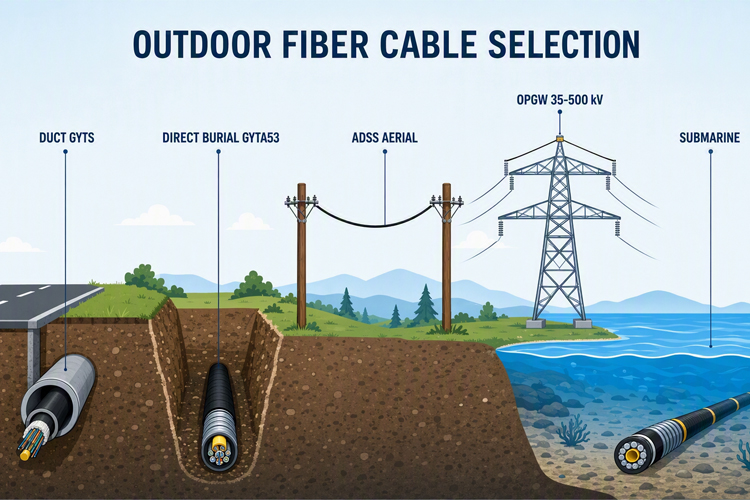 Proper cable selection requires a systematic three-step framework that matches the installation environment, application requirements, and budget constraints.
Step 1: Installation Method → Cable Type
Proper cable selection requires a systematic three-step framework that matches the installation environment, application requirements, and budget constraints.
Step 1: Installation Method → Cable Type
| Installation Method |
Recommended Cable |
Notes |
| Duct (pulling through conduit) |
GYTS / GYTA (non-armored) |
Standard telecom backbone; lubricant recommended |
| Direct burial (underground) |
GYTA53 (armored) |
Steel tape armor, double sheath; anti-corrosion PE |
| Aerial on messenger wire |
GYTS + messenger / GYXTW |
Short to medium spans; messenger wire required |
| Aerial self-supporting (power corridor) |
ADSS (Type AN/AT) |
Non-metallic; match span rating to pole distance |
| Power transmission towers |
OPGW |
35kV-500kV; dual-function lightning + comms |
| Harbor / shallow water |
Submarine armored |
Light or double armor; depth-rated |
| High-voltage proximity |
GYFTZY (non-metallic) |
No induced voltage risk; FRP strength member |
Step 2: Application → Fiber Standard
| Application |
Fiber Standard |
Notes |
| GPON / XGS-PON FTTH |
G.657.A1/A2 |
Bend-insensitive, mandatory for premises |
| Metro / Access Networks |
G.652.D |
Universal, DWDM-compatible |
| Long-Haul / Backbone |
G.652.D or G.655.C |
G.655 for reduced non-linear effects at 1550nm |
| Data Center Interconnect |
G.652.D (enhanced) |
ITU-T G.652.D (B-ODF) extended specs |
| Harsh Temperature (-50°C to +85°C) |
G.652.D (extended temp) |
Extended temperature rated fiber |
Step 3: Cost Comparison — Price Ranges by Cable Type
Fiber optic cable materials typically cost $1 to $6 per linear foot, depending on fiber count, construction type, and specifications. The table below provides estimated procurement ranges based on Q2 2026 market data. (Source: Industry Market Data, December 2025; PW Consulting, March 2026)
| Cable Type |
Fiber Count Range |
Price Range (per meter) |
Price Range (per foot) |
Cost Driver |
| GYXTW |
2-24F |
$0.30 - $0.80 |
$0.10 - $0.25 |
Simplest construction; lowest cost option |
| GYTS |
4-144F |
$0.50 - $2.00 |
$0.15 - $0.60 |
Volume-driven; most economical backbone cable |
| GYTA53 (armored) |
4-144F |
$1.00 - $3.50 |
$0.30 - $1.10 |
Double sheath + steel armor premium |
| ADSS (AN/AT) |
2-288F |
$1.50 - $6.00 |
$0.45 - $1.80 |
Aramid yarn cost; span rating determines spec |
| OPGW |
12-144F |
$3.00 - $12.00 |
$0.90 - $3.60 |
Mechanical grade; lightning current rating |
| Submarine (double-armored) |
12-96F |
$5.00 - $20.00+ |
$1.50 - $6.00+ |
Deep-water rating; specialty manufacturing |
Note: Prices are indicative 2026 market ranges. Actual pricing varies by order volume (MOQ typically 1km for standard types), fiber count, and regional logistics. Contact OPELINK for project-specific quotations.
7. Installation Best Practices — Industry Standards
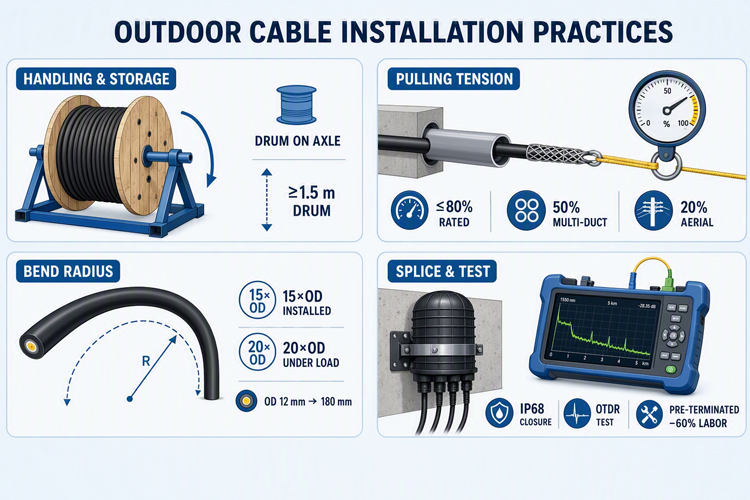 Proper installation is the single most controllable factor in preventing premature outdoor cable failure. According to BICSI’s Telecommunications Cabling Installation (4th Edition), 31% of early outdoor cable failures result from improper storage and handling alone. The following practices are aligned with IEC 60794-1-21 and industry field data.
7.1 Handling & Storage
- Store cable drums on axles — never on flat ground (prevents jacket deformation)
- Roll drums in direction of arrow marking before deployment
- Minimum drum diameter for static storage: 1.5m (reduces bend-induced attenuation)
- Temperature range for installation: typically -15°C to +60°C (check manufacturer spec; below -15°C, jacket becomes brittle)
- UV protection: install within 30 days of removing factory packaging (carbon black additive degrades with prolonged UV exposure to unpackaged cable)
7.2 Pulling Tension Control
Critical Rule: Never exceed 80% of rated short-term tensile strength during installation.
| Installation Method |
Max Pulling Tension |
Prevention Measures |
| Direct pull (straight duct) |
80% of rated tensile |
Cable lubricant, proper mesh pulling grips |
| Pull through multiple ducts |
50% of rated tensile |
Intermediate pull points at every 90° bend |
| Aerial (span installation) |
20% of rated tensile |
Hardware rated for span; sag-tension calculation |
| Mini-duct (blown fiber) |
Mechanical limit of blower |
Air-blown fiber system rated tension settings |
Formula: Max span length (aerial) = (Tensile Rating × Safety Factor) ÷ (Cable Weight + Ice/Wind Load)
7.3 Bend Radius Management
Per IEC 60794-1-21 minimum bend radius specifications:
| Condition |
GYTS / GYTA |
ADSS |
GYXTW |
| Installed (no load) |
15×OD |
15×OD |
10×OD |
| Under tensile load |
20×OD |
20×OD |
15×OD |
| At termination (no tension) |
10×OD |
10×OD |
7.5×OD |
Example: A GYTS cable with OD = 12mm has a minimum installed bend radius of 180mm. Any bend tighter than this risks permanent attenuation increase.
7.4 Splicing & Termination
Using factory-preterminated cable assemblies can reduce splicing labor by up to 60% for projects over 10km — a critical efficiency gain given the skilled labor shortage cited by Panduit as the “biggest bottleneck” in BEAD project execution. (Sources: BICSI 4th Edition; Panduit 2026 Broadband Trends)
- Splice enclosures must be rated IP68 for direct burial, NEMA 4X/6 for aerial installations
- All splices must be within enclosures — never splice in open air
- Use factory-preterminated cables for projects >10km where possible (60% splicing labor reduction)
- OTDR testing mandatory after every splice and termination point
- Document all splice locations with GPS coordinates for maintenance traceability
For projects facing tight timelines or skilled labor constraints, [factory-preterminated cable solutions] can accelerate deployment by 40-60%. Contact OPELINK for custom pre-terminated assemblies with OTDR test reports per drum.
8. Q&A: Temperature Rating and Water Protection for Outdoor Cables
Q: What Temperature Rating and Water Protection Do Outdoor Cables Need?
Temperature Ratings: For deployment in temperate climates, select cable rated -30°C to +70°C. For extreme environments — deserts, arctic regions, tropical zones — choose -40°C to +70°C or -50°C to +70°C rated cable. For the most demanding applications (e.g., Middle East desert deployments or Arctic Circle installations), G.652.D extended-temperature fiber rated -50°C to +85°C is available.
Installation Temperature vs Operating Temperature
| Parameter |
Standard Rating |
Extreme Rating |
Extended Rating |
| Operating Temperature |
-30°C to +70°C |
-40°C to +70°C |
-50°C to +85°C |
| Installation Temperature |
-15°C to +60°C |
-15°C to +60°C |
-20°C to +65°C |
| Storage Temperature |
-40°C to +70°C |
-50°C to +70°C |
-60°C to +85°C |
| Typical Application |
Temperate zones |
Desert / tropical / arctic |
Mission-critical, extreme reliability |
Critical: Installation temperature is the rating for when the cable is being handled and pulled. Below -15°C, the PE jacket becomes brittle and risk of micro-cracking during handling increases significantly. Always verify the installation temperature rating on the cable datasheet before winter deployment. If installation must proceed in cold conditions, consider pre-heating cable drums in temperature-controlled storage for 24 hours before pulling.
Water Protection Strategies: Outdoor cables use a three-layer water protection architecture:
- Gel filling — Water-blocking thixotropic gel inside buffer tubes and interstices prevents longitudinal water migration along the cable core. This is the primary and most critical water-blocking mechanism.
- Water-blocking yarn/tapes — Superabsorbent polymer (SAP) tapes and yarns that swell on contact with water, physically blocking water penetration paths. These provide redundant protection if the gel barrier is compromised.
- Metallic moisture barrier — Aluminum or steel laminate moisture barrier bonded under the outer PE jacket. This provides both radial moisture protection and additional mechanical strength (in armored variants).
For critical outdoor applications (direct burial, submarine, high-water-table areas), choose cable with both gel filling AND water-blocking yarn for redundant protection. The combination ensures water ingress does not propagate beyond a few meters, even if the outer jacket is compromised. All OPELINK outdoor cables feature dual water-blocking as standard. (Per IEC 60794-1-22 water penetration test requirements)
KEY TAKEAWAY: Never confuse operating temperature with installation temperature. The installation window is narrower and more critical — pulling cable at -20°C with a standard -15°C installation rating will cause jacket micro-cracks that propagate into early-life failures. For water protection, dual-layer (gel + SAP yarn) is the minimum standard for any direct burial or high-water-table deployment.
9. Outdoor Cable Standards & Compliance Reference
Compliance with international and regional standards is non-negotiable for outdoor cable procurement. The following standards govern outdoor fiber cable design, testing, and deployment. All OPELINK outdoor cables are manufactured in compliance with these standards and include third-party test certification (SGS, BV, or TÜV).
| Standard |
Title |
Scope |
| IEC 60793-2-50 |
Product specifications — SM fibers |
G.652, G.655, G.657 fiber specifications |
| IEC 60794-1-2 |
Mechanical test methods |
Tensile, crush, impact, torsion, bend testing |
| IEC 60794-1-21 |
Mechanical test methods — optical cables |
Comprehensive environmental test suite |
| IEC 60794-1-22 |
Environmental test methods |
Temperature cycling, water penetration testing |
| IEC 60794-4 |
Aerial optical cables |
ADSS and OPGW specific requirements |
| IEC 61753-1 |
In-service testing — general |
Performance categories and acceptance criteria |
| IEEE 1138 |
OPGW testing standard |
Power utility OPGW qualification testing |
| YD/T 769 |
Chinese standard for outdoor cables |
National equivalent for PRC market deployments |
| TIA-455 / FOTP |
Fiber optic test procedures |
U.S. equivalent mechanical and optical test methods |
When procuring outdoor cable, always request: (1) OTDR traces per drum per IEC 60793-1-40; (2) Mechanical test certificates per IEC 60794-1-2; (3) Third-party inspection reports from SGS, BV, or TÜV. OPELINK provides all three as standard with every shipment.
10. Outdoor Cable Market Outlook 2026–2032
The outdoor fiber cable market is entering a period of sustained structural growth with several key dynamics shaping procurement strategies through 2032.
Fiber Pricing & Supply Dynamics. As of March 2026, G.657A2 bend-insensitive single-mode fiber prices reached $33-35 per kilometer, reflecting a persistent supply-demand imbalance for outdoor and FTTH applications. The tight supply is driven by simultaneous BEAD project launches, 5G backhaul expansion, and AI data center fiber requirements all converging in the 2026-2028 window. Procurement teams should anticipate extended lead times (12-16 weeks for standard types, 16-24 weeks for specialized OPGW and ADSS) and factor this into project planning timelines. (Source: PW Consulting Sector Analysis, March 2026)
U.S. Tariff Impact on Supply Chains. The 2025 U.S. tariff measures have introduced new complexity to global outdoor cable supply chains. Multinational manufacturers are responding by (1) accelerating localized production capabilities in the U.S. and allied markets; (2) establishing regional distribution hubs to reduce tariff exposure; and (3) pursuing modular design principles that allow component-level regional sourcing. For U.S. buyers, this means a growing availability of domestically assembled cables but at a 15-25% premium over pre-tariff imported pricing. Contractual frameworks are evolving toward flexible pricing mechanisms and force majeure clauses tied to trade policy changes. (Source: 360iResearch, January 2026)
Technology Trends. 800G optical module deployment is accelerating in 2026, driving demand for higher-specification outdoor cables that can support longer reaches at higher data rates. Hollow-core fiber is emerging as a next-generation technology for ultra-low-latency applications, though commercialization for outdoor deployments remains 3-5 years away. Pre-terminated cable systems (“plug-and-play”) are gaining traction as a labor-shortage mitigation strategy, reducing field splicing requirements by up to 60%. (Source: Panduit 2026 Broadband Trends)
Regional Forecast 2026-2032
| Region |
2025 Value ($M) |
2032 Value ($M) |
CAGR 2026-2032 |
Key Growth Driver |
| Asia Pacific |
$4,839M |
$8,590M |
8.5% |
5G + FTTH + smart city mega-projects |
| North America |
$2,690M |
$5,080M |
9.6% |
BEAD + AI DCI + 800G deployment |
| Europe |
$2,153M |
$3,620M |
7.8% |
FTTH expansion + backbone modernization |
| Latin America |
$640M |
$1,190M |
9.3% |
Digital inclusion programs + private investment |
| Middle East & Africa |
$438M |
$870M |
10.3% |
Smart cities + submarine landing hubs |
Source: 360iResearch Global Forecast 2026-2032; PW Consulting Market Analysis 2026. CAGR estimates based on reported regional dynamics and project pipelines.
Strategic Recommendations: Procurement teams should (1) secure multi-year supply agreements with price adjustment mechanisms in the current tightening market; (2) qualify at least two regional suppliers to mitigate tariff exposure; (3) prioritize G.657.A2 bend-insensitive fiber for FTTH and DCI applications; and (4) factor 12-16 week lead times into all 2026-2027 project schedules.
Sources and References
[1] 360iResearch — Outdoor Optical Cable Market Global Forecast 2026-2032 (January 2026)
[2] PW Consulting — Worldwide Outdoor Fiber Cable Market 2026
[3] CRU (Commodity Research Unit) — Global Fiber Optic Cable Demand 2025 Actuals & 2026 Forecasts
[4] NTT Technical Review — Fiber Optic Reliability Study 2022 (10-Year Outdoor Cable Failure Analysis)
[5] BICSI — Telecommunications Cabling Installation, 4th Edition
[6] FTTH Council Asia-Pacific — 2023 Deployment Handbook
[7] IEC 60794-1-2/21/22 — Mechanical and Environmental Test Methods for Optical Fiber Cables
[8] IEC 60794-4 — Aerial Optical Cables (ADSS, OPGW Specifications)
[9] IEEE 1138 — Standard for Testing and Performance of Optical Ground Wire (OPGW)
[10] LightReading / C-FOL — BEAD Program Implementation Status Report (December 2025)
[11] Panduit / Today's Headlines — 2026 Broadband Network Future Trends Report (January 2026)
Frequently Asked Questions
Q1: What is the difference between loose-tube and tight-buffered outdoor fiber cable?
Loose-tube cable houses fibers in gel-filled buffer tubes that allow independent movement, protecting fibers from mechanical stress and moisture. It is the standard for outdoor backbone and long-haul applications (GYTS, ADSS, OPGW). Tight-buffered cable has fibers embedded in a 900μm buffer coating, making it more rigid and suitable for indoor/outdoor transition points and campus backbones where direct termination without splice enclosures is preferred. For outdoor runs beyond 2km, loose-tube is the recommended construction. See Chapter 5 for detailed comparison.
Q2: What temperature rating do I need for outdoor cable installation?
For temperate climates, select cable rated -30°C to +70°C operating, with installation temperature typically -15°C to +60°C. For extreme environments (desert, arctic, tropical), choose -40°C to +70°C or -50°C to +85°C rated cable. Critical distinction: installation temperature is narrower than operating temperature. Below -15°C, PE cable jackets become brittle and risk micro-cracking during pulling. Always verify the installation temperature rating on the datasheet before cold-weather deployment.
Q3: What water protection features do outdoor fiber cables have?
Outdoor cables use a three-layer water protection strategy: (1) Gel filling — thixotropic water-blocking gel inside buffer tubes and interstices prevents longitudinal water migration. (2) Water-blocking yarn/tapes — superabsorbent polymer materials that swell on water contact, physically blocking penetration paths. (3) Metallic moisture barrier — aluminum or steel laminate under the outer jacket for radial moisture protection. For critical applications (direct burial, submarine, high water table), dual-layer protection (gel + SAP yarn) is the minimum recommended standard.
Q4: Does direct burial require armored cable? What type?
Yes, direct burial applications require armored cable. The standard recommendation is GYTA53 — a double-sheath, steel tape armored loose-tube cable designed specifically for direct burial. The steel tape armor provides crush resistance (≥ 300N/100mm) and rodent protection, while the double PE sheath with anti-corrosion compound protects against soil chemical attack. Alternatives include GYXTW53 for smaller fiber counts (2-24F) and GYFTZY53 for environments requiring non-metallic construction. Never use non-armored cable for direct burial; the absence of mechanical protection will result in premature failure within 2-5 years in most soil conditions.
Q5: What is the difference between ADSS and OPGW, and how do I choose?
ADSS (All-Dielectric Self-Supporting) is a non-metallic aerial cable installed on existing power poles or towers without requiring the power line to be de-energized. It is the preferred choice for fiber broadband expansion using existing utility infrastructure, with installation costs 70% lower than trenching. OPGW (Optical Ground Wire) is a dual-function cable that replaces the traditional ground/earth wire at the top of transmission towers, combining lightning protection with fiber communication. Choose ADSS when (a) adding fiber to existing distribution or transmission corridors without modifying tower grounding; (b) deploying rural broadband using utility poles; (c) fiber count is the primary requirement. Choose OPGW when (a) constructing new transmission lines (110kV+); (b) replacing aging ground wires; (c) lightning protection is equally critical as communications.
Related Guides

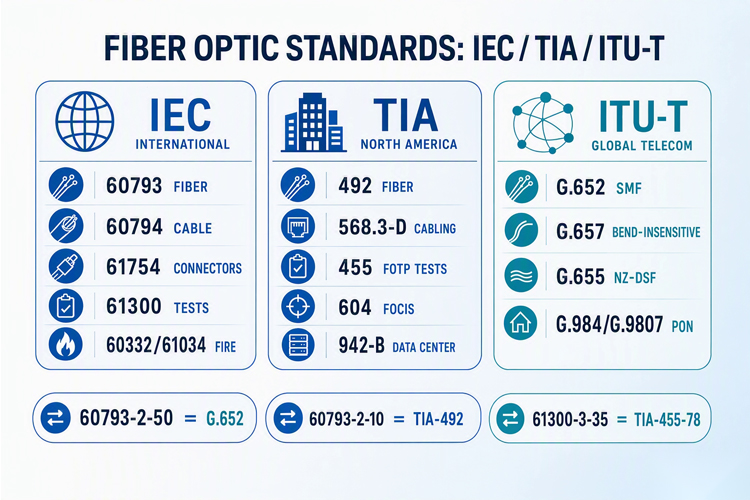 Fiber Optic Cable Standards: IEC/TIA/ITU Complete Guide
 Fiber Optic for CCTV & Security: Long-Distance Surveillance Guide
 Railway & Mass Transit Fiber Communication Systems Guide
 Oil & Gas Fiber Optic: Explosive-Proof Cabling Solutions Guide


