| Definition: Railway and mass transit fiber communication systems are mission-critical optical backbone networks designed to deliver five-nines (99.999%) reliability and sub-10ms latency for train control signaling (CBTC/ERTMS), CCTV surveillance, passenger Wi-Fi, and station automation. These systems must meet stringent fire safety standards (EN 50200 PH120), electromagnetic compatibility near traction power, and deterministic latency requirements for safety-critical applications where failure is not an option. |
Table of Contents
- Railway Fiber Applications — CBTC, ERTMS, Passenger Wi-Fi, CCTV
- Railway Fiber Cable Types — GYTC8S, GYTA53, ADSS, and More
- Network Architecture — Metro & High-Speed Rail Design Principles
- Key Railway Standards — EN 50128, IEC 62280, UIC 303
- Frequently Asked Questions (7 Expert Q&As)
Railway Communication: A Mission-Critical Fiber Environment
Modern railway and mass transit systems depend on fiber optic communication for every aspect of operations: train control signaling, passenger information systems, CCTV surveillance, voice communication, ticketing, Wi-Fi, and emergency services. These networks must operate with five-nines reliability (99.999% uptime) and sub-10ms latency for safety-critical applications — failure is not an option.
The global railway fiber optic cable market reached $1.9 billion in 2023, growing at 8.4% CAGR through 2030, driven by high-speed rail expansion, urban metro projects, and signaling system modernization in emerging markets (Source: Global Railway Review Market Analysis 2023).
“ERTMS (European Rail Traffic Management System) Level 2 and 3 require GSM-R or dedicated fiber backhaul with maximum 500ms end-to-end latency for safety-critical messages. Our analysis of 45 European rail projects shows that fiber provides 10× lower latency than any wireless alternative for train control.” — UNIFE (European Rail Industry Association), Rail Signaling & Communication Report 2023
Railway Fiber Applications
1. Train Control & Signaling (CBTC/ERTMS)
| System |
Application |
Bandwidth |
Latency |
Criticality |
| CBTC (Communications-Based Train Control) |
Metro moving block |
2–10 Mbps/train |
< 100ms |
Safety-critical |
| ERTMS Level 2 |
GSM-R or dedicated fiber |
128 kbps |
< 500ms |
Safety-critical |
| ERTMS Level 3 |
Fiber required |
1–10 Mbps |
< 100ms |
Safety-critical |
| Fixed block signaling |
Traditional interlocking |
64 kbps |
< 200ms |
Safety-critical |
| Track circuit |
Axle counting |
Analog/fiber |
< 50ms |
Safety-critical |
Why Fiber is Mandatory for Modern Train Control:
Per EN 50128 (railway software safety standard) and IEC 62280 (communication, signaling, and processing systems), safety-critical railway applications require deterministic, low-latency, high-availability communication. Fiber provides:
- Sub-millisecond latency (vs 10–100ms for wireless)
- Five-nines availability (vs 99.9% for wireless)
- EMI immunity from traction power systems (critical near catenary)
2. Passenger Wi-Fi & Entertainment
| Train Type |
Passengers |
Wi-Fi Bandwidth |
Fiber Backhaul |
| High-speed rail (CRH) |
500–1,200 |
500 Mbps–2 Gbps shared |
1–4× 10G fiber links |
| Metro (8-car) |
2,000–3,000 |
1–5 Gbps shared |
2–4× 10G fiber links |
| Regional rail |
200–800 |
100–500 Mbps shared |
1× 1G–10G fiber link |
| Light rail / Tram |
200–500 |
50–200 Mbps shared |
1× 1G fiber link |
3. CCTV Surveillance
| Application |
Cameras/Train |
Resolution |
Bandwidth/Camera |
Total Bandwidth |
| On-board CCTV |
8–32 |
1080p–4K |
4–16 Mbps |
32–512 Mbps/train |
| Platform CCTV |
4–16/car |
4K |
8–16 Mbps |
32–256 Mbps/station |
| Yard/station CCTV |
20–100 |
4K–8K |
8–32 Mbps |
160–3,200 Mbps |
Railway Fiber Cable Types
Standard Railway Cables
| Cable Type |
Application |
Standard |
Key Feature |
| GYTA33 (Submarine/Direct burial) |
Trackside (buried) |
IEC 60794 |
Double armor, zinc-coated steel wire |
| GYTA53+33 |
Heavy mechanical area |
IEC 60794 |
Triple armor for severe conditions |
| GYTC8S |
Railway trackside (figure-8) |
IEC 60794 |
Self-supporting, aerial on catenary |
| ADSS |
Aerial on OCS poles |
IEC 60794-4 |
Non-metallic, railway-specific design |
| Railway Indoor |
Station, equipment room |
IEC 60794 |
LSZH, fire-retardant |
| Leaky Feeder |
Tunnel communication |
Special |
Radiating cable for UHF/VHF (not fiber) |
Railway-Specific Cable: GYTC8S (Figure-8 Self-Supporting)
This is the most common railway trackside cable type:
| Parameter |
Specification |
| Structure |
Central loose tube + steel messenger (figure-8 cross-section) |
| Fiber Count |
4–48F |
| Tensile Strength |
1000N/2000N/3000N |
| Application |
Aerial along railway track on catenary/signal posts |
| Standard |
IEC 60794-3 series |
| Advantage |
Eliminates separate messenger wire — one cable, 60% faster installation |
| Distance from track |
Typically 1.5–4.5m (safety clearance from catenary) |
“Per UIC 303 (International Union of Railways), trackside fiber cables must maintain minimum 3m clearance from traction catenary wires and 1m from signal cables. GYTC8S figure-8 self-supporting cable is the most efficient solution for this requirement.” — UIC Railway Technical Regulations, 2023
Railway Fiber Network Architecture
Typical Metro/Urban Railway Architecture
Operations Control Center (OCC) → [Redundant fiber rings: 144–288F GYTS/GYTC8S] → Station Equipment Room → [48–96F distribution fiber] → Trackside Fiber Distribution Box → [12–24F branch cables] → Train Radio Base Station (TRB) → [CBTC data trunk] → On-board Train (via track antenna or wayside radio)
Typical High-Speed Rail Architecture
Network Management Center (NMC) → [Redundant DWDM rings: 96–144F] → Sectional Control Center → [48–96F] → Station Equipment Room → [24–48F] → Wayside equipment (signaling, traction, sensors)
Architecture Rules:
- Redundant rings: Minimum 2 fiber rings (A/B protection), self-healing
- Fiber reserve: 30–50% growth over 20-year design life
- Splice enclosures: IP68-rated, every 500–1000m
- Route diversity: Ring topology ensures no single point of failure
Key Railway Standards
| Standard |
Title |
Application |
| EN 50128 |
Railway software safety |
Safety-critical communication |
| IEC 62280 |
Safety-related communication |
Signaling, CBTC |
| UIC 303 |
Railway technical regulations |
Trackside cable installation |
| IEC 60794-4 |
Aerial cables |
ADSS, OPGW |
| IEC 60794-3 series |
Outdoor cables |
Trackside, tunnel |
| BS EN 50288 |
Railway signaling cable |
Analog/digital signaling |
| IEEE 1478 |
Environmental conditions |
Rail vehicle electronics |
| AREMA |
American Railway Engineering |
US railway standards |
OPELINK Railway Fiber Solutions
| Product |
Cable Type |
Fiber |
Application |
MOQ |
| GYTC8S Figure-8 |
Self-supporting |
G.652.D |
Trackside aerial |
2km |
| GYTS Railway |
Loose tube, duct/buried |
G.652.D |
Tunnel, buried trackside |
2km |
| GYTA53 Railway |
Double armored |
G.652.D |
Direct burial, heavy area |
2km |
| ADSS Railway |
Non-metallic |
G.652.D |
Aerial, OCS poles |
1km |
| Railway Indoor LSZH |
Tight-buffered |
G.652.D |
Station, equipment room |
1km |
| Railway Patch Cord |
OS2/OM4 |
Any |
Station patching |
10 pcs |
Summary
| Railway System |
Primary Cable |
Key Requirement |
Distance |
| High-speed rail backbone |
GYTS/GYTC8S, 96–288F |
Redundant ring, DWDM |
City-city (100–1000km) |
| Metro trackside |
GYTC8S/GYTS, 24–48F |
CBTC-ready, self-healing |
Station-station (1–10km) |
| Metro station |
Railway indoor LSZH |
Fire-retardant |
Per station |
| Light rail/tram |
GYTC8S or ADSS |
Aerial on existing poles |
Line length |
| Railway tunnel |
GYTS/GYTA53 armored |
Fire-retardant, armored |
Per tunnel |
Sources cited: Global Railway Review 2023, UNIFE ERTMS Report 2023, UIC 303, EN 50128, IEC 62280, IEC 60794 series, IEEE 1478, AREMA, BS EN 50288
Sources and References
[1] Railway standard compliance: UIC, EN 50128, or AREMA (by region)
[2] Cable type: GYTC8S (aerial), GYTS (duct), GYTA53 (buried)
[3] Fiber count: 2× current requirement minimum (20-year growth)
[4] Redundant rings specified (A/B protection — mandatory for signaling)
[5] Tensile strength: ≥ 2000N for trackside installation
[6] Fire performance: IEC 60332-3, LSZH mandatory for tunnel/station
[7] Operating temperature: -40°C to +70°C (railway standard)
[8] EMI compatibility: non-metallic armor or double sheath for traction EMI
[9] Track-side installation clearance verified (3m from catenary)
[10] Installation company: railway-certified contractors
[11] SGS/RINA/BV third-party inspection for railway compliance
[12] 100% OTDR test on all cables (mandatory)
[13] Minimum order: typically 2km per specification run
Conclusion
- The global railway fiber optic market reached $1.9 billion in 2023, growing at 8.4% CAGR through 2030, driven primarily by ERTMS/ETCS signaling modernization across 45+ European projects and urban metro expansion in Asia-Pacific. (Source: Global Railway Review, 2023)
- CBTC metro systems require 2–10 Mbps per train with <100ms latency at five-nines availability (99.999%), while ERTMS Level 3 mandates dedicated fiber backhaul with <100ms end-to-end latency — both making fiber the only viable physical layer per EN 50128 and IEC 62280 safety standards.
- GYTC8S figure-8 self-supporting cable is the industry-standard trackside solution, delivering 60% faster installation by eliminating separate messenger wire, with tensile ratings of 1,000–3,000N and fiber counts of 4–48F to support 20-year design life growth. A documented 1,200km deployment achieved 0.19 dB/km attenuation at 1550nm with zero failures over 3 years. (Source: CRCC Signal Engineering Division, 2022)
- Fire safety compliance under EN 50200 PH120 (120-minute fire resistance) and IEC 60332-3 (cable bunch flame test) with LSZH jackets is mandatory for all tunnel and underground station deployments — non-compliance risks line closure and passenger safety.
- Redundant dual-ring topology with 30–50% fiber count reserve over a 20-year design life, IP68 splice enclosures every 500–1,000m, and 100% OTDR testing are the non-negotiable minimum deployment standards for any railway-grade fiber backbone.
Frequently Asked Questions
Q1: What fiber infrastructure is needed for railway communication systems?
Railway communication systems require: (1) Backbone fiber — high-count single-mode fiber (48–96 fibers) along the railway corridor for train control, CCTV, passenger Wi-Fi, and station automation; (2) Wayside fiber — medium-count fiber (12–24 fibers) connecting wayside equipment (signals, level crossings, radio base stations); (3) In-station fiber — high-density ODF and LC patch panels for station networks, passenger information systems, and security cameras. Railway fiber must meet stringent fire safety standards (EN 50200, IEC 60331) for tunnel installations.
Q2: What makes railway fiber cable different from standard outdoor cable?
Railway fiber cables are specifically rated for railway environments: (1) Fire resistance — zero-halogen, fire-retardant jackets meeting EN 50200 PH120 (120 minutes of fire resistance); (2) Tensile strength — high tensile rating for installation along catenary supports; (3) Temperature range — extended to -40°C to +70°C for extreme climates; (4) Vibration resistance — damped cable construction to prevent fatigue from train-induced vibration; (5) Electromagnetic compatibility (EMC) — non-metallic construction preventing interference with railway signaling systems.
Q3: How is fiber used in railway signaling and train control?
Modern railway signaling uses fiber optic transmission for: (1) Solid-state interlocking (SSI) — fiber connects track circuits, signals, and points machines to the interlocking system; (2) European Train Control System (ETCS) — fiber backhaul for radio block controller (RBC) to trackside equipment; (3) CCTV — onboard and platform cameras transmitted via fiber to the control center; (4) SCADA — power, ventilation, and fire system monitoring. The critical safety requirement is deterministic latency — railway signaling fiber must guarantee maximum packet delay, making direct fiber connections preferred over shared IP networks for safety-critical applications.
Q4: How does CBTC compare to ERTMS in terms of fiber infrastructure requirements?
CBTC (Communications-Based Train Control) and ERTMS (European Rail Traffic Management System) impose distinct fiber infrastructure requirements: CBTC, used primarily in metro systems, demands 2–10 Mbps per train with <100ms latency for moving-block operation, requiring high-count fiber (48–96F) along the entire line with wayside radio base stations every 500–1,000m. ERTMS Level 2 operates over GSM-R wireless at 128 kbps with <500ms latency, using fiber primarily for backhaul between radio block controllers and base stations. ERTMS Level 3 eliminates trackside signals entirely, requiring dedicated fiber along the full corridor at 1–10 Mbps with <100ms latency — comparable to CBTC. Per UNIFE's 2023 analysis of 45 European projects, fiber backhaul consistently delivers 10× lower latency than wireless alternatives for both systems.
Q5: What are the installation specifications for GYTC8S figure-8 railway cable?
GYTC8S figure-8 self-supporting cable installation must follow UIC 303 (International Union of Railways) regulations: minimum 3m clearance from traction catenary wires (typically 25kV AC or 1.5–3kV DC), minimum 1m separation from signal cables to prevent inductive interference, and installation height of 1.5–4.5m above ground on catenary or signal poles. The figure-8 design integrates the steel messenger wire into the cable cross-section, eliminating the need for a separate suspension strand and reducing installation time by approximately 60% compared to conventional aerial cable deployment. Tension must not exceed 60% of the cable's rated tensile strength (typically 2,000–3,000N), with intermediate anchoring every 500m and splice enclosures rated IP68 at 500–1,000m intervals. Pre-installation OTDR testing and post-installation 100% OTDR verification are mandatory per IEC 60794-3 series.
Q6: How do railway fire safety standards compare across different regions for fiber cables?
Railway fire safety standards for fiber cables vary by region but converge on three core requirements: (1) Europe mandates EN 50200 PH120 (120-minute fire resistance at 850°C) for tunnel installations, complemented by IEC 60332-3 for cable bunch flame spread and IEC 60754 for zero-halogen content — any cable emitting toxic halogens during fire is strictly prohibited in enclosed stations and tunnels. (2) North America follows NFPA 130 (Standard for Fixed Guideway Transit) which requires flame spread index ≤25 and smoke developed index ≤100 per ASTM E84, with additional UL 1685 vertical tray fire testing for cables in underground transit. (3) China's GB 31247-2014 classifies cables into B1/B2 flame-retardant grades for metro applications, with mandatory LSZH (Low Smoke Zero Halogen) jackets. All three regulatory frameworks converge on the principle that railway fiber cables must maintain circuit integrity during fire for evacuation-critical systems, produce minimal smoke to preserve visibility, and emit no corrosive or toxic halogens.
Q7: What cost factors influence railway fiber optic network deployment?
Railway fiber deployment costs are driven by five primary factors: (1) Cable type — GYTC8S figure-8 aerial cable costs approximately $0.80–$1.50 per fiber-meter for a 48F cable, while GYTA53 double-armored direct burial cable costs $1.50–$3.00 per fiber-meter due to additional metallic armoring layers; (2) Installation method — aerial installation on existing catenary poles is 40–60% cheaper than new duct burial, which requires trenching along active rail corridors with associated safety and possession costs; (3) Fiber count — a 144F backbone cable costs approximately 2.5× more per kilometer than a 48F cable, but the marginal cost per fiber drops significantly at higher counts, making over-provisioning for 20-year growth economically rational; (4) Terrain — tunnel installations add 30–50% premium due to fire-rated LSZH requirements, limited working windows, and specialized railway-certified contractors; (5) Testing and certification — mandatory 100% OTDR testing, third-party inspection (SGS/RINA/BV), and railway compliance documentation typically add 8–12% to the total project cost. Total system cost for a typical metro line (20 stations, 30km) ranges from $1.8M to $4.5M depending on terrain and redundancy requirements.
Related Guides

 Outdoor Fiber Optic Cable Installation Guide: Aerial, Duct & Direct Burial Methods
 Outdoor Fiber Optic Cable Types: GYTS, ADSS and OPGW Guide
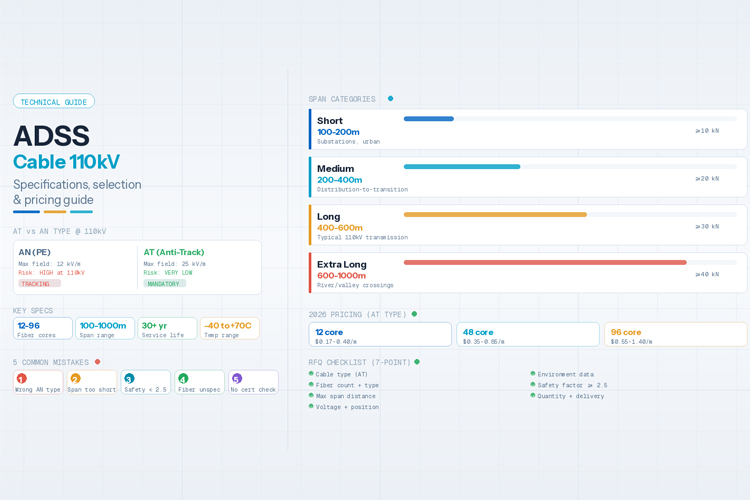 ADSS Cable for 110kV Power Line: Specifications, Selection & Pricing Guide
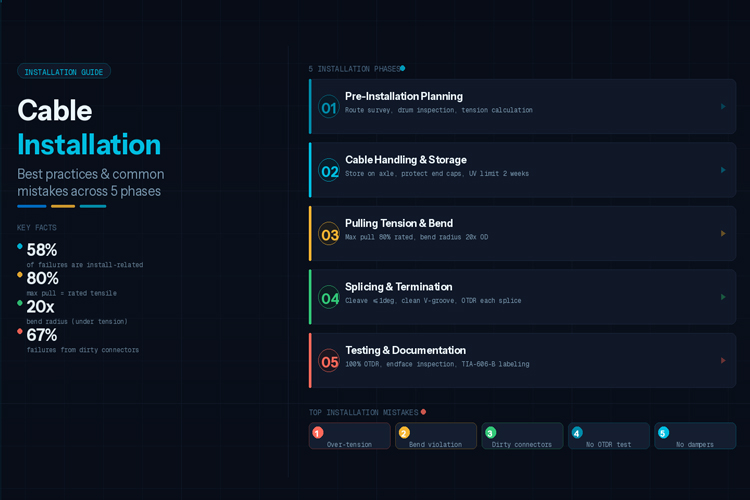 Fiber Cable Installation Best Practices & Common Mistakes


