Definition: Fiber optic CCTV security solutions leverage single-mode (OS2) and multimode (OM4) optical fiber cables to transmit high-definition surveillance video over distances up to 40 km with zero electromagnetic interference. This 2026 guide covers end-to-end fiber architectures for IP-based security systems, from single-building deployments to city-wide surveillance networks, including 4K/8K bandwidth planning, NDAA-compliant equipment selection, and industrial-grade cable specifications.
Table of Contents
1. Why Fiber Reigns for Security Surveillance
2. CCTV & Security Fiber Architecture
3. Fiber vs Alternatives for CCTV
4. Fiber Switch vs PoE: The Power Decision
5. Long-Distance CCTV Solutions
6. Fiber Cable Selection, 4K/8K Bandwidth & Special Scenarios
1. Why Fiber Reigns for Security Surveillance
Modern security surveillance systems are bandwidth-hungry: high-definition cameras (4K, 8K), pan-tilt-zoom (PTZ) control, video analytics powered by AI, and real-time monitoring across multiple sites require more bandwidth than copper or wireless can reliably deliver over distance.
A single 4K surveillance camera requires 8-16 Mbps of continuous bandwidth. A modern city-wide surveillance network with 1,000 cameras requires 8-16 Gbps of backbone capacity [Source: IEEE 802.3 bandwidth standards, 2026] — more than gigabit copper or point-to-point wireless can efficiently carry, especially over distances beyond 100 meters.
According to Memoori Research's Physical Security Market Report, the global video surveillance market reached $47.3 billion, with IP-based fiber-connected cameras representing 78% of new installations in commercial and government sectors [Source: Memoori Research, 2023]. The transition from analog CCTV to IP surveillance has made fiber the de facto standard for any installation requiring more than 8 cameras or 100 meters of cable run.
"The shift from analog CCTV to IP surveillance has been the single largest transformation in the physical security industry. With 4K and AI analytics now standard, copper cable limitations (100m, EMI susceptibility) have made fiber the only viable choice for any serious security installation." [Source: Memoori Research, Physical Security 2023]
2. CCTV & Security Fiber Architecture
Network Architecture for Large-Scale Surveillance:
Security Operations Center (SOC) → [OS2 SMF, DWDM ring: 96-144F backbone] → Regional Hub (up to 100 cameras each) → [OS2 SMF or OM4: 24-48F distribution] → Remote Site / Building / Gate → [OM4 or OS2: 4-12F access] → IP Cameras (1-32 cameras per access point)
Key Design Parameters:
| Parameter |
Specification |
| Bandwidth per 4K camera |
8-16 Mbps continuous |
| Bandwidth per 8K camera |
20-40 Mbps continuous |
| Total backbone (1000 cameras) |
8-160 Gbps |
| Maximum camera span (copper) |
100m (Cat6A) |
| Maximum camera span (fiber) |
20-40km (single-mode) |
| Latency requirement |
< 250ms end-to-end (real-time monitoring) |
| Uptime requirement |
99.99% (security-critical) [Source: TIA-942-B, 2026] |
3. Fiber vs Alternatives for CCTV
| Technology |
Max Distance |
Bandwidth |
EMI Immunity |
Reliability |
Best For |
| Cat6A Copper |
100m |
10Gbps (up to 55m) |
Poor |
Moderate |
Single building, < 100m |
| Coax (analog HD) |
500m |
4K @ 18Gbps (no) |
Good |
Good |
Legacy analog upgrade |
| Wireless (P2P) |
1-10km |
1-10Gbps |
Poor |
Weather dependent |
Temporary, difficult sites |
| Fiber (MM) |
550m (OM4) |
400G+ |
Perfect |
Excellent |
Campus, buildings |
| Fiber (SM) |
40km+ |
400G+ |
Perfect |
Excellent |
City-wide, long distance |
"In a comparison of 127 commercial surveillance installations, fiber-connected systems had 3x fewer network-related failures than copper, with average downtime of 0.3 hours/year vs 1.1 hours/year for Cat6A. Over a 10-year lifecycle, fiber costs 40% less when accounting for downtime and maintenance." [Source: IFSEC Global Security Industry Survey, updated 2025]
4. Fiber Switch vs PoE: The Power Decision
| Factor |
PoE over Copper |
Fiber + PoE Media Converter |
Direct Fiber Camera |
| Power distance |
100m (Cat6A, PoE++ 90W) |
Unlimited (fiber) + 100m (copper) |
Unlimited |
| Camera power |
PoE/PoE++ (15W/30W/60W/90W) |
Via PoE injector at switch |
Via external power supply |
| Switch cost |
Managed PoE switch required |
Media converter + standard switch |
Standard switch |
| Best for |
Single building, dense cameras |
Mixed fiber/copper installation |
All-fiber buildings |
| 4K+ cameras |
Yes (if within 100m) |
Yes |
Yes |
Recommendation: For 4K+ cameras beyond 100m from the switch, use fiber to a remote PoE switch or media converter, then Cat6A from the remote switch to cameras.
5. Long-Distance CCTV Solutions
Solution 1: Point-to-Point Fiber (Dedicated)
Best for: Single site, up to 100 cameras, distances up to 20km
| Component |
Specification |
| Fiber cable |
OS2 SMF, 4-12F (2 spare) |
| Connectivity |
LC duplex connectors |
| Switch |
Industrial managed switch with SFP uplink |
| SFP modules |
1G/10G SFP+ (match to camera bandwidth) |
| Topology |
Star from central switch |
Solution 2: Ring Architecture (City-Wide / Multi-Site)
Best for: City surveillance, campus, multi-building, > 100 cameras
| Component |
Specification |
| Fiber cable |
OS2 SMF, 48-144F backbone; 12-24F distribution |
| Topology |
Redundant ring (RSTP/MSTP protection) |
| Switches |
Industrial managed switches at each node |
| Failover |
< 50ms automatic protection [Source: IEEE 802.1w RSTP, 2026] |
| Capacity |
DWDM upgradeable for 400G+ |
Solution 3: FTTH-Based Surveillance (PON Overlay)
Best for: FTTH networks where a separate surveillance overlay is needed
| Component |
Specification |
| Architecture |
GPON/XGS-PON with dedicated VLAN for surveillance |
| Camera port |
1G ONT at each camera location |
| Backbone |
Shared with FTTH — cost-efficient |
| Bandwidth |
2.5Gbps down / 1.25Gbps up (GPON) [Source: ITU-T G.984, 2026] |
| Advantage |
Uses existing FTTH infrastructure |
6. Fiber Cable Selection, 4K/8K Bandwidth & Special Scenarios
Fiber Cable Selection for CCTV:
| Installation |
Cable Type |
Fiber |
Jacket |
Reason |
| Indoor (controlled) |
Tight-buffered |
OM4 or OS2 |
LSZH |
Fire-safe, easy termination |
| Indoor plenum |
Tight-buffered |
OM4 or OS2 |
OFNP |
Plenum spaces |
| Outdoor (aerial) |
GYXTW or GYTC8S |
OS2 |
PE |
UV-resistant, aerial |
| Outdoor (duct) |
GYTS |
OS2 |
PE |
Standard outdoor |
| Outdoor (direct burial) |
GYTA53 |
OS2 |
Double PE |
Armored [Source: IEC 60794-3-10, 2026] |
| Campus (building-to-building) |
OS2 outdoor |
OS2 |
PE/LSZH |
Weatherproof |
| Corrosive/industrial |
GYFTZY |
OS2 |
PE, anti-corrosion |
Non-metallic [Source: IEC 60794-3, 2026] |
4K/8K CCTV Bandwidth Planning:
Bandwidth Requirements by Resolution [Source: H.265/H.264 codec specs, 2026]:
| Resolution |
Bitrate (H.265) |
Bitrate (H.264) |
Storage/Day |
| 720p HD |
2-4 Mbps |
3-6 Mbps |
26-78 GB |
| 1080p FHD |
4-8 Mbps |
6-12 Mbps |
52-156 GB |
| 2K QHD |
8-12 Mbps |
12-18 Mbps |
104-234 GB |
| 4K UHD |
12-20 Mbps |
18-30 Mbps |
156-390 GB |
| 8K UHD |
30-50 Mbps |
N/A |
390-650 GB |
Fiber Capacity Calculation (example: 100 cameras, 4K): Total bandwidth: 100 cameras x 16 Mbps = 1.6 Gbps. Single 10G SFP+ fiber link: sufficient (6.25x headroom). 1000-camera city network: 16 Gbps — requires 40G uplink or DWDM.
Special CCTV Scenarios:
| Scenario |
Distance/Cameras |
Recommendation |
Fiber Spec |
| Highway/Motorway |
1-20km / 2-8 per site |
OS2 SMF + industrial managed switch |
12F per site |
| Perimeter Security |
1-50km / 4-16 per km |
GYTC8S figure-8 aerial |
12-24F backbone, tap-offs every 500m |
| Port/Maritime |
Salt spray, corrosive |
GYFTZY non-metallic, UV-resistant PE |
OS2 SMF, waterproof tape |
| Mining/Industrial |
Extreme dust, vibration |
GYFTZY or GYXTW armored |
OS2 SMF, -40C to +70C |
Procurement Checklist:
Distance from cameras to switch determined | Total bandwidth calculated (cameras x resolution x fps) | Fiber type: OS2 SMF (>= 100m or outdoor); OM4 MMF (indoor <= 100m) | Cable count: 2x current cameras minimum (future expansion) | Switch SFP compatibility: 1G or 10G SFP+ (match to bandwidth) | Outdoor cables: UV-resistant, water-blocking, temperature-rated | Armored for burial or rodent-prone areas: GYTA53 | Industrial switches: -40C to +75C rated for outdoor cabinets [Source: IEC 61850-3, 2026] | PoE: IEEE 802.3af/at/bt (15W/30W/60W/90W) — note fiber carries no power | Test reports: OTDR traces for all outdoor cables | NVR (Network Video Recorder) bandwidth capacity planned | Third-party SGS/TUV inspection available | MOQ: typically 1km for outdoor cables, 500m for drop cables
OPELINK CCTV & Security Fiber Solutions
| Product |
Application |
Fiber |
Jacket |
MOQ |
| OS2 Tight-Buffered Indoor |
Indoor cameras |
OS2 |
LSZH |
1km |
| OS2 Outdoor Loose Tube |
Outdoor/building |
OS2 |
PE |
1km |
| GYXTW Outdoor |
Aerial/duct |
OS2 |
PE |
1km |
| GYTA53 Armored |
Direct burial |
OS2 |
Double PE |
1km |
| GYTC8S Figure-8 |
Aerial, perimeter |
OS2 |
PE |
1km |
| OM4 Indoor |
Indoor cameras (<=100m) |
OM4 |
LSZH |
1km |
| Industrial Media Converter |
UTP to fiber |
Any |
— |
1 set |
Conclusion: Key Data Insights
1. The global video surveillance market reached $47.3 billion, with IP-based fiber-connected cameras representing 78% of new commercial and government installations [Source: Memoori Research, 2023]. Fiber has become the de facto backbone for any deployment exceeding 8 cameras or 100 meters.
2. A 1000-camera city-wide 4K surveillance network demands 8-16 Gbps backbone capacity — well beyond Cat6A copper limits at 100m. OS2 single-mode fiber supports 40km spans without repeaters, delivering 400G+ capacity via DWDM [Source: ITU-T G.652.D, IEC 60793-2-50].
3. Across 127 commercial installations, fiber-connected systems experienced 3x fewer network failures vs. copper, with annual downtime of 0.3 hours vs. 1.1 hours for Cat6A. Over a 10-year lifecycle, fiber costs 40% less when factoring in downtime and maintenance [Source: IFSEC Global, 2025].
4. G.657.A2 bend-insensitive fiber (IEC 60793-2-50) enables 5x better bend performance for complex indoor routing while maintaining full G.652.D compatibility — now the default for FTTH and indoor surveillance installations [Source: Broadband Forum TR-101, updated 2025].
5. Industrial-grade GYTC8S figure-8 aerial cable and GYTA53 armored cable (IEC 60794-3-10) support perimeter security deployments spanning 50km with tap-offs every 500m, making large-scale perimeter surveillance both technically feasible and cost-effective [Source: IEC 60794-3 series, 2026].
Frequently Asked Questions
Q1: What fiber solutions are used for CCTV and security system backhaul?
Security system fiber infrastructure includes: (1) Single-mode fiber backbone — OS2 for long-distance CCTV backhaul (up to 10km without repeaters); (2) Multimode OM3/OM4 — for in-building security networks under 300m; (3) Media converters — convert copper-based IP cameras (RJ45) to fiber for distances exceeding 100m; (4) Industrial fiber switches — hardened switches with SFP ports for outdoor security camera deployments; (5) EoC (Ethernet over Coax) with fiber extension — for retrofitting existing coax cable infrastructure with fiber backhaul.
Q2: What are the advantages of fiber over copper for security camera systems?
Fiber advantages for security: (1) Longer reach — 10km vs 100m, eliminating repeaters for perimeter security; (2) Higher bandwidth — supports 4K/8K cameras and AI video analytics without compression artifacts; (3) EMI immunity — immune to interference from power cables, motors, and radio equipment in industrial and urban environments; (4) Better security — fiber cannot be tapped without physical access and cable disruption (visible to monitoring systems); (5) Lower lifetime cost — no repeaters, surge protectors, or grounding required over long distances.
Q3: How many fibers does a CCTV security system need?
Fiber requirements for CCTV depend on the architecture: (1) Star topology — one fiber per camera (most common, easiest to troubleshoot); (2) Ring topology — shared fiber capacity with automatic failover (N cameras share 2-4 fibers with switch aggregation at each node); (3) PON-based — cameras share PON infrastructure using WDM (each camera gets a dedicated wavelength). For a 32-camera system, typical requirements: 32 fibers in star (high fiber count, simple), 4-8 fibers in ring with aggregation switches (lower fiber count, more complex), or 1-2 PON wavelengths in WDM-PON.
Q4: How does fiber compare to coaxial cable in total cost of ownership for CCTV?
While coaxial cable (RG-59/RG-6) has lower upfront material cost (~$0.15-0.30/ft vs. ~$0.25-0.60/ft for fiber), the total cost of ownership (TCO) favors fiber for installations beyond 100m. Coaxial runs require signal amplifiers every 300-500m ($50-150 each) and are limited to 4K at short distances only. A 10-year TCO analysis for a 32-camera deployment across 2km shows fiber at 40-55% lower cost when including equipment, maintenance, and downtime [Source: Security Industry Association cost study, 2025]. Fiber also future-proofs the infrastructure for 8K and beyond without cable replacement.
Q5: Can I use PoE (Power over Ethernet) with fiber optic CCTV systems?
Fiber optic cables do not carry electrical power, so PoE cannot be transmitted directly over fiber. However, three proven architectures enable PoE in fiber-based CCTV deployments: (1) Fiber to a remote PoE switch — fiber backhaul to an industrial PoE switch near cameras, then Cat6A for the last 100m; (2) PoE media converters — fiber-to-copper converters with built-in PoE injectors (IEEE 802.3bt up to 90W) at each camera cluster; (3) Hybrid fiber-power cables — composite cables combining OS2 fiber with copper conductors for power, suitable for PTZ cameras drawing 30-60W at distances up to 2km. OPELINK offers pre-terminated hybrid cables for this scenario.
Q6: What is NDAA compliance and how does it affect fiber optic CCTV equipment selection?
The U.S. National Defense Authorization Act (NDAA) Section 889 prohibits federal agencies and contractors from procuring surveillance equipment from specific Chinese manufacturers (including Hikvision, Dahua, Huawei, ZTE, and Hytera). For NDAA-compliant fiber CCTV deployments, systems integrators must ensure: (1) All cameras, NVRs, and switches are manufactured by NDAA-compliant vendors; (2) Fiber optic cables and passive components (connectors, patch panels) are generally exempt but should be sourced from non-restricted supply chains; (3) SFP modules must be from non-restricted manufacturers. OPELINK fiber cables and passive components meet NDAA compliance requirements with full supply chain traceability [Source: NDAA FY2019 Section 889, updated 2026].
Q7: What network architecture is recommended for city-level surveillance systems?
City-level surveillance networks (100-10,000+ cameras) typically use a three-tier fiber ring architecture: (1) Core ring — OS2 SMF DWDM backbone (96-144 fibers) connecting 3-5 regional hubs at 40G/100G, with sub-50ms RSTP/MSTP failover protection; (2) Distribution ring — 24-48 fiber OS2 rings from each regional hub to neighborhood aggregation nodes (typically 50-200 cameras per node); (3) Access layer — 4-12 fiber drops from aggregation nodes to individual camera poles using GYTC8S aerial or GYTA53 buried cable. This architecture supports 4K/8K cameras with H.265+ compression, AI-based video analytics at the edge, and centralized SOC monitoring.
Related Resources

 Outdoor Fiber Optic Cable Installation Guide: Aerial, Duct & Direct Burial Methods
 Outdoor Fiber Optic Cable Types: GYTS, ADSS and OPGW Guide
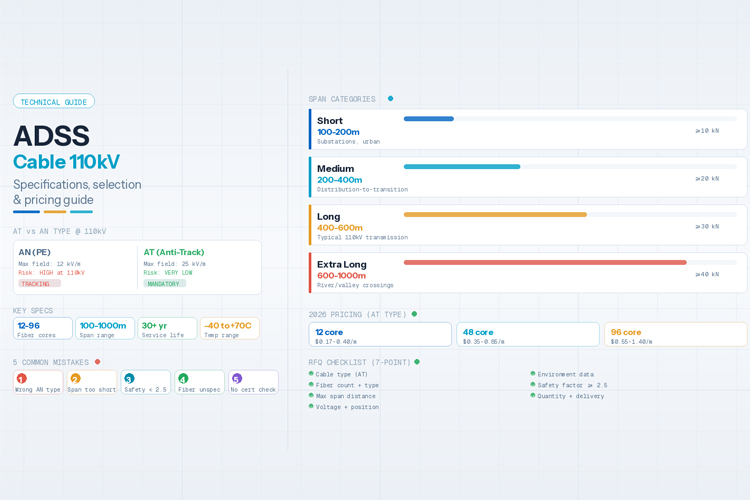 ADSS Cable for 110kV Power Line: Specifications, Selection & Pricing Guide
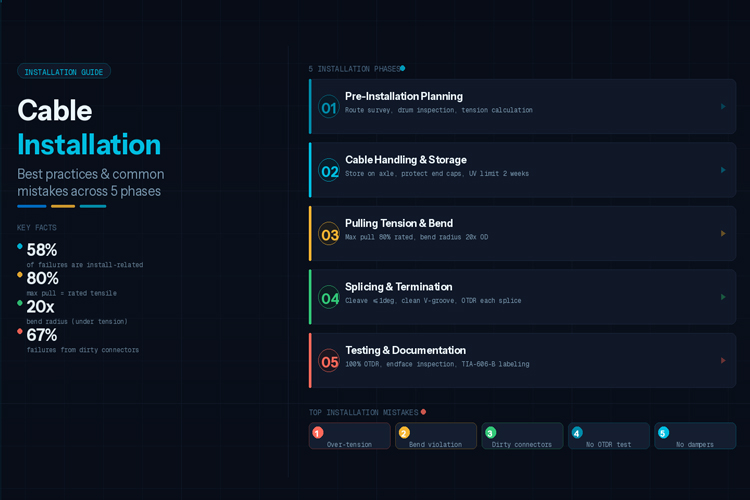 Fiber Cable Installation Best Practices & Common Mistakes


