Product Overview
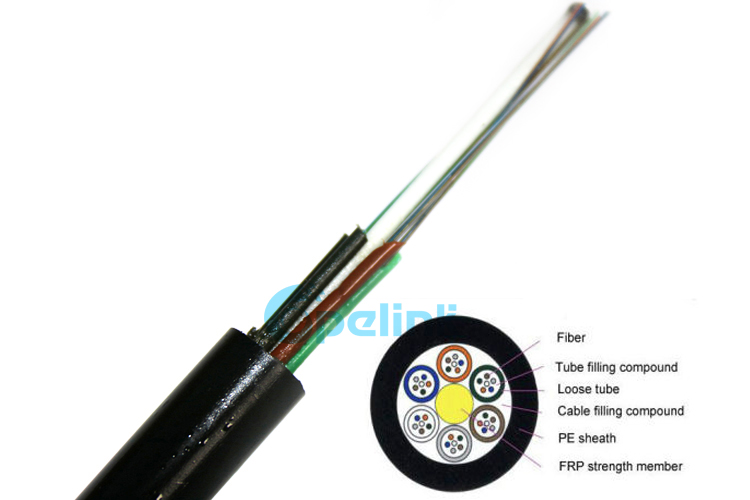
GYFTY is an all-dielectric (fully non-metallic) outdoor fiber optic cable with a central FRP (Fiber Reinforced Plastic) strength member, SZ-stranded loose tubes, and PE outer sheath. It is designed for aerial and duct installation in environments with high electromagnetic field strength, near power transmission lines, and in areas with frequent lightning activity.
The all-dielectric construction eliminates the need for grounding and provides immunity to electromagnetic interference and lightning strikes. With 2 to 144 fiber cores available, GYFTY is suitable for access networks, local area networks, long-distance communication, and power system communication where metallic cables would be unsafe or unreliable.
Key Features
- All-dielectric construction: FRP central strength member and non-metallic components throughout, no grounding required
- Immune to electromagnetic interference: ideal for installation near high-voltage power lines and in lightning-prone areas
- Lightweight and small diameter: easy to lay in ducts or lash to support wires for aerial installation
- SZ-stranded loose tube structure: enables easy mid-span branching and efficient splicing
- Comprehensive water-blocking system: gel-filled loose tubes + water-blocking tape + flooding compound in cable core
- Precise fiber excess length control: ensures excellent mechanical and temperature performance across operating range
- PE outer sheath: UV-resistant, moisture-proof, suitable for long-term outdoor exposure
- Available sheath options: PE (standard outdoor), LSZH (flame retardant), anti-rodent variant with glass yarn
- Fiber options: G.652D (standard single-mode), G.655 (NZDS), G.657A1/A2 (bend-insensitive), multimode (OM1-OM4)
- Operating temperature: -40 degC to +60 degC (storage and transport); -20 degC to +60 degC (installation)
GYFTY vs Other Outdoor Cable Types
Understanding when to choose GYFTY over other outdoor cable types:
| Cable Type |
Strength Member |
Armor |
Best For |
Key Advantage |
| GYFTY (This Product) |
FRP (non-metallic) |
None |
Aerial/duct near power lines, lightning areas |
All-dielectric, no grounding needed |
| GYTA |
Steel wire (metallic) |
Aluminum tape |
Duct, direct burial |
Lower cost, higher strength |
| GYTS |
Steel wire (metallic) |
Steel tape |
Direct burial, rodent protection |
Best mechanical protection |
| GYTA53 |
Steel wire (metallic) |
Double steel tape |
Heavy direct burial |
Maximum crush resistance |
| ADSS |
Aramid yarn |
None |
Aerial on power towers |
High tensile, all-dielectric, long span |
Note: GYFTY is the best choice when electromagnetic immunity is critical and installation is in ducts or lashed aerial (not self-supporting). For self-supporting aerial spans, consider ADSS. For direct burial with rodent protection, consider GYTS or GYTA53.
Application Scenarios
- Power system communication networks: installation along high-voltage transmission corridors where metallic cables are unsafe
- Lightning-prone areas: all-dielectric construction eliminates lightning strike risk to communication equipment
- Aerial installation with lashing: lash to existing support wires or poles using cable lashing machines
- Duct installation: pull through pre-installed HDPE or PVC underground ducts
- Access network and local area network construction: suburban and rural fiber deployment
- Long-distance communication backbone: metro and regional fiber links
- Subscriber access networks: FTTx distribution from central office to neighborhood cabinets
- Voice, data, and video transmission: supporting triple-play services over single fiber infrastructure
- Electromagnetic interfering places: industrial zones, near radio transmitters, railway electrification corridors
Frequently Asked Questions
What does GYFTY stand for and how is it different from GYTA?
GYFTY: G = outdoor, Y = PE sheath, F = non-metallic (FRP) strength member, T = filled loose tube, Y = PE outer sheath. GYTA uses a metallic (steel wire) strength member and aluminum tape armor. GYFTY is all-dielectric (no metal at all), making it suitable for high EMF areas, while GYTA offers higher mechanical strength for direct burial.
Is GYFTY self-supporting for aerial installation?
No. GYFTY does not have a built-in messenger wire or self-supporting element. For aerial installation, it must be lashed to a separate support wire (strand) using a lashing machine. For self-supporting aerial installation without a messenger, use ADSS or GYTC8S cables instead.
Why choose an all-dielectric cable like GYFTY?
All-dielectric construction provides three key advantages: (1) no grounding or bonding required, reducing installation complexity; (2) immunity to electromagnetic interference near power lines; (3) no lightning strike risk to connected equipment. This makes GYFTY ideal for power system communication, lightning-prone areas, and installations near high-voltage infrastructure.
What fiber types are available?
G.652D (standard single-mode, most common), G.655 (non-zero dispersion-shifted for long-haul/WDM), G.657A1/A2 (bend-insensitive for access networks), and multimode (OM1/OM2/OM3/OM4 for short-reach data center/LAN). G.652D is the default for most telecom applications.
Can GYFTY be used for direct burial?
Standard GYFTY without armor is not recommended for direct burial due to lack of rodent protection and crush resistance. For direct burial, use GYTS (steel tape armored) or GYTA53 (double steel tape armored). An anti-rodent GYFTY variant with glass yarn is available for mild direct burial applications.
What is the maximum fiber count?
Standard configurations go up to 144 fibers. Custom designs can accommodate up to 288 fibers using multi-layer stranding. Higher fiber counts increase cable diameter and weight, which may affect installation method selection.
What is the difference between GYFTY and ADSS?
Both are all-dielectric, but ADSS has aramid yarn strength members designed for self-supporting aerial spans (can hang between poles without a messenger wire), while GYFTY has FRP strength members and must be lashed to a support wire for aerial use. ADSS is more expensive but offers longer self-supporting spans; GYFTY is more economical for duct or lashed aerial installation.
What is the lead time and MOQ?
MOQ is 1 km for standard configurations (2-144 cores, G.652D, PE sheath). Lead time is 5-10 days for standard types and 10-20 days for custom designs. Rush production is available for urgent projects.
What certifications come with the cable?
Standard certifications include ISO 9001, CE, and RoHS. Each shipment includes OTDR test report, attenuation data, mechanical test report, and compliance certificate. Third-party certifications (SGS, TUV, BV) available on request.