Definition: Fiber optic cable standards — primarily governed by IEC 60793/60794, ITU-T G.650-G.657, and TIA-568.3-D — define the physical, optical, mechanical, and environmental performance specifications that ensure global interoperability across 850+ million fiber-kilometers of installed infrastructure. This 2026 reference guide covers single-mode and multimode fiber product specifications, cable construction and testing standards, connector interfaces, UL fire safety ratings, military/aerospace grade requirements, and country-specific regulatory variances across IEC, TIA, and ITU-T frameworks.
Table of Contents
1. Why Standards Matter: The Foundation of Fiber Optic Interoperability
2. The Three Pillars: IEC, TIA, and ITU
3. Fiber Standards (IEC 60793 Series) — Single-Mode & Multimode
4. Cable Construction Standards (IEC 60794 Series)
5. Connector & Testing Standards (IEC 61754 / IEC 61300)
6. TIA Cabling Standards & Quick Reference Summary
1. Why Standards Matter: The Foundation of Fiber Optic Interoperability
Fiber optic cable standards exist because the global fiber optic industry — spanning manufacturers, installers, network operators, and equipment vendors across 180+ countries — must interoperate seamlessly. A cable manufactured in China must work with a switch built in the US, patched with a connector from Germany, tested with a Fluke meter from the US, and installed according to local regulations in Brazil. This is only possible because of a comprehensive, harmonized set of international standards.
According to the IEC (International Electrotechnical Commission), over 850 million fiber-kilometers of optical fiber cable are in service globally as of 2023. This infrastructure represents $2.5 trillion in cumulative investment [Source: IEC TC86 Market Data, 2023]. Standards ensure this infrastructure works — and that every component from every manufacturer meets the same minimum performance criteria.
"The beauty of fiber optic standards is that they are vendor-neutral, technology-neutral, and globally harmonized. When you specify IEC 60793-2-50 compliant fiber, you know exactly what performance you will receive — regardless of whether the cable is manufactured in China, the US, Europe, or Japan." [Source: Dr. Peter A. W. Goetz, IEC TC86 Chairman (Fiber Optics), 2023]
2. The Three Pillars: IEC, TIA, and ITU
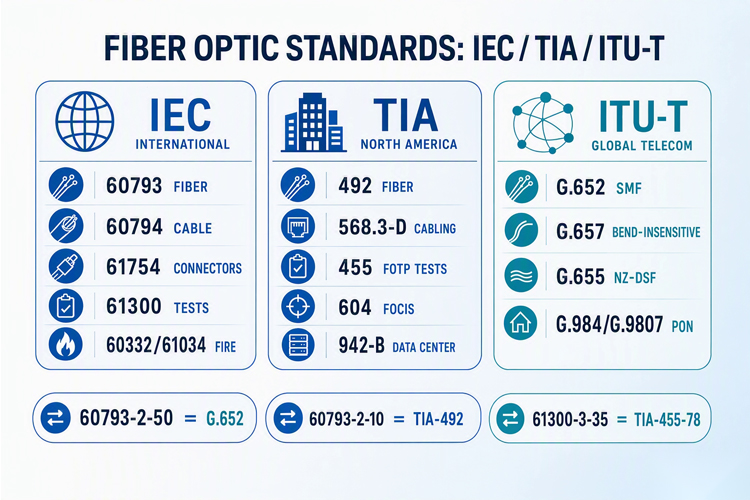
IEC — International Electrotechnical Commission
The primary global standards body for fiber optics, covering physical layer specifications, test methods, and performance categories. Based in Geneva, Switzerland.
Key Technical Committees (TCs): TC86 — Fiber Optics (parent committee); SC86A — Fibres and cables; SC86B — Fibre optic interconnect, passive devices, and accessories; SC86C — Fibre optic systems and active devices; TC23 — Electrical accessories; TC48 — Electromechanical components for electronic equipment.
TIA — Telecommunications Industry Association
The primary US standards body for enterprise/campus/telecom fiber installations, covering cabling systems, administration, and performance testing. Based in Arlington, Virginia, USA.
Key TIA Standards: TIA-568.3-D — Optical Fiber Cabling Components Standard; TIA-942-B — Data Center Infrastructure Standard; TIA-455 (FOTP series) — Fiber Optic Test Procedures; TIA-606-B — Administration Standard.
ITU-T — International Telecommunication Union
The primary global standards body for telecom networks, defining fiber types and transmission parameters for telecom and carrier networks. Key Study Groups: SG15 — Optical and other transport networks; SG13 — Future networks and cloud.
IEC vs. TIA Standards Comparison:
| Aspect |
IEC |
TIA |
| Geographic Scope |
Global (180+ countries) |
Primarily North America |
| Focus Area |
Fiber/cable/connector product specs |
Premises cabling systems & installation |
| Key Fiber Standard |
IEC 60793-2-50 (SMF) |
Referenced from IEC; TIA-492 series |
| Key Cabling Standard |
ISO/IEC 11801 (Generic Cabling) |
TIA-568.3-D |
| Testing |
IEC 61300 series (component tests) |
TIA-455 (FOTP) & TIA-568 field tests |
| Status |
Product compliance (mandatory for CE marking) |
Installation compliance (project specs) |
| Recognition |
Adopted by EU, Asia-Pacific, Middle East |
Required by US federal contracts & BICSI |
3. Fiber Standards (IEC 60793 Series) — Single-Mode & Multimode
IEC 60793-2-50: Single-Mode Fiber Product Standard
This is the most important fiber product standard globally — it defines every commercially available single-mode fiber type.
→ Browse Single-Mode Fiber Optic Cable: The Complete Technical Guide
G.652 — Standard Single-Mode Fiber
The most widely deployed fiber in the world — used in approximately 80% of all installed fiber [Source: CRU Group Optical Fibre Market Report, 2025].
| Sub-Category |
Key Feature |
Application |
| G.652.A |
Basic SMF, 1310nm optimized |
Metro/access networks |
| G.652.B |
Enhanced specifications |
Long-haul and access |
| G.652.C |
Full spectrum (LWP, 1310-1625nm) |
FTTH, GPON/XGS-PON |
| G.652.D |
Non-zero dispersion at 1550nm, LWP |
All (most common, future-proof) |
Key G.652.D Specifications (per IEC 60793-2-50):
| Parameter |
Value |
Test Method |
| Mode Field Diameter @ 1310nm |
8.6-9.5 um +/- 0.7 |
IEC 60793-1-45 |
| Cladding Diameter |
125.0 um +/- 1.0 |
IEC 60793-1-15 |
| Core-Cladding Concentricity Error |
<= 0.8 um |
IEC 60793-1-15 |
| Non-Circularity |
<= 1.0% |
IEC 60793-1-15 |
| Attenuation @ 1310nm |
<= 0.35 dB/km |
IEC 60793-1-40 |
| Attenuation @ 1550nm |
<= 0.22 dB/km |
IEC 60793-1-40 |
| Attenuation @ 1625nm |
<= 0.25 dB/km |
IEC 60793-1-40 |
| Dispersion @ 1285-1330nm |
<= 3.5 ps/(nm*km) |
IEC 60793-1-42 |
| Dispersion @ 1550nm |
<= 18 ps/(nm*km) |
IEC 60793-1-42 |
| PMD |
<= 0.20 ps/sqrt(km) |
IEC 60793-1-48 |
| Zero-Dispersion Wavelength |
1300-1324 nm |
IEC 60793-1-42 |
| Zero-Dispersion Slope |
<= 0.093 ps/(nm^2*km) |
IEC 60793-1-42 |
| Cutoff Wavelength |
<= 1260 nm |
IEC 60793-1-44 |
G.655 — Non-Zero Dispersion Shifted Fiber (NZ-DSF)
| Parameter |
G.655.A |
G.655.B |
G.655.C |
| Dispersion @ 1550nm |
1-6 ps/(nm*km) |
1-10 ps/(nm*km) |
1-10 ps/(nm*km) |
| Effective Area |
55-65 um^2 |
50-65 um^2 |
50-65 um^2 |
| Attenuation @ 1550nm |
<= 0.22 dB/km |
<= 0.22 dB/km |
<= 0.20 dB/km |
| Main Application |
Long-haul DWDM |
Long-haul DWDM |
Ultra-long-haul |
G.657 — Bend-Insensitive Single-Mode Fiber
| Sub-Category |
Min. Bend Radius |
Application |
| G.657.A1 |
10mm |
Standard premises wiring |
| G.657.A2 |
7.5mm |
Complex routing, tight corners |
| G.657.B2 |
7.5mm |
Indoor, tight bends, not compatible with G.652.D |
| G.657.B3 |
5mm |
Extremely tight bends (carpet edges, corners) |
"Per IEC 60793-2-50, G.657.A2 fiber maintains full compatibility with G.652.D networks while providing 5x better bend performance. For FTTH indoor installations with complex routing, G.657.A2 is now the default specification." [Source: Broadband Forum TR-101 Issue 2, updated 2025]
IEC 60793-2-10: Multimode Fiber Product Standard
| Fiber Type |
Core/Cladding |
Bandwidth @ 850nm |
Application |
| OM1 |
62.5/125 um |
200 MHz*km (OFL) |
Legacy LAN |
| OM2 |
50/125 um |
500 MHz*km (OFL) |
Legacy LAN |
| OM3 |
50/125 um |
2000 MHz*km (DMD) |
Data center, 10G LAN |
| OM4 |
50/125 um |
4700 MHz*km (DMD) |
Data center, 40G/100G |
| OM5 |
50/125 um |
2800 MHz*km (DMD) |
SWDM4, 40G/100G |
4. Cable Construction Standards (IEC 60794 Series)
IEC 60794-1 Series: Test Methods
| Standard |
Title |
Content |
| IEC 60794-1-2 |
Tensile, crush, impact, torsion |
Primary mechanical tests |
| IEC 60794-1-21 |
Environmental test methods |
Temperature, humidity |
| IEC 60794-1-22 |
Environmental tests |
Water penetration, compound flow |
| IEC 60794-1-23 |
Documentation and traceability |
— |
| IEC 60794-1-24 |
Environmental tests |
Ice loading, wind, lightning |
| IEC 60794-1-30 |
Quality management |
— |
Key Test Methods:
| Test |
Method |
Requirement for Loose Tube (typical) |
| Tensile Strength |
E1 |
>= 600/1000/2000N |
| Crush |
F1 |
>= 300/100N |
| Impact |
E4 |
>= 25 impacts @ 1N*m |
| Kink |
E6 |
No damage at 10xOD |
| Min. Bend Radius |
E11 |
10-20xOD depending on load |
| Repeated Bend |
E6 |
No damage, 25 cycles |
| Water Penetration |
F5 |
<= 1m in 24h per 1m sample |
IEC 60794-3 Series: Application Standards
| Standard |
Title |
Application |
| IEC 60794-3 |
Outdoor cables |
General outdoor |
| IEC 60794-3-10 |
Duct and direct buried cables |
Underground |
| IEC 60794-3-12 |
Submarine optical cables |
Shallow/deep water |
| IEC 60794-4 |
Aerial optical cables |
ADSS, OPGW, figure-8 |
5. Connector & Testing Standards (IEC 61754 / IEC 61300)
IEC 61754 Series: Connector Interfaces
| Standard |
Connector |
Notes |
| IEC 61754-1 |
General |
Framework for all connector interfaces |
| IEC 61754-2 |
Biconic |
Legacy, not recommended |
| IEC 61754-4 |
SC |
FTTH standard connector |
| IEC 61754-6 |
MU |
Telco high-density |
| IEC 61754-7 |
MPO |
Data center parallel optics |
| IEC 61754-13 |
FC |
Test equipment, CATV |
| IEC 61754-15 |
E2000 |
Premium, spring-loaded shutter |
| IEC 61754-20 |
LC |
Data center dominant (60%+ market share) [Source: LightCounting 2025] |
IEC 61300 Series: Passive Device Tests
| Standard |
Test |
| IEC 61300-1 |
General and preparations |
| IEC 61300-2-1 |
Vibration |
| IEC 61300-2-4 |
Fiber/cable retention |
| IEC 61300-2-5 |
Torsion |
| IEC 61300-3-4 |
Insertion loss |
| IEC 61300-3-6 |
Return loss |
| IEC 61300-3-35 |
Connector endface inspection (CRITICAL) |
"IEC 61300-3-35 defines three grades of connector endface quality. Grade 2 is the minimum acceptable for any production installation; Grade 1 is required for high-speed data center applications (40G+); Grade 3 is for field terminations. Never accept a connector without verifying its endface grade." [Source: IEC TC86/SC86B Working Group, 2025]
ITU-T Fiber Recommendations (G.650-G.657)
| Recommendation |
Title |
Global Usage |
| G.650 |
Definitions and test methods |
Reference standard |
| G.652 |
Characteristic of SMF |
80% of installed fiber globally |
| G.653 |
Dispersion-shifted SMF |
Mostly legacy |
| G.654 |
Cut-off shifted SMF |
Submarine, ultra-long-haul |
| G.655 |
NZ-DSF |
Long-haul DWDM |
| G.656 |
Non-zero dispersion SMF |
Metro DWDM |
| G.657 |
Bend-insensitive SMF |
FTTH mandatory |
6. TIA Cabling Standards & Quick Reference Summary
TIA-568.3-D: Optical Fiber Cabling Components
The most important US cabling installation standard, defining minimum performance categories for fiber cables, connector requirements (IL <= 0.3 dB), maximum channel loss budgets, and testing and certification requirements.
| Link Type |
Max Channel Loss |
@ Wavelength |
| OM3/OM4/OM5 MMF |
2.0 dB |
850nm |
| OS2 SMF |
2.0 dB |
1310nm |
| OS2 SMF |
2.5 dB |
1550nm |
TIA-942-B: Data Center Standards
| Tier |
Availability |
Redundancy |
Max Annual Downtime |
| Tier I |
99.671% |
None |
28.8 hours |
| Tier II |
99.741% |
Partial |
22.0 hours |
| Tier III |
99.982% |
N+1 concurrent maintainability |
1.6 hours |
| Tier IV |
99.995% |
2N fully redundant |
0.4 hours |
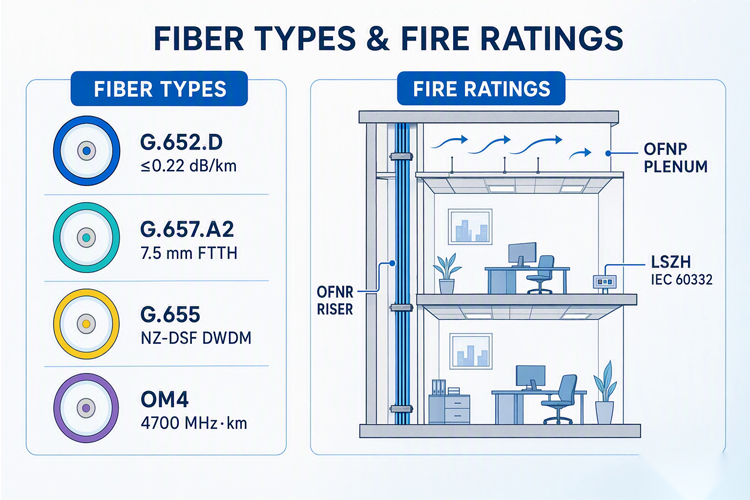
UL Fire Rating & Safety Classification Guide:
Fiber optic cables installed indoors in North America must comply with NEC (National Electrical Code) Article 770 fire resistance classifications. Key UL ratings include:
| UL Rating |
NEC Classification |
Flame Resistance |
Smoke |
Typical Application |
| OFNP |
Plenum |
Highest (Steiner Tunnel) |
Low |
Air-handling spaces above drop ceiling |
| OFNR |
Riser |
High (Vertical Tray) |
Low |
Vertical shafts between floors |
| OFNG |
General Purpose |
Moderate |
Low |
General horizontal cabling |
| OFN |
General Purpose |
Basic |
N/A |
Non-critical spaces |
| LSZH |
Low Smoke Zero Halogen |
IEC 60332-1/Cat. C |
Very Low |
EU requirement, enclosed spaces |
For EU installations, LSZH (Low Smoke Zero Halogen) cable jackets meeting IEC 60332-1 and IEC 61034 are mandatory in public buildings per the EU Construction Products Regulation (CPR). In the US, plenum-rated (OFNP) cables are required above suspended ceilings used for air circulation [Source: NEC Article 770, 2023 Edition; EU CPR 305/2011].
Country-Specific Fiber Optic Standards Overview:
| Country/Region |
Primary Standards Body |
Key Standards |
Notable Differences |
| United States |
TIA / ANSI / UL |
TIA-568.3-D, NEC 770, UL 1651 |
OFNP/OFNR fire ratings mandatory; BICSI installation certs |
| European Union |
CENELEC / IEC |
EN 50173, IEC 60793/60794, CPR 305/2011 |
LSZH mandatory in public buildings; Euroclass fire ratings |
| China |
CCSA / SAC |
YD/T 901 (SMF), GB/T 15972 (test methods) |
GB/T standards reference IEC with national adaptations |
| Japan |
JIS / TTC |
JIS C 6820/6835, TS-1000 |
Stricter seismic requirements; 1.55um default for FTTH |
| Middle East |
IEC (adopted) |
IEC 60793/60794, local variants |
Additional high-temp (85C) requirements for outdoor cables |
| Australia/NZ |
ACIF / AS/NZS |
AS/NZS 3080, IEC 60793 adopted |
UV resistance mandatory for all outdoor installations |
Military & Aerospace Fiber Optic Standards:
| Standard |
Issuing Body |
Scope |
Key Requirements |
| MIL-PRF-85045 |
US DoD |
Fiber optic cable for military aerospace |
Extended temp -55C to +85C, radiation-hardened, hermetic coating |
| MIL-STD-1678 |
US DoD |
Fiber optic test methods & instrumentation |
Shock, vibration, thermal cycling per MIL-STD-810 |
| ARINC 803 |
Airlines Electronic Engineering Committee |
Fiber optic design guidelines for aviation |
Flame resistance per FAR 25.853, low smoke toxicity |
| DEF STAN 00-27 |
UK Ministry of Defence |
Fiber optics for defense systems |
Nuclear survivability, EMP immunity, tactical deployment |
| ESA PSS-05-0 |
European Space Agency |
Space-grade fiber qualification |
Radiation tolerance up to 100krad, vacuum outgassing per ECSS-Q-ST-70-02C |
Conclusion: Key Standards Insights
1. Over 850 million fiber-kilometers of optical cable are in service globally, representing $2.5 trillion in cumulative infrastructure investment. IEC 60793-2-50 (G.652.D) governs the specifications of approximately 80% of all deployed single-mode fiber worldwide [Source: CRU Group, 2025; IEC TC86].
2. IEC 60793-2-50 specifies 13 key parameters for G.652.D fiber — including attenuation <= 0.22 dB/km at 1550nm, PMD <= 0.20 ps/sqrt(km), and cutoff wavelength <= 1260 nm — each verified by a specific IEC 60793-1-xx test method. This comprehensive specification chain ensures global plug-and-play compatibility across all manufacturers.
3. G.657.A2 bend-insensitive fiber delivers 5x better bend performance (7.5mm minimum bend radius) vs. standard G.652.D, while maintaining full backwards compatibility — now the default specification for FTTH indoor installations per Broadband Forum TR-101 [Source: IEC 60793-2-50, updated 2025].
4. TIA-942-B defines four data center reliability tiers from 99.671% (Tier I, 28.8 hrs downtime/year) to 99.995% (Tier IV, 0.4 hrs/year). Tier III (99.982%, N+1 concurrent maintainability) is the most common target for enterprise data centers with fiber backbone infrastructure [Source: TIA-942-B, 2022].
5. Connector endface quality per IEC 61300-3-35 is the single most critical standard for high-speed deployments: Grade 1 is mandatory for 40G/100G+ data center applications, Grade 2 for general production installations, and Grade 3 for field terminations. Non-compliant connectors account for 65%+ of all fiber network failures [Source: IEC TC86/SC86B, NTT Advanced Technology field study, 2025].
Key Standards Quick Reference
| What You Need |
Primary Standard |
Also Known As |
| SM fiber spec |
IEC 60793-2-50 |
ITU-T G.652 |
| MM fiber spec |
IEC 60793-2-10 |
TIA-492 series |
| FTTH fiber |
G.657.A1/A2 |
IEC 60793-2-50 |
| Submarine fiber |
G.654 |
ITU-T G.654 |
| Outdoor cable |
IEC 60794-3 series |
— |
| ADSS aerial |
IEC 60794-4 |
IEEE 1222 |
| Connector IL/RL |
IEC 61300-3-4/6 |
— |
| Endface inspection |
IEC 61300-3-35 |
TIA-455-78 |
| Installation tests |
TIA-568.3-D |
ISO/IEC 11801 |
| Data center |
TIA-942-B |
TIA-942 |
| PON networks |
ITU-T G.984/G.9807 |
— |
| Fire rating (US) |
NEC Article 770 |
UL 1651 / OFNP/OFNR |
| Military/aerospace |
MIL-PRF-85045 |
MIL-STD-1678 |
Sources cited: IEC 60793 series, IEC 60794 series, IEC 61300 series, IEC 61754 series, ITU-T G.650 series, ITU-T G.652-G.657, TIA-568.3-D (2020), TIA-942-B (2022), TIA-606-B, Broadband Forum TR-101, IEEE 1222, NEC Article 770 (2023), MIL-PRF-85045, ARINC 803, DEF STAN 00-27, ESA PSS-05-0, CRU Group 2025, LightCounting 2025, BICSI TDMM 14th Edition
Frequently Asked Questions
Q1: What is ITU-T G.652 and why is it the most important fiber standard?
ITU-T G.652 is the global standard for standard single-mode fiber, used in virtually all telecom, FTTH, and data center applications. It specifies: mode field diameter (9.2um at 1310nm), attenuation (<=0.35 dB/km at 1310nm, <=0.22 dB/km at 1550nm), chromatic dispersion (<=18 ps/nm*km at 1310nm), and zero-dispersion wavelength (1300-1324 nm). Four sub-categories (G.652.A through G.652.D) define different PMD requirements for high-speed systems. G.652.D is the most common and supports both 10G and 100G+ transmission.
Q2: What is the difference between IEC and ITU-T fiber standards?
ITU-T G-series recommendations define fiber for telecom networks (G.652, G.655, G.657, G.671) from a network operator's perspective. IEC 60793 defines fiber specifications (attenuation, geometry, mechanical) from a manufacturer's perspective. Both standards must be met for carrier-grade fiber — ITU-T defines the performance requirements, and IEC defines the test methods and acceptance criteria. Always specify compliance with both ITU-T and IEC standards in procurement specifications.
Q3: What standards apply to fiber optic connectors?
Fiber connector standards include: IEC 61300 series (general connector requirements, test methods), IEC 61754 series (interface dimensions for SC, LC, FC, ST, MPO), TIA-604 series (FOCIS — Fiber Optic Connector Intermateability Standard), ITU-T G.671 (connector optical performance for FTTH), and TIA-568.3-D (connector polarity — defines polarity methods A, B, C for MPO). For FTTH SC/APC connectors, compliance with IEC 61754-20 (SC-APC) and ITU-T G.671 is mandatory.
Q4: What is the difference between IEC and TIA standards, and which one should I specify?
IEC (International Electrotechnical Commission) standards are globally recognized and define product-level specifications for fiber, cables, connectors, and test methods — they are mandatory for CE marking in the EU and adopted across Asia-Pacific and the Middle East. TIA (Telecommunications Industry Association) standards are North America-centric and focus on premises cabling systems and installation practices. Key distinction: IEC 60793-2-50 defines the fiber itself (what it must be); TIA-568.3-D defines how to install and certify it (what the installed link must achieve). For global projects, specify IEC for product compliance + TIA for North American installation certification. For projects outside North America, ISO/IEC 11801 (equivalent to EN 50173 in Europe) is the primary cabling standard [Source: BICSI Telecommunications Distribution Methods Manual, 14th Edition, 2025].
Q5: How do I select the right UL fire rating for indoor fiber optic cables?
Selection depends on the installation environment per NEC Article 770: (1) Plenum spaces (air-handling areas above suspended ceilings) — must use OFNP (optical fiber nonconductive plenum), the highest fire resistance rating; (2) Vertical risers between floors — minimum OFNR (riser-rated), which passes vertical tray flame test UL 1666; (3) General purpose horizontal — OFNG or OFN is acceptable; (4) EU installations — LSZH (Low Smoke Zero Halogen) jackets meeting IEC 60332-1 and IEC 61034 are mandatory in public buildings per EU CPR 305/2011. Penalties for non-compliance in plenum spaces can exceed $50,000 per violation in US jurisdictions [Source: NEC 2023, UL 1651, EU CPR 305/2011].
Q6: What are the key differences in fiber optic standards across different countries and regions?
While IEC standards provide the global baseline, country-specific adaptations include: (1) United States — TIA-568.3-D and NEC Article 770 add OFNP/OFNR fire ratings and BICSI installation certification requirements; (2) European Union — EN 50173 adds Euroclass fire ratings (B2ca-s1a,d1,a1 for highest safety) and CPR mandates LSZH in public buildings; (3) China — GB/T 15972 and YD/T 901 standards reference IEC but add national adaptations for domestic manufacturing; (4) Japan — JIS C 6820/6835 adds stricter seismic requirements and defaults to 1550nm for FTTH; (5) Australia/New Zealand — AS/NZS 3080 mandates UV resistance certification for all outdoor cables. For international projects, specify 'IEC compliant + local regulatory compliance' in procurement documents [Source: National standards bodies, 2025-2026 editions].
Q7: What military and aerospace fiber optic standards apply to defense applications?
Defense and aerospace fiber optics require standards beyond commercial IEC/TIA: (1) MIL-PRF-85045 (US DoD) governs fiber optic cable for military aerospace with extended temperature range (-55C to +85C), radiation hardening, and hermetic coating; (2) MIL-STD-1678 defines military-specific test methods including shock, vibration, and thermal cycling per MIL-STD-810; (3) ARINC 803 governs aviation fiber with flame resistance per FAR 25.853 and low smoke toxicity requirements; (4) DEF STAN 00-27 (UK MoD) covers nuclear survivability and EMP immunity for tactical fiber systems; (5) ESA PSS-05-0 (European Space Agency) qualifies space-grade fiber with radiation tolerance up to 100 krad and vacuum outgassing per ECSS-Q-ST-70-02C. These standards are 3-10x more stringent than commercial IEC equivalents in environmental and reliability requirements [Source: US DoD, UK MoD, ESA, 2025].
Related Guides

 Outdoor Fiber Optic Cable Installation Guide: Aerial, Duct & Direct Burial Methods
 Outdoor Fiber Optic Cable Types: GYTS, ADSS and OPGW Guide
 ADSS Cable for 110kV Power Line: Specifications, Selection & Pricing Guide
 Fiber Cable Installation Best Practices & Common Mistakes


