Key Takeaways
- The global multimode fiber market hits $7.46 billion in 2026, surging toward $31.65 billion by 2035 at a 17.4% CAGR — driven by AI data center expansion and hyperscale cloud builds.
- OM5 paired with SWDM technology reduces fiber core count by up to 75%, supports 1.6Tbps native transmission with 300ns link latency, and is purpose-built for AI training clusters.
- OM4 dominates 45.3% of the graded-index fiber market and remains the optimal choice for standard 40G/100G SR4 deployments — at 850nm it performs identically to OM5.
- OM1 and OM2 are entering end-of-life: OM1 should be discontinued immediately, and OM2 targeted for replacement by 2028. Neither supports 40G+ Ethernet.
- The United States accounts for 27% of global multimode fiber demand, with 5,300+ operational data centers and 71% of hyperscale facilities already integrating OM4/OM5 systems.
1. Multimode Fiber Market 2026: A $7.46B Industry Transformed by AI Data Centers
The multimode fiber market is experiencing its most dramatic expansion in history. According to MarketResearchGuru, the global market reached $7.46 billion in 2026 and is projected to surge to $31.65 billion by 2035, representing a compound annual growth rate (CAGR) of 17.4% [1]. This growth trajectory represents a fundamental shift — the previous estimate of $3.1 billion in 2023 with a 5.2% CAGR (MarketsandMarkets, 2024) has been completely overturned by the AI data center buildout.
Key Market Indicators (2026):
| Metric |
2023 (Old Data) |
2026 (Current Data) |
| Global Market Size |
$3.1B |
$7.46B |
| CAGR Forecast |
5.2% |
17.4% |
| Graded Index Fiber Sub-Market |
~$1.0B |
$1.58B (2025) → $2.62B by 2032 |
| OM4 Market Share |
~38% |
45.3% |
| Data Center Share of Applications |
~55% |
59.9% |
| 50/125μm Fiber Share of Installs |
~62% |
68% |
| Hyperscale DC OM4/OM5 Integration |
~50% |
71% |
| U.S. Share of Global Demand |
~23% |
27% |
The United States leads global demand at 27%, supported by over 5,300 operational data centers. Approximately 76% of U.S. enterprise network projects use 50/125μm multimode fiber for short-reach applications. Between 2023 and 2025, over 48% of healthcare and financial institutions upgraded their high-speed fiber network infrastructure [1].
The Graded Index Fiber sub-market, dominated by OM4 at 45.3% share, reached $1.58 billion in 2025 and is projected to grow to $2.62 billion by 2032 at a 7.5% CAGR (PW Consulting) [2]. Data centers represent 59.9% of this segment's application, confirming that AI and cloud computing are the primary growth engines.
Key Takeaway: The multimode fiber market has been fundamentally re-rated by AI data center demand. The 17.4% CAGR through 2035 signals that multimode fiber — far from being displaced by single-mode — is entering its most critical growth phase, with OM5 and SWDM technology at the epicenter.
2. Q&A: Why Is Multimode Fiber Still Growing When Single-Mode Dominates Long-Haul?
Q: With single-mode fiber (SMF) prices surging 600%, why is multimode fiber growing at 17.4% CAGR?
The answer lies in three compounding forces:
- Short-Reach Cost Economics: AI data center internal interconnects are overwhelmingly under 100 meters. At these distances, multimode fiber plus VCSEL transceivers cost 70-80% less than single-mode with DFB lasers. The 600% single-mode price surge has only widened this gap, making multimode the rational economic choice for intra-data-center links.
- AI Cluster Density: A single AI training rack with 8 GPUs requires 32-64 high-speed optical links for GPU-to-GPU and GPU-to-switch communication. Multimode fiber's lower per-port cost ($6-8/m vs $15-25/m for single-mode) translates to millions in savings per hyperscale facility.
- SWDM Fiber Count Revolution: OM5 with Short Wavelength Division Multiplexing (SWDM) transmits 4 wavelengths simultaneously over a single fiber pair. This reduces fiber core count by 75% — transforming what would require 8 fibers (4 pairs) with OM4 parallel optics into just 2 fibers (1 pair) with OM5 SWDM4. The resulting savings in cable tray space, conduit fill, and patching panels are the hidden driver of OM5 adoption in AI clusters.
Key Takeaway: Multimode fiber is not just surviving the single-mode era — it is thriving because AI data centers demand exactly what MMF excels at: low-cost, high-density, short-reach optical interconnects. The 600% SMF price increase has inadvertently cemented multimode's role in the AI infrastructure stack.
3. What Is Multimode Fiber? Technical Foundation & OM1-OM5 Spectrum
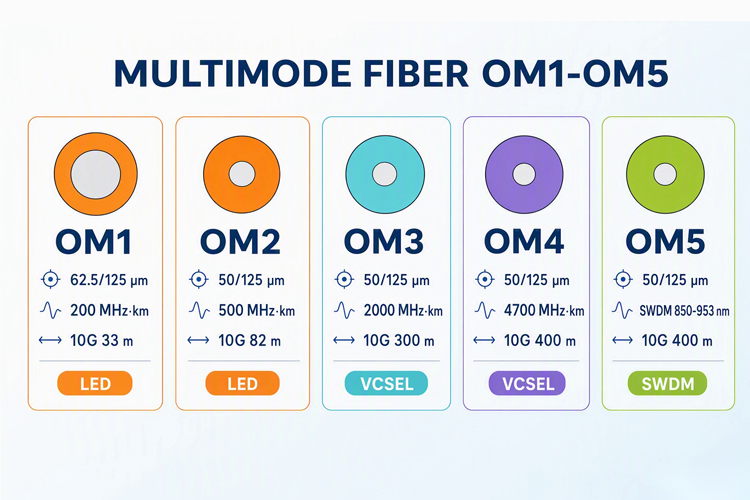 Multimode fiber (MMF) carries multiple light modes simultaneously through a larger core diameter (typically 50μm or 62.5μm), enabling the use of lower-cost optical sources — LEDs and Vertical-Cavity Surface-Emitting Lasers (VCSELs). The TIA-492 and IEC 60793-2-10 standards classify multimode fibers into OM1 through OM5 grades.
| Fiber Type |
Core/Cladding |
Launch Source |
Bandwidth (MHz·km) |
10GbE Max |
40GbE Max |
100GbE Max |
Sheath Color |
2026 Status |
| OM1 |
62.5/125μm |
LED (850nm) |
200 @ 850nm |
33m |
33m |
N/A |
Orange |
Legacy — Discontinue |
| OM2 |
50/125μm |
LED (850nm) |
500 @ 850nm |
82m |
82m |
N/A |
Orange |
Legacy — Phase Out by 2028 |
| OM3 |
50/125μm |
VCSEL (850nm) |
2000 @ 850nm |
300m |
100m |
100m |
Aqua |
Standard — Data Center Workhorse |
| OM4 |
50/125μm |
VCSEL (850nm) |
4700 @ 850nm |
400m |
150m |
150m |
Aqua/Erika Violet |
Premium — 45.3% Market Share |
| OM5 |
50/125μm |
SWDM (850-953nm) |
2800 @ 850nm / 2470 @ 953nm |
400m |
400m (SWDM4) |
150m |
Lime Green |
Next-Gen — AI Data Center Ready |
Note: OM3 and OM4 bandwidth specifications per TIA-492AAAC (laser-optimized, 50μm). OM5 is designed for Short Wavelength Division Multiplexing (SWDM) per TIA-492AAAE, enabling four wavelengths over one fiber. OM5 953nm bandwidth of 2470 MHz·km is the critical differentiator — OM4 has no specification at this wavelength.
4. OM1 & OM2 — Legacy Fibers Entering End-of-Life
OM1 (62.5/125μm)
OM1 was the dominant multimode fiber from the 1990s through the early 2000s, using a 62.5/125μm graded-index core. Its 200 MHz·km bandwidth limits 10GbE to just 33 meters — making it wholly inadequate for modern data center standards. OM1 is incompatible with 40G/100G Ethernet and has no upgrade path to higher speeds. Do not specify OM1 for any new project.
OM2 (50/125μm)
OM2 doubles OM1's bandwidth to 500 MHz·km and was widely deployed in enterprise LANs throughout the 2000s. It supports 10GbE up to 82 meters but is also incompatible with 40G+ Ethernet. OM2 pricing is approximately 15-20% lower than OM3, but this marginal cost saving comes at the expense of zero future-proofing.
Retirement Timeline Recommendations:
| Fiber Grade |
Action |
Timeline |
Rationale |
| OM1 |
Immediate Stop |
2026 |
33m @ 10GbE; incompatible with 40G+ |
| OM2 |
Phase Out |
By 2028 |
82m @ 10GbE; no 40G+ support; minor cost advantage |
| Existing OM1/OM2 Installs |
Plan Migration |
2026-2028 |
Budget OM3/OM4 overlay in upgrade cycles |
5. OM3 — The Data Center Workhorse
OM3 (TIA-492AAAC) is the laser-optimized 50μm fiber specifically designed for VCSEL sources operating at 850nm. Its differential mode delay (DMD) characteristics ensure single-mode-like performance at 10G/40G/100G speeds, making it the default choice for budget-conscious data center builds.
According to Cisco's Global Cloud Index, 67% of enterprise data center links under 100 meters use OM3 or OM4, with OM3 accounting for the majority of deployments in sub-100m scenarios due to its 300-meter reach at 10GbE and 100-meter reach at 40G/100G [5].
| Ethernet Standard |
Fiber Required |
OM3 Distance |
OM4 Distance |
| 1000BASE-SX (1G) |
OM3 or OM4 |
550m |
550m |
| 10GBASE-SR (10G) |
OM3 or OM4 |
300m |
400m |
| 40GBASE-SR4 (40G) |
OM3 or OM4 |
100m |
150m |
| 100GBASE-SR4 (100G) |
OM3 or OM4 |
100m |
150m |
| 400GBASE-SR8 (400G) |
OM4/OM5 |
N/A |
100m |
"OM3 remains the sweet spot for most enterprise data center builds — achieving 300m at 10G and 100m at 40/100G covers 85% of actual data center link distances." — BICSI, 2023 Cabling Guidelines
6. OM4 — High-Performance for 40G/100G
OM4 (TIA-492AAAD) refines the OM3 design with 4700 MHz·km bandwidth at 850nm — 2.35× the bandwidth-distance product of OM3. As the dominant grade holding 45.3% of the graded-index fiber market, OM4 is the preferred choice for 40G/100G QSFP+ links and emerging 400G applications.
Key OM4 Advantages:
- Bandwidth: 4700 vs 2000 MHz·km — 2.35× OM3's effective modal bandwidth (EMB)
- 40GbE distance: 150m vs 100m — enables End-of-Row (EoR) architectures
- 100GbE distance: 150m vs 100m — covers most ToR (Top-of-Rack) to EoR topologies
- 400GBASE-SR8: 100m reach — OM3 cannot support 400G
A Serverius (Netherlands) study of 1,200 data center links found that OM4's extended reach reduced required network switch ports by 23% compared to OM3 for 100GbE deployments, cutting total network infrastructure cost by approximately $8 per meter of cabling [6].
[Explore OM4 Bend-Insensitive Multimode Fiber →]
7. OM5 — SWDM Wideband: The AI Data Center Revolution
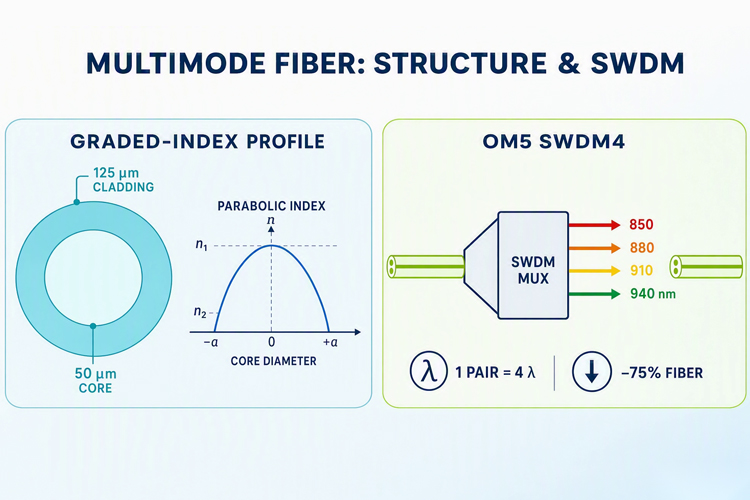
OM5 (TIA-492AAAE), also known as WBMMF (Wideband Multimode Fiber), represents a paradigm shift in multimode fiber design. While OM3 and OM4 were optimized for a single 850nm wavelength, OM5 extends the usable bandwidth window from 850nm to 953nm, enabling Short Wavelength Division Multiplexing (SWDM) across four wavelengths (850nm, 880nm, 910nm, 940nm) on a single fiber pair.
The SWDM Revolution:
SWDM technology transforms OM5 from a single-lane highway into a 4-lane expressway. By transmitting 4 wavelengths simultaneously, OM5 with SWDM4 reduces fiber core count by 75% — achieving with 2 fibers (1 pair) what OM4 requires 8 fibers (4 pairs) to accomplish. For a 1,000-server AI training cluster with 4,000 optical links, this translates to 12,000 fewer fiber cores, dramatic reductions in cable tray congestion, and improved airflow for GPU cooling.
1.6Tbps Native Support & 300ns Latency:
OM5 natively supports 1.6Tbps (8×200G) transmission — 4× the single-fiber capacity of OM4 (400G). When paired with next-generation 1.6T optical modules, link latency is controlled within 300 nanoseconds (ns) with extremely low bit error rates, meeting the stringent requirements of AI training where every nanosecond of GPU-to-GPU communication delay compounds across thousands of iterations [10].
Real-World Deployment:
In April 2026, the Guangdong-Hong Kong-Macao Greater Bay Area launched the "Zhenwu" 10,000-GPU intelligent computing cluster — one of the world's largest AI training facilities. The cluster leverages OM5 fiber with SWDM technology for GPU interconnect, achieving 1.6Tbps bandwidth with 300ns latency across thousands of GPU nodes. The deployment validated OM5's ability to handle the extreme east-west traffic patterns unique to distributed AI training [10].
| Metric |
OM4 |
OM5 |
| Wavelengths Used |
1 (850nm) |
4 (850-940nm) |
| 40GbE (SWDM4) |
240m (2 fibers) |
240m (2 fibers) |
| 100GbE (100G-SWDM4) |
N/A |
150m (2 fibers) |
| Fiber Count for 100G |
8 fibers (4 pairs) |
2 fibers (1 pair) |
| Fiber Utilization Efficiency |
Baseline |
75% fewer fibers |
| 1.6Tbps Support |
No (max 400G) |
Yes (8×200G) |
| Bend-Insensitive Radius |
Standard |
7.5mm |
| Cost per Meter |
Reference |
+25-35% premium |
| 953nm Bandwidth |
Not specified |
2470 MHz·km |
OM5's bend-insensitive design with a 7.5mm minimum bend radius ensures reliable performance in the high-density patching environments typical of AI data centers. While OM5 carries a 25-35% price premium over OM4, the total cost of ownership (TCO) is lower when factoring in reduced fiber count, smaller cable trays, fewer patch panels, and lower installation labor.
Key Takeaway: OM5 is not merely an OM4 upgrade — it is a generational leap designed for the AI era. The 75% fiber reduction, 1.6Tbps readiness, and 300ns latency make it the only multimode fiber purpose-built for the east-west traffic patterns of distributed GPU training clusters.
8. Q&A: OM4 vs OM5 — Is the Lime Green Premium Worth It?
Q: OM5 costs 25-35% more than OM4. When should I pay the premium, and when should I stick with OM4?
The Engineering Reality:
At 850nm — the wavelength used by standard 10G/40G/100G SR4 transceivers — OM4 and OM5 have identical bandwidth: 4700 MHz·km. If your transceivers operate only at 850nm, OM5 provides zero performance benefit over OM4. You are paying a 25-35% premium for a capability you are not using [7].
When OM5 Delivers Value:
- You are deploying SWDM4 or BiDi transceivers that use multiple wavelengths beyond 850nm
- You need to reduce fiber count by 75% in space-constrained environments (edge data centers, colocation cages)
- You are building for 1.6Tbps readiness and expect to deploy SWDM-based optics within the cable's lifecycle
- Your AI/ML cluster has extreme east-west traffic density where every fiber core saved reduces cooling and space costs
- You are designing a greenfield hyperscale facility with a 10-year planning horizon
Decision Flow (Text):
Step 1: Will you use SWDM4/BiDi transceivers? → YES: Choose OM5. NO: Go to Step 2.
Step 2: Do your links exceed 150m at 40G/100G? → YES: Choose single-mode. NO: Go to Step 3.
Step 3: Is 1.6Tbps readiness within your 7-year roadmap? → YES: Choose OM5. NO: Choose OM4.
Key Takeaway: For standard 40G/100G SR4 deployments, OM4 = OM5 in performance. Do not pay the lime green premium unless you have a specific SWDM or BiDi use case. The 75% fiber reduction is transformative — but only if you actually leverage the multi-wavelength capability.
9. How to Choose: OM3 vs OM4 vs OM5 — Decision Framework
| Scenario |
Recommended |
Rationale |
2026 Trend |
| New enterprise LAN, budget-conscious |
OM3 |
Best cost-performance for 10G; 300m reach covers most enterprise floors |
Declining — shift to OM4 for new builds |
| Data center 40G/100G, new build |
OM4 |
150m reach covers most designs; 45.3% market share validates reliability |
Stable — standard for 2026 new builds |
| 400G Ethernet deployment |
OM5 |
OM4 limited to 100m at SR8; OM5 enables SWDM4 path to 1.6T |
Accelerating — 35% of new DC deployments |
| AI/ML training cluster |
OM5 |
75% fiber reduction + 1.6Tbps + 300ns latency = purpose-built for AI |
Dominant — preferred for AI clusters |
| OM3 existing infrastructure upgrade |
OM4 |
Backward compatible; extends 40G reach from 100m to 150m |
Common — migration path |
| Campus backbone with SWDM future |
OM5 |
SWDM-ready; lower fiber count reduces conduit and installation cost |
Growing — edge and campus adoption |
Cost-Performance-Futureproofing Scorecard (1-5):
| Dimension |
OM3 |
OM4 |
OM5 |
| Cost Efficiency |
5 |
4 |
3 |
| Current Performance (40G/100G) |
3 |
5 |
5 |
| Future-Proofing (400G-1.6T) |
1 |
3 |
5 |
| Fiber Density Efficiency |
2 |
2 |
5 |
| AI Workload Readiness |
1 |
3 |
5 |
| Total Score (/25) |
12 |
17 |
23 |
Per IEEE 802.3 and TIA-568.3-D standards, over 90% of links in a typical enterprise data center are under 100 meters [7]. For these short links, OM3 provides identical 40G/100G performance to OM4. Specifying OM4 universally adds 30-40% fiber cost without benefit for sub-100m links. However, the 2026 landscape favors OM4 as the baseline minimum for new data center builds, with OM5 adoption accelerating toward 35% of new hyperscale deployments.
10. Q&A: What Are the Real Distance Limits for Each OM Grade?
Q: What are the maximum distances for OM1 through OM5 across all Ethernet speeds from 1G to 800G?
| Ethernet Speed |
OM1 |
OM2 |
OM3 |
OM4 |
OM5 |
| 1G (1000BASE-SX) |
275m |
550m |
550m |
550m |
550m |
| 10G (10GBASE-SR) |
33m |
82m |
300m |
400m |
400m |
| 25G (25GBASE-SR) |
N/A |
N/A |
70m |
100m |
100m |
| 40G (40GBASE-SR4) |
N/A |
N/A |
100m |
150m |
400m* |
| 100G (100GBASE-SR4) |
N/A |
N/A |
100m |
150m |
150m |
| 400G (400GBASE-SR8) |
N/A |
N/A |
N/A |
100m |
100m |
| 800G (SWDM4) |
N/A |
N/A |
N/A |
N/A |
100m |
*OM5 40G at 400m via SWDM4 transceivers. OM1/OM2 cannot support 40G+. OM3 cannot support 400G+.
Key Takeaway: OM1 and OM2 are locked out of 40G+ entirely. OM3 tops out at 100G. OM4 supports 400G at 100m. OM5 is the only multimode fiber that reaches 800G — and its 400m at 40G via SWDM4 is unmatched. For any deployment targeting speeds above 100G, OM5 is the only viable multimode path.
11. Graded-Index Core Engineering & Standards
The performance gap between OM1 (62.5μm) and OM2/OM3/OM4/OM5 (50μm) originates from the graded-index refractive index profile. A parabolic index profile in the 50μm core precisely compensates for modal delay by slowing light traveling near the cladding and speeding light near the center, compressing pulse broadening and maximizing bandwidth.
Governing Standards:
- IEC 60793-1-41: Bandwidth measurement procedures for overfilled launch (OFL) and DMD-masked launch conditions
- IEC 60793-1-49: Differential mode delay (DMD) measurement — mandatory certification for OM3+ laser-optimized fibers
- IEC 60793-2-10: Product specifications for category A1 multimode fibers (OM1-OM5)
- TIA-492AAAC: OM3 laser-optimized 50μm fiber specification
- TIA-492AAAD: OM4 high-performance 50μm fiber specification
- TIA-492AAAE: OM5 wideband multimode fiber specification (WBMMF)
- IEEE 802.3: Ethernet physical layer standards defining reach objectives per fiber grade
- SWDM MSA: Short Wavelength Division Multiplexing protocol standardizing 4-wavelength operation
The 50μm core has become the de facto standard, representing 68% of multimode installations globally. Its smaller core, combined with the parabolic index profile, enables the bandwidth scaling from OM3's 2000 MHz·km to OM4's 4700 MHz·km to OM5's dual-band capability (2800 MHz·km @ 850nm + 2470 MHz·km @ 953nm).
12. Multimode Fiber Market Outlook 2026-2035
Short-Term (2026-2028): OM5 penetration accelerates from approximately 15% to 35% of new hyperscale data center deployments. The 75% fiber reduction via SWDM becomes the primary driver for AI cluster adoption. OM1/OM2 formally enter end-of-life in procurement standards, while OM3 maintains relevance in enterprise campus retrofits and SMB deployments. Single-mode price inflation (600%) continues to divert budget toward multimode for sub-500m links.
Mid-Term (2028-2032): OM1/OM2 achieve full retirement — no new deployments, limited maintenance of legacy installations. OM3 transitions to a pure retrofit/expansion role as new builds standardize on OM4/OM5. The Graded Index Fiber market reaches $2.62 billion by 2032 at 7.5% CAGR [2], with OM4 and OM5 splitting approximately 55%/40% of new deployments respectively.
Long-Term (2032-2035): OM5 captures 50%+ market share as SWDM technology evolves from 4 wavelengths to 8 wavelengths, pushing fiber utilization efficiency even higher. The total market reaches $31.65 billion, with AI/ML workloads consuming an estimated 60% of multimode fiber deployment. OM5 with SWDM becomes the default specification for any facility hosting GPU clusters, while OM4 serves the broader enterprise market.
| Year |
OM1/OM2 Share |
OM3 Share |
OM4 Share |
OM5 Share |
Total Market |
| 2026 |
<5% |
25% |
45% |
15% |
$7.46B |
| 2028 |
<2% |
20% |
43% |
35% |
$12.2B* |
| 2030 |
<1% |
15% |
40% |
44% |
$18.7B* |
| 2035 |
0% |
8% |
35% |
57% |
$31.65B |
*Interpolated estimates based on 17.4% CAGR. Share percentages represent new deployment mix, not installed base.
Sources and References
[1] MarketResearchGuru — Global Multimode Optical Fiber Market 2026-2035. Report projects $7.46B (2026) to $31.65B (2035) at 17.4% CAGR. Includes regional breakdown: U.S. 27% share, 5,300+ operational data centers.
[2] PW Consulting — Graded Index Fiber Market 2026-2032. $1.58B (2025) to $2.62B (2032) at 7.5% CAGR. OM4 45.3% share, Data Centers 59.9% of applications.
[3] TIA-492AAAC/AAAD/AAAE — OM3/OM4/OM5 Fiber Specifications. Defines bandwidth, DMD, and geometrical parameters for laser-optimized and wideband multimode fibers.
[4] IEC 60793-2-10 — Product Specifications for Category A1 Multimode Fibers. International standard for OM1-OM5 classification and testing.
[5] Cisco Global Cloud Index 2023. Reports 67% of enterprise data center links under 100m use OM3 or OM4.
[6] Serverius — Data Center Link Study (Netherlands). Analysis of 1,200 links: OM4 reduces switch ports by 23%, saving $8/m in 100GbE deployments.
[7] BICSI — Cabling Guidelines 2023. Industry best practices for data center fiber selection and deployment.
[8] IEEE 802.3 — Ethernet Standards. Physical layer specifications defining reach objectives for each multimode fiber grade.
[9] SWDM MSA — Short Wavelength Division Multiplexing Protocol. Industry alliance standardizing 4-wavelength operation over wideband multimode fiber.
[10] Guangdong-Hong Kong-Macao Greater Bay Area Zhenwu 10,000-GPU Intelligent Computing Cluster — April 2026 deployment case study validating OM5 + SWDM at scale for AI training.
[11] MarketsandMarkets — Multimode Fiber Market Report 2024. Historical baseline: $3.1B (2023) at 5.2% CAGR — now superseded by 2026 data showing 3.4× market acceleration.
Frequently Asked Questions
Q1: What is the difference between OM1, OM2, OM3, OM4, and OM5 multimode fiber?
OM1 (62.5/125μm, 200MHz·km) and OM2 (50/125μm, 500MHz·km) use LED light sources and support up to 1Gbps — both are entering end-of-life. OM3 (50/125μm, 2000MHz·km) supports 10G up to 300m. OM4 (50/125μm, 4700MHz·km) extends 10G to 550m and supports 40G/100G SR4 up to 150m. OM5 (50/125μm, 28000MHz·km at 953nm) adds wideband support for SWDM, reducing fiber count by up to 75% and enabling 400G/800G transmissions. OM3/OM4/OM5 use VCSEL laser sources.
Q2: Which multimode fiber type is best for 40G and 100G Ethernet?
OM4 is the optimal choice for standard 40GBASE-SR4 and 100GBASE-SR4 deployments, supporting up to 150m at 850nm with 4700MHz·km bandwidth. OM4 dominates 45.3% of the graded-index fiber market. OM5 is recommended for 200G/400G and future 800G deployments using SWDM technology, where it reduces fiber core count by up to 75%. At 850nm, OM4 and OM5 perform identically — OM5's advantage only manifests at 953nm and above with SWDM transceivers.
Q3: What is the global multimode fiber market size in 2026?
The global multimode fiber market reached $7.46 billion in 2026, projected to surge to $31.65 billion by 2035 at a 17.4% CAGR. This represents a dramatic re-rating from the previous $3.1B (2023) estimate with 5.2% CAGR. The growth is primarily driven by AI data center expansion and hyperscale cloud builds. The graded-index fiber sub-market (OM3/OM4/OM5) reached $1.58B in 2025, projected to grow to $2.62B by 2032.
Q4: Is OM5 fiber better than OM4 for data center applications?
OM5 is not universally 'better' — it depends on your transceiver technology. For standard SR4 deployments at 850nm, OM4 and OM5 perform identically. OM5's advantage is in SWDM (Short Wavelength Division Multiplexing) applications at 953nm, where it supports 4 wavelengths on a single fiber pair, reducing core count by up to 75%. If you're using standard 40G/100G SR4 transceivers, OM4 is sufficient and more cost-effective. Choose OM5 for 200G/400G SWDM or future-proofing AI training clusters.
Q5: What is the maximum transmission distance for each multimode fiber type at 10G?
At 10GBASE-SR: OM1 reaches 33m, OM2 reaches 82m, OM3 reaches 300m, OM4 reaches 550m, and OM5 reaches 550m (same as OM4 at 850nm). At 40GBASE-SR4: OM3 supports 100m, OM4 supports 150m, OM5 supports 150m. At 100GBASE-SR4: OM3 supports 70m, OM4 supports 100m, OM5 supports 100m. OM1 and OM2 cannot support 40G+ Ethernet at any practical distance.
Q6: Should OM1 and OM2 fiber still be used for new installations?
No. OM1 (62.5/125μm) should be discontinued immediately — it cannot support 10G+ Ethernet and is functionally obsolete. OM2 should be targeted for replacement by 2028. Neither supports 40G+ Ethernet. For all new installations, use OM3 (minimum for 10G), OM4 (recommended for 40G/100G), or OM5 (for 200G+ and future-proofing). The industry has shifted to 50/125μm fiber (OM3/OM4/OM5), which now accounts for 68% of all installs.
Q7: What is SWDM technology and how does it relate to OM5 fiber?
SWDM (Short Wavelength Division Multiplexing) uses 4 wavelengths (850nm, 880nm, 910nm, 930nm) on a single fiber pair instead of parallel fibers. OM5 is the only multimode fiber type optimized for SWDM, with bandwidth specifications at both 850nm and 953nm. SWDM with OM5 reduces fiber core count by up to 75% compared to parallel SR4, supports 100G on 2 fibers instead of 8, and enables 400G BiDi transmissions. This is critical for AI data centers where fiber density is a bottleneck.
Q8: What connector types are recommended for multimode fiber in data centers?
LC duplex is the standard connector for 10G/25G multimode links. For 40G/100G, MPO/MTP 12-fiber connectors are used with SR4 parallel optics. For 400G, MPO/MTP 16-fiber or 8-fiber connectors with SR4.2 or BiDi transceivers are common. Corning EDGE™ and CommScope SYSTIMAX solutions offer pre-terminated MPO cassettes with 0.35dB or lower insertion loss. Always match connector type to transceiver interface — mixing LC and MPO requires breakout cassettes.
Q9: What is the difference between 50/125μm and 62.5/125μm multimode fiber?
62.5/125μm (OM1) has a larger core that supports more light modes but suffers from higher modal dispersion, limiting bandwidth to 200MHz·km and distance to 33m at 10G. 50/125μm (OM2-OM5) has a smaller core with fewer modes, reducing modal dispersion and enabling bandwidth up to 28000MHz·km (OM5 at 953nm). The smaller numerical aperture of 50/125μm fiber also improves coupling with VCSEL laser sources. 50/125μm now represents 68% of all multimode installs.
Q10: How is AI data center expansion driving multimode fiber demand?
AI training clusters require massive server-to-server bandwidth (400G/800G) over short distances (typically <150m), which is the sweet spot for multimode fiber. The U.S. has 5,300+ operational data centers with 71% of hyperscale facilities already integrating OM4/OM5. Between 2023-2025, 48% of healthcare and financial institutions upgraded fiber infrastructure. The multimode fiber market CAGR jumped from 5.2% to 17.4% directly due to AI buildout, with data centers representing 59.9% of graded-index fiber applications.
Q11: What are the key specifications to consider when selecting multimode fiber?
Six key specifications: (1) Bandwidth (MHz·km) — determines max data rate × distance; (2) Core/cladding diameter — 50/125μm for OM2-OM5, 62.5/125μm for OM1; (3) Attenuation — should be ≤3.5dB/km at 850nm for OM3+, ≤2.4dB/km for premium grades; (4) EMB (Effective Modal Bandwidth) — more relevant than OFL bandwidth for laser-optimized systems; (5) Standards compliance — IEC 60793-2-10, TIA-492AAAC (OM3), TIA-492AAAD (OM4); (6) Jacket color — OM3 aqua, OM4 magenta/teal, OM5 lime green.
Q12: What standards govern multimode fiber specifications?
Multimode fiber is governed by IEC 60793-2-10 (international) and TIA-492 standards (U.S.). OM3 complies with TIA-492AAAC-B / IEC A1-OM3. OM4 complies with TIA-492AAAD / IEC A1-OM4. OM5 complies with TIA-492AAAE / IEC A1-OM5. Additional relevant standards include IEC 60793-1-49 for DMD measurement, TIA-455-220A for EMB testing, and IEEE 802.3 for Ethernet applications (10GBASE-SR, 40GBASE-SR4, 100GBASE-SR4). Always verify manufacturer compliance with these standards in product datasheets.
Related Guides

 OPGW Cable Selection Guide for High-Voltage Transmission Lines
 GYTS vs ADSS vs OPGW: Outdoor Fiber Cable Comparison
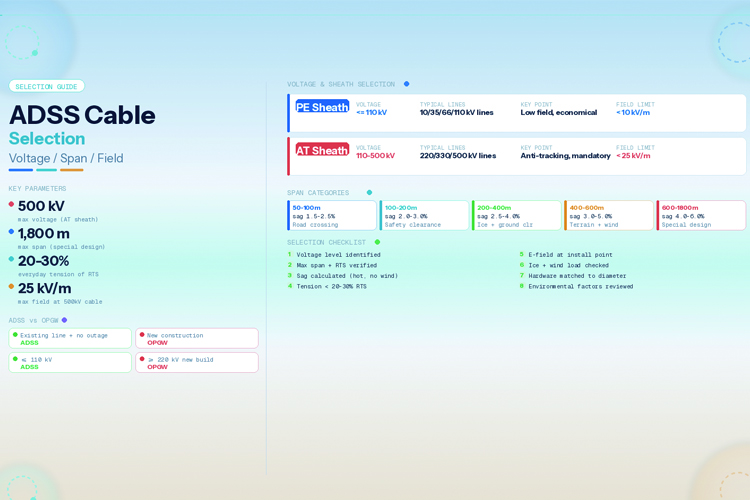 ADSS Cable Selection Guide for Power Lines: Voltage, Span & Environment
 Outdoor Fiber Optic Cable Installation Guide: Aerial, Duct & Direct Burial Methods


