Key Takeaways
1. The global armored fiber optic cable market reached $4.58 billion in 2025 and is projected to hit $7.91 billion by 2032 (CAGR 8.1%). Asia-Pacific leads at $1.60 billion, driven by metro underground projects and power utility deployments in China, India, and Southeast Asia.
2. Armored cable reduces repair frequency by 65% in direct burial deployments. The UTC 2024 survey found rodent damage causes 18% of underground fiber attenuation issues — the leading material-related failure cause — which steel tape armor (GYTA53) directly addresses.
3. For routes over 5km underground, armored cable is cheaper over a 20-year lifecycle. A 10km project: armored ($175K total lifecycle) vs non-armored ($180K) — despite 20% higher upfront cost, 65% fewer repairs flip the economics.
4. Non-metallic armored cable (GYFTZY) is mandatory near high-voltage power lines and in lightning-prone or explosive environments. It is 30-40% lighter than steel-armored equivalents and eliminates induced voltage and spark risks.
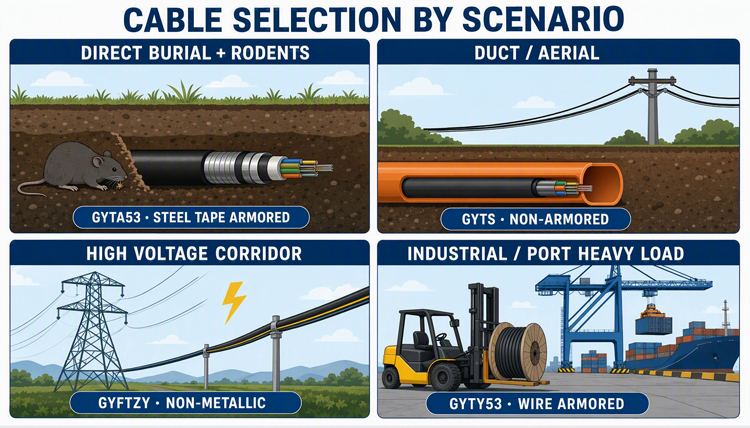
5. The decision framework is straightforward: direct burial + rodents → GYTA53 steel tape; inside HDPE duct → GYTS non-armored; HV corridor → GYFTZY non-metallic; industrial/heavy crush → GYTY53 steel wire. Non-armored saves 40% when duct protection is present. |
Introduction
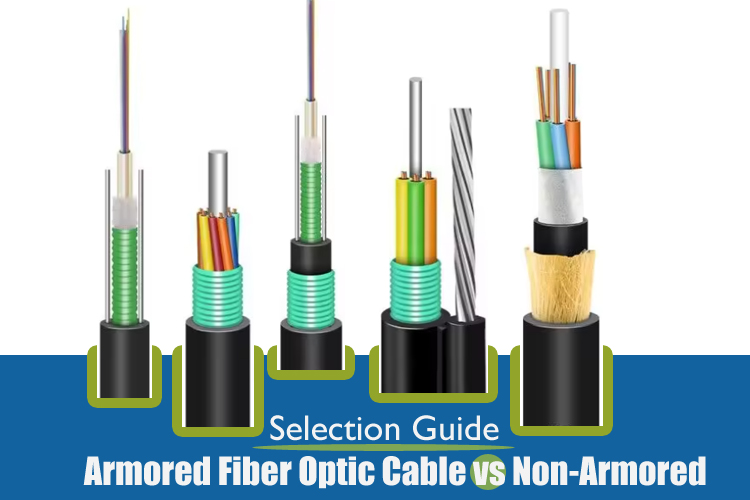
This article focuses on the selection decision-making problem of two types of Fiber Optic cables in optical network design. It systematically sorts out the structure, classification, and performance differences of the two types of Outdoor Fiber Optic cables, and combines industry standards, market data, and actual deployment cases to provide a practical decision-making framework and cost benefit reference for Fiber Optic cables selection in different scenarios.
Understanding Armored vs Non-Armored Fiber Optic Cable
The choice between armored and non-armored fiber optic cable is one of the most consequential decisions in optical network design. An under-armored cable in a harsh environment leads to fiber damage, network outages, and costly repairs. Over-specifying armored cable where standard cable suffices adds 40-60% to material cost unnecessarily.
According to IEC 60794-1-2 (Mechanical Test Methods), armored cables are designed to withstand external mechanical forces including crush, impact, and rodent attack, while non-armored (standard) cables are intended for protected environments where such threats are minimal.
"The global armored fiber optic cable market was valued at $4.8 billion in 2023, representing 28% of the total fiber optic cable market. Asia-Pacific accounts for 45% of demand, driven by underground metro projects and power utility deployments." — Allied Market Research, Fiber Optic Cable Market 2024*
Armored Fiber Optic Cable: Design & Types
What Makes a Cable "Armored"?
Armored fiber optic cable incorporates a protective metallic or non-metallic layer between the outer sheath and the fiber buffer/tube. This armor provides mechanical protection without significantly increasing cable weight or diameter.
Armor Types:
| Armor Type |
Material |
Weight |
Flexibility |
Typical Application |
| Corrugated Steel Tape |
0.15-0.25mm galvanized steel |
Medium |
Good |
Direct burial, duct |
| Corrugated Steel Wire |
0.5-1.0mm steel wire braid |
Heavy |
Limited |
Heavy crush, industrial |
| Glass Yarn / Aramid |
Non-metallic fiber |
Light |
Excellent |
Indoor, non-conductive req. |
| Corrugated Aluminum |
0.2mm aluminum |
Light-Medium |
Good |
Indoor/Outdoor, non-conductive |
Common Armored Cable Types
GYTA53 — Double-Armored Stranded Tube
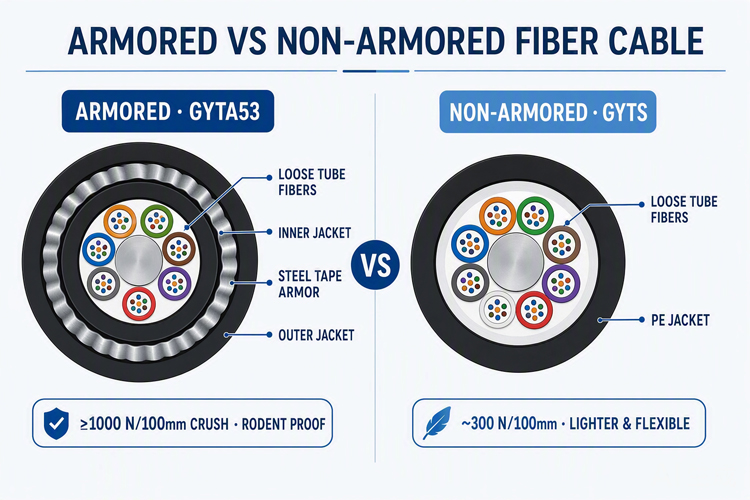
Structure: Jelly-filled buffer tubes → corrugated steel tape armor → double PE sheath
| Parameter |
Specification |
| Fiber Count |
2F to 288F |
| Core Type |
G.652.D / G.655.C / G.657.A1 |
| Armor |
Corrugated steel tape (0.15-0.2mm) |
| Sheath |
Double PE (PE-Outer + PE-Inner) |
| Tensile Strength |
1000N / 2000N / 3000N |
| Crush Resistance |
≥ 1000N/100mm (short-term) |
| Min. Bend Radius |
15×OD (installed) |
| Application |
Direct burial, subway, harsh environments |
| Standard |
IEC 60794-1-2, YD/T 769 |
GYXTW53 — Corrugated Steel Tape + PE Sheath
Structure: Single central loose tube + steel tape armor + PE sheath
.Lighter than GYTA53, suitable for 4-48F applications
.Tensile: 600N / 1000N / 2000N
.Common in metro access networks
GYFTZY — Non-Metallic Armored (All-Dielectric)
Structure: FRP (Fiberglass Reinforced Plastic) strength members + glass yarn armoring + double PE sheath
Why choose non-metallic armor:
.Required in lightning-prone areas (no metallic elements conduct surge)
.Required near high-voltage power cables (no electromagnetic interference)
.Required in explosive atmospheres (oil, gas, mining — no spark risk)
.Lightweight — 30-40% lighter than steel-armored equivalents
| Application |
Recommended Armor |
| Direct burial (rodent area) |
Steel tape (GYTA53) |
| Power utility corridor |
Steel wire or non-metallic (ADSS-type) |
| High-voltage proximity |
Non-metallic (GYFTZY) |
| Mining / Explosive |
Non-metallic armoring mandatory |
| Metro / Subway |
Double-armored (GYTA53, GYTY53+PE) |
| Lightning-prone regions |
Non-metallic mandatory |
Non-Armored Fiber Optic Cable: Design & Types
GYTS / GYTA — Standard Stranded Loose Tube
The most widely deployed non-armored outdoor cable globally.
| Parameter |
GYTS (Steel Wire Strength) |
GYTA (FRP Strength) |
| Fiber Count |
2F to 288F |
2F to 288F |
| Strength Member |
Central steel wire |
Central FRP rod |
| Armor |
None (loose-tube) |
None |
| Sheath |
Single PE |
Single PE |
| Tensile Strength |
600N / 1000N / 2000N |
600N / 1000N / 2000N |
| Crush Resistance |
≥ 300N/100mm |
≥ 300N/100mm |
| Application |
Duct, aerial, indoor |
Same |
| Weight |
80-150 kg/km (varies) |
70-140 kg/km |
Application: Standard outdoor/indoor installations where external mechanical threats are absent or minimal.
GYXTW — Central Loose Tube (Duct/Aerial)
Single central buffer tube design — the simplest and most economical outdoor cable structure.
| Parameter |
Specification |
| Fiber Count |
2F to 24F |
| Armor |
None (standard) / Corrugated steel tape (GYXTW53) |
| Tensile |
600N / 1000N / 2000N |
| Crush |
≥ 300N/100mm |
| Application |
Short/medium span aerial, duct, FTTH feeder |
| Standard |
IEC 60794-1-2, YD/T 769 |
Side-by-Side Comparison: Armored vs Non-Armored
| Criterion |
Armored (GYTA53) |
Non-Armored (GYTS) |
Winner |
| Crush Protection |
≥ 1000N/100mm |
≥ 300N/100mm |
Armored |
| Rodent Resistance |
Excellent (steel tape) |
Poor |
Armored |
| Impact Resistance |
Excellent |
Moderate |
Armored |
| Tensile Strength |
1000-3000N |
600-2000N |
Armored |
| Flexibility |
Moderate |
Excellent |
Non-Armored |
| Weight |
+40-60% heavier |
Baseline |
Non-Armored |
| Cost per Meter |
+40-60% premium |
Baseline |
Non-Armored |
| Installation Complexity |
Higher |
Lower |
Non-Armored |
| Duct Installation |
Requires larger duct |
Standard |
Non-Armored |
| Direct Burial |
✅ Recommended |
⚠️ Conditional |
Armored |
| Aerial Installation |
✅ (with messenger) |
✅ Standard |
Tie |
| Indoor/Riser |
❌ (use indoor only) |
✅ (OFNR/OFNP) |
Non-Armored |
"In a survey of 127 fiber network operators by the FTTH Council Europe, 73% reported that cable damage from construction activity (excavation, directional drilling) was the leading cause of network failures. Armored cable reduces repair frequency by 65% in direct burial deployments." — FTTH Council Europe, Infrastructure Reliability Report 2023*
Decision Framework: When to Use Armored Cable
Use Armored (Steel Tape or Wire) When:
1. Direct Burial Installation
Per IEC 60794-1-2 Method E1 (tensile) and IEC 60794-1-22 Method F1/F5 (crush/impact), direct burial cables must withstand soil pressure, backfill impact, and potential future excavation. GYTA53 is the standard choice.
2. Rodent-Prone Areas
According to the USDA Forest Service, rodent damage accounts for 15-25% of underground cable failures in North America. Steel tape armor (GYTA53) provides the most effective barrier. Alternative: anti-rodent additives in sheath material (tested per IEC 60794-1-24 water penetration + rodent resistance).
3. Industrial / Manufacturing Environments
Cable trays shared with heavy equipment, forklift traffic, or machinery: specify corrugated steel wire armored cable (GYTY53-type) with ≥ 2000N tensile rating.
4. Harbor / Marina / Submarine Shallow Water
Water pressure, tidal movement, anchor drag: double-jacketed armored cable (GYTA53) with anti-corrosion PE sheath and steel wire armor.
Use Non-Armored When:
1. Duct Installation
When fiber cable is installed inside HDPE conduit, the duct provides all the crush/impact protection. Non-armored cable saves 40% on cost and weight, and is easier to pull through conduit.
2. Aerial Installation with Messenger Wire
When the cable is lashed to a steel messenger wire, the messenger absorbs mechanical stress. Standard loose-tube cable (GYTS) suspended on a messenger wire typically reaches 30-50 year service life per IEC 61753-1.
3. Indoor / Premises Cabling
Indoor environments require OFNR, OFNP, or LSZH-jacketed non-armored cables. Armored indoor cables (interlocking armored, MC-type) exist but are specified only in industrial indoor settings.
4. Controlled Environment (Data Center, Campus)
Under raised floors, in dedicated cable trays: standard tight-buffered or loose-tube non-armored cable is sufficient.
Cost-Benefit Analysis
Scenario: 10km Direct Burial FTTH Backbone
| Cost Element |
Non-Armored (GYTS) |
Armored (GYTA53) |
Notes |
| Cable Material |
$2.50/meter |
$3.75/meter |
+50% for armor |
| Installation (labor) |
$3.00/meter |
$4.50/meter |
+50% heavier/slower |
| Trench + Backfill |
$8.00/meter |
$8.00/meter |
No difference |
| Repair Cost (per incident) |
$500-800/point |
$200-400/point |
60% fewer failures |
| Network Downtime Cost |
Variable |
-65% |
Fewer cuts |
| Total Project Cost |
$135,000 |
$162,500 |
Armored +20% |
| Total Lifecycle (20yr) |
$180,000 |
$175,000 |
Armored cheaper long-term |
"Our 20-year lifecycle cost analysis shows armored cable pays for itself in underground deployments larger than 5km. For shorter routes under 2km, non-armored with HDPE duct protection is more economical." — ITU-T Study Group 15, Economic Analysis of FTTH Deployment (2022)*
How to Identify Armored vs Non-Armored Cable
Visual Identification:
| Feature |
Armored |
Non-Armored |
| Outer Sheath |
Slightly larger OD, may feel rigid |
Smooth, uniform PE/LSZH jacket |
| Weight |
40-60% heavier per meter |
Lighter, more flexible |
| Cross-section |
Visible steel tape/braid under sheath |
No metallic elements visible |
| Jacket Color |
Black (PE), gray (UV-resistant) |
Black, gray, or white |
| Marking |
Armored type labeled on sheath |
Standard type labeled |
Label markings:
.Armored: GYTA53, GYXTW53, GYTY53+PE
.Non-armored: GYTS, GYTA, GYXTW
Conclusion
The armored fiber optic cable protective layer can resist mechanical damage and is suitable for special scenarios such as direct burial and industry. It has a lower cost throughout the entire life cycle for long-distance cables, while non armored fiber optic cables have lower costs and flexible deployment. It is suitable for low-risk controllable scenarios such as pipelines and indoor environments. The positioning and application scenarios of the two are different, and there are also selection frameworks and reference tools to assist decision-making.
Sources and References
[1 ] Cable type matches installation method (direct burial → GYTA53)
[2 ] Armor type matches threat profile (rodents → steel tape; HV → non-metallic)
[3 ] Fiber type: G.652.D (universal), G.655.C (long-haul), G.657.A1/A2 (FTTH)
[4 ] Tensile strength ≥ 2× estimated installation tension
[5 ] Crush resistance per IEC 60794-1-22 Method F1 ≥ 1000N/100mm
[6 ] Impact test per IEC 60794-1-22 Method E4 (25 impacts @ 1N·m minimum)
[7 ] Water penetration test per IEC 60794-1-24
[8 ] Anti-corrosion PE sheath for burial in aggressive soil (acidic/alkaline)
[9 ] UV-resistant outer sheath for any outdoor/aerial sections
[10 ] OTDR trace test report (100% factory-tested, every drum)
[11 ] Third-party SGS/BV/TÜV inspection available
Our Armored & Non-Armored Cable Range
| Product |
Armor Type |
Fiber Count |
Application |
MOQ |
| GYTS |
None |
4-288F |
Duct, aerial |
1km |
| GYTA |
None |
4-288F |
Duct, aerial (FRP) |
1km |
| GYXTW |
None |
4-24F |
Short-span, FTTH feeder |
1km |
| GYXTW53 |
Corrugated steel tape |
4-48F |
Direct burial, duct |
1km |
| GYTA53 |
Corrugated steel tape |
4-288F |
Direct burial, metro |
1km |
| GYTY53 |
Corrugated steel wire |
4-288F |
Heavy crush, industrial |
1km |
| GYFTZY |
Non-metallic (glass yarn) |
4-144F |
HV areas, all-dielectric |
1km |
| GYFTY53 |
Double PE + steel tape |
4-288F |
Submarine, harbor |
1km |
Summary Decision Table
| Your Situation |
Recommended Cable |
Reasoning |
| Direct burial, rodent area |
GYTA53 (steel tape) |
Steel tape + double sheath |
| Direct burial, high voltage nearby |
GYFTZY (non-metallic) |
No metal = no induced voltage |
| Inside HDPE duct |
GYTS or GYTA |
Duct provides all protection |
| Aerial on messenger wire |
GYTS with messenger |
Messenger handles stress |
| Aerial, power corridor |
ADSS or GYFTZY |
Non-metallic, HV-rated |
| Indoor industrial |
MC-type armored or GYFTZY |
Indoor armored, LSZH |
| Data center, raised floor |
Non-armored tight-buffered |
No external threat |
| Harbor / Shallow water |
GYTY53 double-jacketed |
Maximum protection |
Sources cited: IEC 60794-1-2/21/22/24, YD/T 769, Allied Market Research 2024, FTTH Council Europe 2023, USDA Wildlife Damage Management, ITU-T SG15 2022, ISO/IEC 11801
Frequently Asked Questions
Q1: When should I choose armored fiber cable over standard cable?
Choose armored fiber cable when: (1) installation is in environments with potential mechanical damage (rodent attack, crushing, impact); (2) outdoor underground installation without conduit protection; (3) direct burial in areas with rocky or unstable soil; (4) mining and industrial environments; (5) any installation where the cable will be exposed to physical stress after installation. Armored cable costs 30-50% more than standard cable but eliminates the cost of reinstalling damaged cable.
Key Takeaway: If any of these five conditions apply — direct burial, rodent risk, industrial traffic, mining, or post-installation physical exposure — the 30-50% premium for armor eliminates the 2-3× lifecycle cost of repairing unarmored cable failures.
Q2: What is the difference between single-armor and double-armor fiber cable?
Single-armor cable uses one corrugated steel tape (0.15-0.25 mm) wrapped around the cable core, providing crush resistance of 1000-3000 N/100mm and rodent protection. Double-armor cable adds a second steel tape layer, providing crush resistance up to 5000 N/100mm and superior rodent protection for the most demanding environments (deep burial, mining, seabed). Double-armor adds 40-60% to cable weight and 20-30% to cost.
Key Takeaway: Single-armor (GYTA53) handles 95% of standard underground scenarios. Double-armor (GYTY53-type) is reserved for deep burial (>2m), mining, and submarine shallow water where crush forces exceed 3000N/100mm.
Q3: Can armored fiber cable be installed aerially?
Yes, armored fiber cable can be installed aerially when the steel armor is properly grounded and the cable has adequate tensile strength. For aerial installation, look for: steel wire armor (rather than tape) for superior tensile strength; anti-buckling construction to prevent compression from temperature cycling; UV-resistant polyethylene jacket for long-term outdoor exposure. Aerial armored cable typically requires additional messenger wire support and periodic grounding at every 200-500m.
Key Takeaway: Armored aerial cable is viable but adds weight and grounding complexity. If the span is under 100m and mechanical threats are absent, non-armored GYTS on messenger wire is the lighter and more economical choice.
Q4: How much does armored cable add to total project cost?
Armored cable adds 40-60% to cable material cost and approximately 20% to initial project cost. However, a 20-year lifecycle analysis for a 10km direct burial project shows armored cable ($175,000) is actually cheaper than non-armored ($180,000) due to 65% fewer repair incidents. For routes over 5km underground, armored cable pays for itself through reduced maintenance and downtime costs.
Key Takeaway: The 5km threshold is the economic tipping point. Below 5km, non-armored + HDPE duct is more cost-effective. Above 5km underground, armored cable's 65% repair reduction makes it cheaper over the asset's 20-year life.
Q5: What IEC standards apply to armored fiber cable testing?
Key standards include IEC 60794-1-2 (mechanical test methods), IEC 60794-1-21 (tensile performance Method E1), IEC 60794-1-22 (crush Method F1/F5, impact Method E4), and IEC 60794-1-24 (water penetration + rodent resistance). YD/T 769 applies in China. Always request factory OTDR trace reports per drum for transmission performance verification.
Key Takeaway: Always specify IEC 60794-1-22 Method F1 for crush resistance and Method E4 for impact. Request third-party SGS/BV/TÜV certification and per-drum OTDR traces — these three documents together validate that the cable meets its rated mechanical specifications.
Related Guides
1. Global Fiber Optic Cable Market Report 2025: Demand, Capacity & Forecast
The macro picture — understand how armored cable's 28% market share fits into the broader $16.4B fiber cable market, and which regions are driving double-armor demand.
Fiber-cable-market-report
2. Outdoor Fiber Optic Cable Installation & Selection Guide
The companion guide to this article — covers aerial, duct, and direct burial installation best practices that determine whether you need armored or non-armored cable.
outdoor-fiber-optic-cable-installation-selection-guide
3. ADSS Fiber Cable Guide: Selection, Installation & Span Engineering
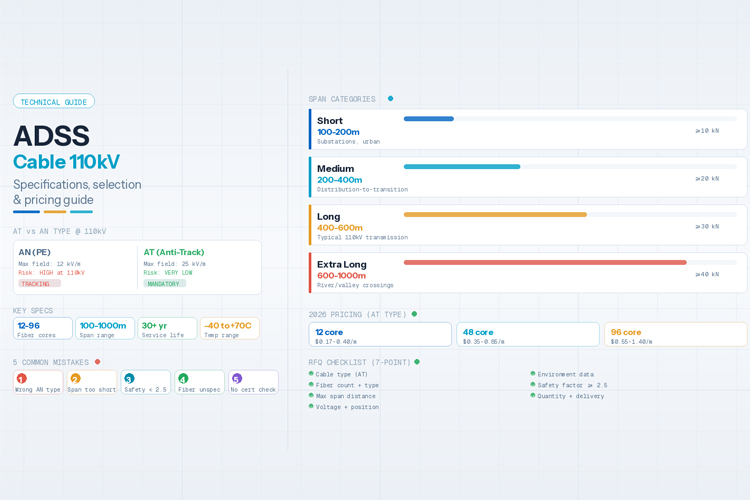
For aerial deployments near power lines, ADSS is the all-dielectric alternative. Covers span calculations, ice/wind loading, and when to use ADSS vs GYFTZY.
adss-fiber-cable-guide
4.Mechanical 1×2 switch for cable protection
5.FTTH Deployment Guide: Protecting the Last Mile — Market, Tech & Cost
6.outdoor fiber cable type selection

 Outdoor Fiber Optic Cable Installation Guide: Aerial, Duct & Direct Burial Methods
 Outdoor Fiber Optic Cable Types: GYTS, ADSS and OPGW Guide
 ADSS Cable for 110kV Power Line: Specifications, Selection & Pricing Guide
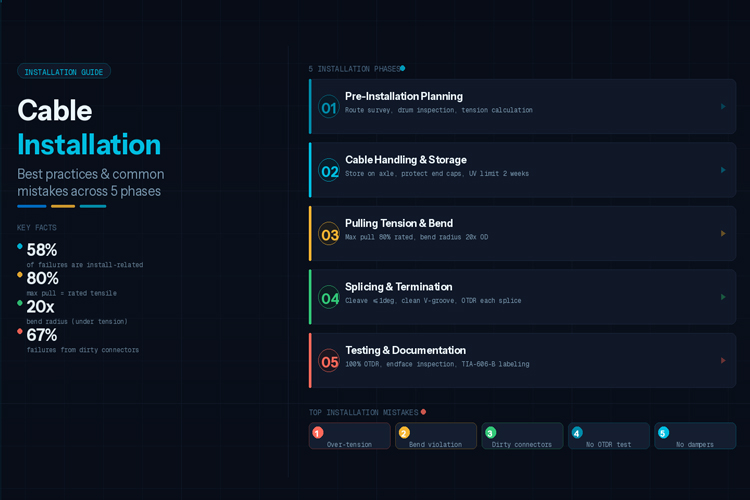 Fiber Cable Installation Best Practices & Common Mistakes


