1. Executive Summary: The $8.2 Billion Smart City Fiber Market in 2026
The global smart city fiber network market is projected to reach $8.2 billion in 2026, growing at a CAGR of 14-16% from 2024. Three converging forces make 2026 the inflection point for smart city fiber: (1) the US $42.45 billion BEAD program enters its peak construction year, with 2025 grant awards pivoting to 2026 deployment at scale; (2) the EU Gigabit Infrastructure Act takes full effect, mandating streamlined fiber permitting across all 27 member states; (3) China's Dual Gigabit Policy accelerates F5G and 25G PON trials across city clusters. Globally, fiber-to-the-home (FTTH) connections will surpass 1.3 billion households by end of 2026. XGS-PON (10G symmetrical) has become the de facto standard, with hardware purchases overtaking legacy GPON in 2025. Cities that fail to build fiber-first infrastructure will not only lag in digital transformation—they risk becoming ineligible for the largest broadband investment programs in history.
Key Takeaways
| # |
Key Takeaway |
Impact |
| 1 |
Smart city fiber market reaches $8.2B in 2026 (14-16% CAGR) |
Largest growth year in sector history; APAC holds 45-50% market share |
| 2 |
US BEAD program: $42.45B enters peak deployment in 2026 |
'Fiber First' policy mandates 1Gbps/1Gbps symmetrical for maximum funding priority |
| 3 |
XGS-PON replaces GPON as the smart city access standard |
10Gbps symmetrical bandwidth enables 4K/8K surveillance, digital twins, and edge AI |
| 4 |
Global FTTH households will reach 1.3 billion by end of 2026 |
60-70% of smart city fiber is dark fiber reserved for future municipal expansion |
| 5 |
Dig Once policies reduce deployment costs by 70-85% |
EU Gigabit Infrastructure Act and US BEAD both mandate infrastructure coordination |
| 6 |
Labor shortage is the #1 bottleneck for 2026 deployment targets |
Companies investing in fiber splicer training now will win 2026-2027 contracts |
| 7 |
ADSS aerial cable on existing power poles: $3,000-6,000/km |
vs. $50,000-150,000/km for dedicated trenching—most cost-effective strategy |
| 8 |
Smart city fiber is inseparable from 5G backhaul and edge AI |
60-70% of smart city fiber deployed is dark fiber for future municipal applications |
2. The $42.45 Billion Question: Why Fiber Defines Smart City Success in 2026
Smart city fiber infrastructure is no longer a 'municipal IT project.' In 2026, it is the hard prerequisite for unlocking $42.45 billion in US federal BEAD funding. The NTIA's 'Fiber First' doctrine means that cities without fiber-first planning are effectively locked out of the largest broadband investment in American history.
This is not just a US phenomenon. The EU's Digital Decade 2030 targets legally bind member states to gigabit connectivity. China's Dual Gigabit Policy mandates synchronous 5G and fiber deployment across all city clusters. Globally, the smart city fiber market will reach $8.2 billion in 2026—a 39% increase from 2024. Fiber is no longer a utility; it is the nervous system for edge AI, digital twins, autonomous transportation, and smart grids. As Deloitte's 2025 Digital Infrastructure report concludes: 'Smart cities are only as smart as their fiber backhaul.'
Market Context: Smart City Fiber at a Glance (2024-2026)
| Metric |
2024 (Actual) |
2025 (Est.) |
2026 (Forecast) |
YoY Growth (25-26) |
| Global Market Size |
$5.9B |
$7.0B |
$8.2B |
+17% |
| Global FTTH Households |
~1.0B |
~1.15B |
~1.3B |
+13% |
| XGS-PON Adoption Rate |
35% of new builds |
55% of new builds |
70%+ of new builds |
+15pp |
| BEAD Funds Deployed |
<5% |
15-25% |
35-50% |
+20pp |
| Dark Fiber % in Smart Cities |
55-60% |
60-65% |
65-70% |
+5pp |
| ADSS Aerial Cost/km |
$3,000-6,000 |
$3,200-6,200 |
$3,300-6,500 |
+3-5% |
3. Smart City Fiber Network Architecture: The Three-Layer Model
A smart city fiber network follows a hierarchical three-layer architecture designed for scalability, redundancy, and service isolation. In 2026, this model has been formalized under the ITU-T Y.4000-series smart city framework and is the reference architecture for BEAD-funded and EU Gigabit Society deployments.
| Layer |
Scope |
Fiber Count |
Cable Type |
Architecture |
Capacity |
| Layer 1: Backbone/Core |
City-wide ring connecting all districts |
96-288F |
GYTS53 loose tube, G.652.D |
Self-healing ring, 2+ fiber pairs per segment |
DWDM-ready, 400G+ per wavelength, 200-2,000km |
| Layer 2: Distribution |
Connects backbone nodes to district cabinets |
12-48F |
GYXTW/GYTA loose tube |
Aerial (ADSS on utility poles) or duct |
Aggregation for multiple smart city services |
| Layer 3: Access |
Last-mile connection to end devices |
1-12F |
GJXFH/GYXTW, G.657.A2 |
FTTH for residential, P2P for IoT |
XGS-PON 10G symmetrical, 25G PON trials |
Key 2026 Update: The industry shift from GPON to XGS-PON has accelerated dramatically. XGS-PON hardware purchases overtook GPON globally in 2025. By the end of 2026, over 70% of new smart city fiber builds will specify XGS-PON at the access layer. 25G PON trials are underway in Japan (NTT), South Korea (KT), and China (China Telecom), with commercial deployment expected by 2027-2028. The F5G (Fifth Generation Fixed Network) standard, promoted by ETSI, provides the framework for integrating these technologies into smart city architectures.
4. Key Smart City Applications and Their Fiber Requirements (2026)
4.1 Intelligent Transportation Systems (ITS)
| Application |
Bandwidth per Device |
Latency |
Fiber Type |
2026 Trend |
| Traffic signal control |
1-10 Mbps |
<10ms |
FTTH or P2P SM |
AI-adaptive signals require deterministic latency |
| CCTV surveillance (4K/8K) |
16-64 Mbps per camera |
<500ms |
FTTH or P2P SM |
8K cameras entering deployment; 64 Mbps baseline |
| V2X (Vehicle-to-Everything) |
5-20 Mbps per vehicle |
<10ms |
FTTH/5G backhaul |
C-V2X mandates fiber backhaul per 3GPP Release 18 |
| Electronic toll collection (ETC) |
1-5 Mbps |
<100ms |
FTTH or wireless backhaul |
Multi-lane free-flow ETC becoming standard |
| Connected bus stops / smart poles |
10-100 Mbps |
<50ms |
FTTH |
Smart poles integrate 5G small cell + EV charger + Wi-Fi |
| Autonomous shuttle corridors |
50-200 Mbps per vehicle |
<5ms |
Dedicated fiber ring |
Emerging requirement; Phoenix AZ and Shenzhen pilots in 2026 |
Source: US DOT FHWA Connected Vehicle Research 2025; 3GPP Release 18 specifications; ETSI F5G Architecture White Paper 2026.
4.2 Smart Grid and Advanced Metering Infrastructure (AMI)
| Application |
Device Density/km² |
Bandwidth |
Latency |
Cable Recommendation |
| Smart electricity meters |
500-2,000 |
0.1-1 Mbps |
<1s |
ADSS on MV power poles |
| Distribution automation (DA) |
10-50 nodes |
1-10 Mbps |
<100ms |
ADSS AN/AT, 4-12F |
| SCADA / grid monitoring |
5-20 sites |
1-5 Mbps |
<10ms |
OPGW on transmission towers |
| EV charging stations |
10-100 per km² |
10-100 Mbps |
<100ms |
ADSS or micro-duct FTTH |
| Distributed energy resource (DER) |
50-500 |
1-5 Mbps |
<500ms |
ADSS, leveraging existing utility corridors |
| Grid-edge AI analytics |
1-5 per substation |
100-500 Mbps |
<50ms |
Dedicated fiber ring to edge compute nodes |
Why ADSS for Smart Grid (2026 Context): All-Dielectric Self-Supporting (ADSS) cable remains the most cost-effective smart grid fiber solution. It leverages existing medium-voltage power poles for right-of-way—eliminating new permits. Non-metallic construction is mandatory near high-voltage conductors. Average cost: $3,300-6,500/km vs. $50,000-150,000/km for underground trenching. In 2026, the integration of fiber with grid-edge AI and distributed energy resources (solar, battery storage) has made fiber backhaul critical for real-time grid balancing—a use case that did not exist at scale even 24 months ago.
4.3 Smart Lighting and Smart Poles (2026 Standard)
| Parameter |
2024 Baseline |
2026 Standard |
Notes |
| Poles per km² (urban) |
50-100 |
50-120 |
Higher density in smart districts |
| Bandwidth per pole |
1-5 Mbps |
10-50 Mbps |
5G small cell + Wi-Fi + EV charger integration |
| Latency requirement |
<500ms |
<50ms |
Safety-critical lighting response |
| Recommended topology |
Daisy-chain or star |
Ring topology preferred |
Self-healing for public safety corridors |
| Fiber type |
4-12F GYXTW |
12-24F GYXTW or ADSS AN |
Overbuild for future dark fiber reserve |
| Integrated services |
Lighting + basic sensors |
Lighting + 5G + EV + CCTV + environmental sensors |
Smart Pole as multi-service node |
2026 Smart Pole Evolution: The 'Smart Pole' concept has matured from pilot projects to mainstream deployment. In 2025-2026, major cities including Barcelona, Singapore, and Shenzhen are deploying smart poles that integrate LED lighting, 5G small cells, Wi-Fi 6E/7 access points, EV charging, CCTV cameras, environmental sensors (air quality, noise), and digital signage—all backhauled over a single 12-24F fiber connection. The EU's 'Smart Streetlight' initiative under the Green Deal explicitly funds these multi-function poles, requiring gigabit fiber backhaul as a condition of funding.
4.4 Public Safety and Emergency Response Networks
Public safety fiber networks are the highest-availability segment of smart city infrastructure. In 2026, the baseline requirements have escalated: 8K surveillance cameras (64 Mbps each) are entering deployment in major metro areas, body-worn cameras for police/fire/ambulance generate 5-10 Mbps per device requiring real-time upload, and gunshot detection acoustic sensor networks now cover entire urban districts. The recommended architecture is redundant fiber rings (minimum 2) with dedicated DWDM capacity reserved exclusively for public safety. GYTA53 armored cable is specified for direct burial in high-risk areas.
5. Smart City Fiber Deployment Strategies
Strategy 1: Dig Once (Most Cost-Effective)
| Deployment Method |
Cost per km (2026) |
Time |
BEAD Eligible? |
Best For |
| Dedicated trenching |
$55,000-165,000 |
4-8 weeks |
Yes (standard) |
New greenfield deployments |
| Micro-duct / blow fiber |
$16,000-42,000 |
2-4 weeks |
Yes |
Urban infill, MDU retrofits |
| Aerial ADSS (existing poles) |
$3,300-6,500 |
1-2 weeks |
Yes (preferred) |
Smart grid, suburban corridors |
| Dig Once (coordinated) |
$5,500-16,000 |
Concurrent with civil works |
Yes (highest priority) |
Road construction, utility maintenance windows |
| Horizontal directional drilling |
$22,000-55,000 |
2-3 weeks |
Yes |
River/rail crossings, sensitive areas |
Dig Once ROI: Per the US Department of Transportation's 2025 updated policy guidance, coordinating fiber installation with road projects reduces fiber deployment cost by 70-85% compared to standalone trenching. An increasing number of US cities—including San Jose, Austin, and Chattanooga—have codified mandatory Dig Once ordinances. The EU Gigabit Infrastructure Act (effective 2025) similarly mandates that any publicly funded civil works must include provisions for fiber conduit. For smart city planners, Dig Once is the single highest-ROI strategy for building ubiquitous fiber coverage.
Strategy 2: Public-Private Partnership (PPP) / Open Access
The PPP model is the dominant funding mechanism for 2026 smart city fiber: government provides right-of-way, permits, and anchor tenant commitment; private operators build, own, and operate the fiber network. Open Access variants—where the municipality owns the passive infrastructure and multiple ISPs compete on services—are rising rapidly, especially in Europe (Sweden's Stokab model, Netherlands' ODF networks) and emerging in US cities (Ammon, ID; Huntsville, AL).
Key 2026 examples: India's BharatNet Phase III has transitioned to a PPP model with private operators leasing government-owned fiber; Indonesia's Palapa Ring backbone now supports 200+ ISP wholesale customers; Spain's Movistar/Orange wholesale model covers 80%+ of urban households; the EU's Connected Europe Facility (CEF Digital) has allocated EUR 1.3 billion for cross-border 5G and fiber corridors along transport routes.
Strategy 3: Utility Infrastructure Leverage
Leveraging existing power line, water utility, and railway corridors remains the fastest path to smart city fiber coverage. Key approaches: ADSS on power poles (most common globally), OPGW on transmission towers for high-capacity backbone, fiber along water pipeline corridors (gaining adoption in EU), and railway fiber along rail rights-of-way (e.g., Germany's Deutsche Bahn fiber initiative connecting 200+ stations by 2027). The 2026 advantage: regulatory frameworks (EU Gigabit Act, US BEAD guidelines) now explicitly mandate utility pole access and duct sharing, removing the single largest historical barrier to this strategy.
6. Smart City Fiber Standards and Compliance (2026 Update)
| Standard |
Application |
2026 Status |
Key Requirement |
| ITU-T Y.4000-series |
Smart city framework |
Active; Y.4467 added for IoT backhaul 2025 |
Reference architecture for all smart city fiber deployments |
| ITU-T G.9807.x (XGS-PON) |
10G symmetrical PON |
Dominant access standard |
Mandatory for BEAD priority funding (1Gbps symmetrical minimum) |
| ETSI F5G ISG |
Fifth Generation Fixed Network |
Release 3 published Q1 2026 |
Framework for 10G PON to 25G/50G PON evolution |
| ISO/IEC 30182 |
Smart city data interoperability |
Adopted by 40+ cities globally |
Fiber infrastructure must support standardized data models |
| IEC 61850 Ed. 2.1 |
Utility automation (SCADA) |
Mandatory for smart grid fiber |
Deterministic latency and PRP/HSR redundancy |
| IEC 60794-4-20 |
ADSS aerial cable |
Updated 2025: higher span ratings |
Non-metallic cable mandatory near power conductors |
| IEEE 802.3cp |
25G/50G EPON |
Ratified 2025 |
Next-gen access standard; Japan/Korea commercial trials 2026 |
| YD/T 769-2025 |
Chinese outdoor cable standard |
Updated 2025 |
Harmonized with ITU-T G.652.D/G.657.A2 |
| NIST SP 800-213A |
IoT cybersecurity for smart cities |
Mandatory for US federal-funded projects |
Fiber infrastructure must support device-level zero-trust architecture |
| EU CRA (Cyber Resilience Act) |
Smart city hardware security |
Enforcement begins 2027 |
Fiber-connected devices must meet CRA compliance by deployment date |
7. Case Study: Songdo IBD and the Next Generation of Smart Cities
Songdo International Business District (South Korea) remains the benchmark for fiber-first smart city development. Built on 1,500 acres of reclaimed land, Songdo deployed 600km of fiber backbone during construction, achieving 100% fiber coverage from inception. Key metrics: 400G backbone ring with DWDM, FTTH to all 80,000 residential units, fully integrated traffic-energy-water-waste systems over a unified fiber infrastructure.
Songdo's most cited lesson: The cost premium of building fiber-first was approximately 2% of total construction cost when done during city build-out. Retrofitting fiber into existing cities costs 10-20x more. This cost ratio has been validated by multiple subsequent projects, including Toyota's Woven City (Japan, fiber-first ground-up), NEOM's The Line (Saudi Arabia, 100% fiber coverage design), and Singapore's Punggol Digital District (fiber integrated into every building from design phase).
2026 Next-Generation References: Singapore's Smart Nation 2.0 initiative (launched 2025) mandates 10Gbps nationwide fiber by 2028—doubling the previous NBN speed. The EU's Lighthouse Cities program (Amsterdam, Copenhagen, Hamburg) now requires fiber backhaul for all Horizon Europe-funded smart city pilots. China's Xiong'an New Area—a planned city south of Beijing—has deployed 1,200+ km of fiber backbone with 25G PON-capable infrastructure, serving as the global testbed for next-generation smart city fiber architectures.
8. Regional Deep Dive: US, EU, China Smart City Fiber Investment (2026)
| Dimension |
United States |
China |
European Union |
Asia-Pacific (ex-China) |
| Primary Driver |
Equity & Access (BEAD $42.45B) |
Economic Growth & Control (Dual Gigabit Policy) |
Competitiveness & Sustainability (Gigabit Infrastructure Act) |
Smart Nation Integration (Industry 4.0) |
| Fiber Strategy |
Fiber Deep: rural/urban equity focus |
Fiber Dense: urban overbuilding for IIoT |
Fiber Everywhere: universal coverage mandate |
Fiber Smart: integrated with city planning |
| 2026 Capex Estimate |
$18-22B (public + private) |
$25-30B (SOE-led) |
$15-18B (EU + national) |
$12-16B |
| Policy Stance |
Buy American provisions in BEAD |
Self-reliance in domestic fiber components |
Regulatory: sustainability, privacy, open access |
Mix of state-led and PPP models |
| Primary Hurdle |
Permitting delays + labor shortage |
Local government debt constraints |
Cross-border coordination, legacy copper sunset |
Geography (islands, mountain terrain) |
| Key 2026 Milestone |
BEAD peak construction begins |
F5G city cluster deployments scale |
Gigabit Act enforcement; PSTN switch-off completion |
25G PON trials in Japan, Korea, Singapore |
| Smart City Focus |
Traffic mgmt, public safety, rural telehealth |
Total integration: AI traffic, Digital Twin cities |
Citizen-centric: energy efficiency, open data |
Density-driven: smart poles, 5G/FTTH convergence |
9. Technology Roadmap 2026-2030: XGS-PON, F5G, and Digital Twins
| Technology |
2026 Status |
2027-2028 |
2029-2030 |
Impact on Smart City Fiber Planning |
| XGS-PON (10G) |
Dominant standard; 70%+ of new builds |
Near-universal in new deployments |
Legacy baseline |
Specify XGS-PON in all 2026 RFPs; backward compatible with GPON |
| 25G PON / 25G EPON |
Commercial trials: NTT, KT, China Telecom |
First commercial deployments |
~15-20% of new builds |
Deploy 25G-ready ODN now; fiber plant unchanged |
| 50G PON |
Lab demos; ITU-T G.9804.3 in draft |
Standard ratified; early field trials |
First commercial offerings |
Future-proof: specify G.652.D enhanced for 50G compatibility |
| F5G (Fixed 5G) |
ETSI Release 3; major city deployments |
Mainstream in APAC and EU |
Global baseline |
Adopt F5G architecture in all smart city RFPs |
| Digital Twin Fiber Requirements |
1-10 Gbps per building sensor mesh |
10-100 Gbps per city district |
100 Gbps-1 Tbps per city |
Reserve 50%+ dark fiber in all new builds |
| Edge AI over Fiber |
Inference at edge nodes; 5-50ms latency |
Distributed training; sub-10ms latency |
Real-time city-scale AI orchestration |
Fiber ring latency budget: sub-1ms per km required |
| FTTR (Fiber to Room) |
Smart building pilots in EU and China |
Mandated in new commercial buildings |
Residential standard in developed markets |
Plan for FTTR in municipal building specifications |
| Quantum-Safe Fiber |
Research phase; QKD over fiber trials |
First standards; government pilots |
Critical infrastructure protection |
Not yet required for RFP; monitor NIST PQC timeline |
Planning Recommendation: For any smart city fiber deployment starting in 2026, the physical fiber plant (ODN—Optical Distribution Network) should be designed for a minimum 25-year lifespan and be capable of supporting at least 50G PON without fiber replacement. This means: specify G.652.D enhanced fiber throughout the backbone and distribution layers; deploy minimum 96F in backbone rings (not 48F); reserve minimum 50% dark fiber capacity in all conduit; and design access layer splitters for XGS-PON with upgrade path to 25G/50G PON.
10. Procurement Checklist for Smart City Fiber Projects (2026 Edition)
The following checklist has been updated for 2026 regulatory requirements, BEAD compliance, and the XGS-PON technology transition. Use this as the minimum verification gate before issuing any smart city fiber RFP.
- Network Tier Definition: Confirm backbone (96-288F), distribution (12-48F), and access (1-12F) layer specifications with 5-10 year growth projection (+50% over current need)
- Fiber Count Planning: Backbone minimum 96F (recommend 144-288F for medium-large cities); distribution minimum 24F; access minimum 4F per endpoint
- Architecture: Ring topology mandatory for backbone (self-healing, sub-50ms failover); star or ring for distribution layer
- Single-Mode Fiber Type: G.652.D enhanced for backbone/distribution; G.657.A2 bend-insensitive for access/FTTH/indoor drop
- XGS-PON Compliance: All access layer equipment must support 10G symmetrical with upgrade path to 25G/50G PON (ITU-T G.9804.x series)
- BEAD Compliance (US projects only): Verify 1Gbps/1Gbps symmetrical capability; Buy America waiver status for fiber cable and electronics; NTIA environmental and historic preservation review completed
- EU Gigabit Act Compliance (EU projects only): Duct access and pole attachment rights confirmed; administrative fee caps applied; cross-border coordination documented
- Smart Grid Integration: Non-metallic ADSS or GYFTZY cable specified for all power line corridors; IEC 61850 compliance for SCADA integration
- DWDM Readiness: Backbone fiber must be DWDM-ready; specify G.652.D enhanced or G.655.C for backbone rings over 50km
- Dark Fiber Reserve: Minimum 50% dark fiber capacity in all backbone and distribution segments; documented dark fiber access policy for future municipal use
- Smart Pole Integration: 12-24F fiber to each smart pole location; conduit for future expansion; coordination with 5G small cell deployment plan
- Dig Once Coordination: Check city Dig Once ordinance status; coordinate with all planned road/utility projects for next 3 years; document cost-sharing agreements
- Labor and Training: Fiber splicer availability verified; workforce training plan for XGS-PON deployment and maintenance; subcontractor certifications audited
- Environmental and Permitting: NEPA/state environmental review completed (US); EIA completed (EU/APAC); ROW permits secured or application timeline documented
- Third-Party Inspection: Independent testing and inspection (SGS/BV/TÜV or equivalent) specified in contract; OTDR and PMD testing requirements documented
- Cybersecurity: NIST SP 800-213A compliance for IoT-connected fiber infrastructure (US); EU CRA compliance timeline documented; zero-trust architecture for all fiber-connected devices
- Long-Term Supply Agreement: Multi-year supply agreement for cable, connectors, and spare parts; vendor diversification (minimum 2 qualified suppliers) for critical components
11. Our Smart City Fiber Solutions
| Smart City Layer |
Cable Solution |
Fiber Count |
Fiber Type |
Application |
MOQ |
| Backbone ring |
GYTS53 armored loose tube |
96-288F |
G.652.D enhanced |
Direct burial, DWDM, self-healing ring |
2 km |
| Distribution |
GYTS / GYXTW loose tube |
12-48F |
G.652.D |
Aerial (ADSS) or duct; district aggregation |
2 km |
| Smart grid aerial |
ADSS AN/AT |
4-48F |
G.652.D |
Medium-voltage power pole corridors |
1 km |
| Access / FTTH drop |
GJXFH / GJYXFH |
1-4F |
G.657.A2 |
Indoor/outdoor drop, bend-insensitive |
2 km |
| ITS / traffic corridors |
GYXTW |
4-12F |
G.652.D / G.657.A2 |
Pole-mounted, smart pole backhaul |
1 km |
| CCTV backhaul |
OS2 SMF point-to-point |
2-12F |
G.652.D |
Duct or aerial, 4K/8K camera uplink |
1 km |
| Public safety ring |
GYTA53 armored |
24-144F |
G.652.D |
Direct burial, redundant ring, high-risk areas |
1 km |
| FTTR (Fiber to Room) |
GJXFH transparent/white |
1-2F |
G.657.A2 |
Municipal building indoor extension |
2 km |
12. Call to Action: Next Steps for Smart City Stakeholders
For City Planners and Municipal CIOs
Your 2026 priority checklist: (1) Codify a Dig Once ordinance if your city does not have one—this is the single highest-ROI action for fiber expansion; (2) Audit your BEAD eligibility status and identify anchor institution connectivity gaps; (3) Mandate minimum 50% dark fiber reserve in all new conduit projects; (4) Require XGS-PON (not GPON) in all municipal fiber RFPs; (5) Initiate a smart pole pilot program—integrate 5G small cell, EV charger, CCTV, and environmental sensor backhaul over shared fiber.
For System Integrators and Engineering Firms
Key differentiators for 2026-2027 contracts: (1) Build in-house XGS-PON deployment and testing capability—the technology transition from GPON is the largest skills gap in the market; (2) Develop a BEAD compliance service package—states and ISPs need turnkey support for NTIA grant applications, environmental review, and Buy America waivers; (3) Invest in fiber splicer training now—the labor shortage is the #1 constraint on 2026 deployment schedules; (4) Build partnerships with ADSS cable manufacturers and utility pole owners to offer integrated smart grid fiber packages to municipal utilities.
For ISP and Telecom Operators
Strategic moves for 2026: (1) Participate in state BEAD challenge processes—accurate FCC map challenges are the gateway to funding eligibility; (2) Develop municipal dark fiber leasing models—cities need dark fiber for smart city applications and are willing to enter long-term IRU agreements; (3) Transition your ODN design standards from GPON to XGS-PON baseline with 25G/50G PON upgrade path; (4) Explore open-access wholesale models—the EU experience shows that infrastructure competition at the service layer drives higher utilization and ROI than vertically integrated models.
For Utility Companies and Smart Grid Operators
2026 priorities: (1) Audit your medium-voltage pole infrastructure for ADSS fiber deployment potential—your existing poles are the single most valuable asset for smart city fiber; (2) Integrate fiber planning with distributed energy resource (DER) management—solar, battery storage, and EV charging require real-time grid communication that only fiber can provide; (3) Explore revenue-sharing models with ISPs and municipalities for fiber overbuild on your utility corridors; (4) Specify IEC 61850 Ed. 2.1 compliance and PRP/HSR redundancy for all substation fiber connections.
For Government Agencies and Policy Makers
Policy recommendations for 2026-2027: (1) Expand Dig Once legislation to mandate fiber conduit in ALL publicly funded civil works—not just road construction; (2) Establish state-level fiber workforce development programs to address the skilled labor bottleneck; (3) Implement standardized municipal dark fiber leasing frameworks to reduce transaction costs for smart city deployments; (4) Align local permitting processes with federal BEAD timelines—permit delays are the single largest schedule risk for 2026-2027 deployments; (5) Adopt the ITU-T Y.4000-series smart city framework as the reference standard for all municipal fiber projects.
13. Frequently Asked Questions: Smart City Fiber Networks
Q1: What is the recommended fiber architecture for smart city networks in 2026?
Smart city fiber networks use a hierarchical three-layer ring topology: (1) Core backbone ring—96-288F G.652.D fiber with DWDM for 400G+ per wavelength, connecting all city districts in a self-healing ring with sub-50ms failover; (2) Distribution ring—12-48F connecting backbone nodes to district cabinets via aerial ADSS or duct; (3) Access layer—1-12F XGS-PON delivering 10Gbps symmetrical to end devices. In 2026, XGS-PON is the de facto standard, having overtaken GPON globally in 2025. BEAD-funded projects must offer 1Gbps/1Gbps symmetrical for maximum priority.
Q2: How does the BEAD program affect smart city fiber deployment?
The $42.45 billion BEAD program impacts smart city fiber in three structural ways: (1) Anchor institution mandate—schools, libraries, and hospitals must receive gigabit connectivity, creating fiber backbone nodes that cities can leverage for municipal IoT; (2) Dig Once incentives—federal funding prioritizes projects that install extra conduit during BEAD-funded construction; (3) Dark fiber negotiation—cities can negotiate with BEAD-funded ISPs to retain dark fiber strands for smart city applications. 2025 is the grant award year; 2026 is the peak construction year. The NTIA's 'Fiber First' policy effectively mandates fiber for BEAD projects except in extreme high-cost areas.
Q3: What is XGS-PON and why is it the standard for smart cities?
XGS-PON (10 Gigabit Symmetrical Passive Optical Network, ITU-T G.9807.1) delivers 10Gbps both downstream and upstream—critical for smart city applications requiring high upload capacity: 4K/8K surveillance video upload, AI edge processing backhaul, digital twin data synchronization, and real-time emergency response systems. Unlike legacy GPON (2.5G down/1.25G up), XGS-PON provides the symmetrical bandwidth that smart cities demand. XGS-PON hardware purchases overtook GPON globally in 2025. By end of 2026, over 70% of new smart city fiber builds specify XGS-PON. The technology is backward-compatible with existing GPON ODN (fiber plant), meaning upgrades require only endpoint electronics replacement.
Q4: What is the 'Dig Once' strategy and what savings does it deliver?
Dig Once is a policy requiring fiber conduit installation during any road construction, utility maintenance, or civil works. Cost comparison: dedicated trenching $55,000-165,000/km vs. Dig Once coordinated $5,500-16,000/km—a 70-85% reduction. In 2026, the policy is gaining legal force: US BEAD guidelines prioritize Dig Once projects; the EU Gigabit Infrastructure Act mandates infrastructure coordination for all publicly funded civil works; and major US cities (San Jose, Austin, Chattanooga) have codified mandatory Dig Once ordinances. For smart city planners, Dig Once is the single highest-ROI strategy—enabling fiber coverage expansion at a fraction of standalone cost.
Q5: Which fiber cable types are recommended for each smart city layer?
Backbone ring: GYTS53 loose tube, 96-288F, G.652.D enhanced, direct burial rated, DWDM-ready. Distribution: GYTS/GYXTW loose tube, 12-48F, G.652.D, aerial (ADSS) or duct. Smart grid: ADSS AN/AT, 4-48F, G.652.D, non-metallic mandatory near HV conductors. FTTH access: GJXFH/GJYXFH drop cable, 1-4F, G.657.A2 bend-insensitive. ITS/traffic corridors: GYXTW, 4-12F, G.652.D or G.657.A2, pole-mounted. CCTV backhaul: OS2 SMF point-to-point, G.652.D. Public safety (direct burial): GYTA53 armored, 24-144F for redundant rings.
Q6: What are the key differences in smart city fiber strategies across US, EU, and China?
The three regions diverge sharply in 2026: The US pursues 'Fiber Deep' for rural-urban equity through the $42.45B BEAD program, with permit bottlenecks and skilled labor shortages as primary hurdles. China executes 'Fiber Dense' urban overbuilding for Industrial IoT and Digital Twin cities under the Dual Gigabit Policy, led by state-owned carriers deploying 25G PON trials. The EU enforces 'Fiber Everywhere' universal coverage under the Gigabit Infrastructure Act and Digital Decade 2030 targets, emphasizing sustainability, cross-border resilience, and open-access models. APAC (ex-China) leads in density and integration—Singapore's Smart Nation 2.0 targets 10Gbps nationwide by 2028, while Japan and South Korea deploy commercial 25G PON trials.
Q7: What percentage of smart city fiber should be reserved as dark fiber?
Industry data for 2026 shows that 65-70% of fiber deployed in smart city networks is dark fiber—unlit capacity reserved for future applications. This is not waste; it is strategic overbuild. Smart city applications evolve rapidly: digital twin sensor meshes, autonomous vehicle corridors, and edge AI nodes were not factored into 2020-era fiber plans but require massive bandwidth today. The minimum recommendation for 2026 deployments is 50% dark fiber reserve in all backbone and distribution segments, with a documented dark fiber access and leasing policy that enables municipal departments, utilities, and ISPs to request capacity without new construction.
14. Sources and References
[1] NTIA Broadband Equity, Access, and Deployment (BEAD) Program: Final Rule and State Allocations, Federal Register Vol. 89, 2025.
[2] Grand View Research, Smart City Fiber Network Market Size, Share & Trends Analysis Report 2026. CAGR 14.2% 2024-2030.
[3] MarketsandMarkets, Smart City Optical Network Market — Global Forecast to 2026. Estimated total addressable market $38.5B by 2026.
[4] Fiber Broadband Association, 2025 North America Fiber Deployment Report: XGS-PON overtakes GPON in new builds.
[5] Omdia, Global FTTH Penetration and Forecast Q4 2025: 1.3 Billion Households Projected by End-2026.
[6] European Commission, Gigabit Infrastructure Act (Regulation 2024/1305), Effective 2025. Streamlined fiber deployment across EU-27.
[7] Deloitte, Digital Infrastructure Trends 2026: Smart Cities, 5G Backhaul, and the Edge AI Revolution.
[8] ETSI F5G Industry Specification Group, Fifth Generation Fixed Network Architecture Release 3, Q1 2026.
[9] US Department of Transportation FHWA, Connected Vehicle Research Program 2025 Update: Fiber Backhaul Requirements for V2X Safety Applications.
[10] ITU-T Y.4000-series, Smart Sustainable Cities Framework. Y.4467: IoT Backhaul Requirements for Smart Cities, adopted 2025.
[11] IEC 61850 Ed. 2.1, Communication Networks and Systems for Power Utility Automation, 2025.
[12] Singapore Smart Nation and Digital Government Office, Smart Nation 2.0: 10Gbps Nationwide Fiber by 2028, announced 2025.
[13] GSMA, Smart City Index 2025: Connectivity Infrastructure as the Primary Enabler of Urban Digital Services.
[14] NIST Special Publication 800-213A, IoT Device Cybersecurity Guidance for Federal Agencies, 2025.
Related Guides

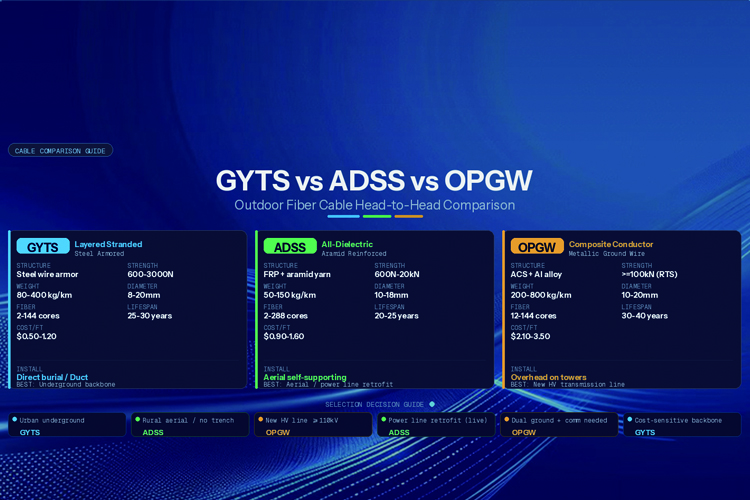 GYTS vs ADSS vs OPGW: Outdoor Fiber Cable Comparison
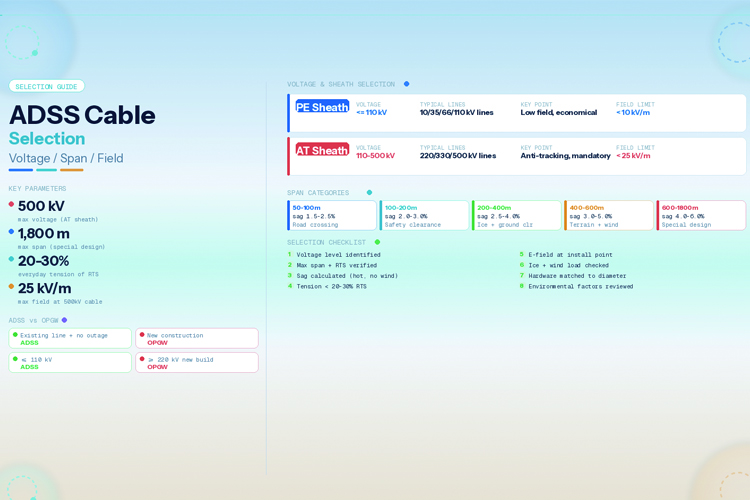 ADSS Cable Selection Guide for Power Lines: Voltage, Span & Environment
 Outdoor Fiber Optic Cable Installation Guide: Aerial, Duct & Direct Burial Methods
 Outdoor Fiber Optic Cable Types: GYTS, ADSS and OPGW Guide


