Introduction
This article is a selection guide for Fiber patch cords and pigtails, which systematically introduces the definitions and differences between the two, different application environments and construction types, specifications and parameters of single core and multi-core Fiber Optic connectors (LC/SC/FC/MPO, etc.) and polishing methods (PC/UPC/APC), key performance indicators (insertion loss and return loss), and provides common fault avoidance methods and quick reference for selection.
Overview: The Critical Last Meter
Fiber patch cords and pigtails are the "last meter" components that connect active equipment (switches, routers, OLTs, ONTs) to the fiber infrastructure. Despite representing less than 1% of total fiber infrastructure cost, they account for 30-40% of all fiber network faults in enterprise and data center environments.
According to Fluke Networks' 2023 Data Center Fiber Survey of 847 data centers worldwide, improper patch cord management and connector contamination caused 67% of network failures. The lesson: never compromise on patch cord quality.
"A single contaminated fiber connector endface — invisible to the naked eye — can introduce 1-5 dB of insertion loss, causing complete link failure in high-speed Ethernet. This is why IEC 61300-3-35 endface inspection standards exist and must be enforced at every termination." — Fluke Networks, Fiber Testing Best Practices 2023*
Fiber Patch Cord vs Fiber Pigtail: What's the Difference?
| Feature |
Fiber Patch Cord |
Fiber Pigtail |
| Definition |
Pre-terminated on both ends |
Pre-terminated on one end; other end is bare fiber |
| Use |
Equipment-to-equipment, patch panel connections |
Fusion splice to distribution cables inside enclosures |
| Connector Types |
Same connector on both ends (e.g., LC-LC, SC-SC) |
Any connector on terminated end; bare fiber on splice end |
| Typical Length |
0.5m to 30m (indoor) |
0.5m to 3m (enclosure splice) |
| Application |
Patch panels, fiber frames, equipment rack interconnects |
Splice closures, ODF (Optical Distribution Frame) termination |
| Reusability |
Fully reusable |
Typically single-use (spliced) |
| Installation |
Plug-and-play |
Requires fusion splice + splice tray |
| Cost |
Higher (two connectors) |
Lower (one connector) |
| Loss Performance |
Factory-tested IL ≤ 0.25 dB typical |
Factory-tested IL ≤ 0.15 dB typical (splice loss 0.05-0.1 dB) |
Fiber Patch Cord Types
By Application Environment
| Type |
Standard |
Application |
Jacket |
Key Feature |
| OFNR |
UL 1666 |
Indoor vertical riser (floor-to-floor) |
PVC |
Non-conductive, non-plenum |
| OFNP |
UL 910 |
Indoor plenum spaces (air handling) |
PVDF |
Fire-rated, no toxic fumes |
| LSZH |
IEC 60332 |
Indoor, public buildings, ships |
LSZH compound |
Low smoke, zero halogen |
| PVC |
General |
Indoor, controlled environments |
Standard PVC |
Economical, flexible |
| Armored |
Indoor/interlocked |
Industrial, high-traffic areas |
Interlocked steel armor |
Crush and impact resistant |
| Outdoor |
UV-resistant |
Outdoor termination points |
PE, UV-stable |
UV and weather resistant |
By Construction Type
1. Simplex Patch Cord
.Single fiber, single connector on each end
.Used for: single-fiber connections, FTTH ONT, 1G SFP connections
.Diameter: 1.6mm, 2.0mm, or 3.0mm jacket
2. Duplex Patch Cord
.Two fibers, two connectors on each end (zipcord or round)
.Used for: Ethernet (Tx/Rx pairs), Fibre Channel, bidirectional (BiDi)
.Diameter: 1.6×3.4mm (zipcord) or 2.0-3.0mm round
3. Multi-Fiber MPO/MTP Cables
.8, 12, 16, 24, 48 fibers in one cable
.MPO (Megabit Push-On) connector on both ends
.Used for: 40G/100G/400G Ethernet parallel optics, data center structured cabling
.Per IEC 61754-7 and TIA-568.3-D
4. Mode Conditioning Patch Cord (MCP)
.Combines MM and SM fiber in one cord
.Used for: 10GBASE-LRM (1300nm) over legacy OM1/OM2 multimode
.Eliminates DMD (Differential Mode Delay) issues
Connector Types: Complete Guide
Single-Fiber Connectors
| Connector |
Full Name |
Key Feature |
Typical Use |
IL (Typical) |
RL |
Standard |
| LC |
Lucent Connector |
Small form factor (1.25mm ferrule) |
Data centers, SFP+ |
≤ 0.15 dB |
≥ 45 dB |
IEC 61754-20 |
| SC |
Subscriber Connector |
Snap-in, push-pull |
FTTH, telecom |
≤ 0.15 dB |
≥ 45 dB |
IEC 61754-4 |
| FC |
Ferrule Connector |
Screw-type, secure |
Test equipment, CATV |
≤ 0.15 dB |
≥ 45 dB |
IEC 61754-13 |
| ST |
Straight Tip |
Bayonet twist-lock |
Legacy LAN, military |
≤ 0.25 dB |
≥ 40 dB |
IEC 61754-2 |
| MU |
Mini-UUPC |
Small form factor (1.25mm ferrule) |
High-density, telecom |
≤ 0.15 dB |
≥ 45 dB |
IEC 61754-6 |
| E2000 |
E-2000 |
Spring-loaded shutter |
Medical, defense |
≤ 0.10 dB |
≥ 55 dB |
IEC 61754-15 |
Ferrule Material: Zirconia ceramic (standard, ≥ 95% of market), Stainless Steel (industrial), Plastic (economy, not recommended)
Polish Types: PC, APC, UPC
| Polish |
Color |
Return Loss |
Application |
| PC (Physical Contact) |
Beige/Blue |
≥ 40 dB |
Multimode, legacy |
| UPC (Ultra Physical Contact) |
Blue |
≥ 50 dB |
Data centers, GPON |
| APC (Angled Physical Contact) |
Green |
≥ 60 dB |
CATV, DWDM, RFoG |
"APC connectors reduce return loss by 10-20 dB compared to UPC, which is critical for analog video (CATV), radio over fiber (RoF), and DWDM systems. In GPON FTTH networks, mixing APC and UPC causes 3-8 dB of unnecessary loss — always verify your OLT and ONT connector types before ordering." — Broadband Forum TR-101, 2022*
MPO/MTP Connectors (Multi-Fiber)
| Type |
Fiber Count |
Polarity |
Key Application |
Standard |
| MPO-8 |
8 fibers |
Type A/B/C |
40G QSFP+ (SR4), 100G SR4 |
IEC 61754-7 |
| MPO-12 |
12 fibers |
Type A/B/C |
40G QSFP+ (SR4), 12F parallel |
IEC 61754-7 |
| MPO-16 |
16 fibers |
Type A/B |
100G SR4 (16F used), 400G SR8 |
IEC 61754-7 |
| MPO-24 |
24 fibers |
Type A/B/C |
400G SR4.2, 100G SR4 (12F used) |
IEC 61754-7 |
Polarity Management (TIA-568.3-D):
.Type A: Key-up to key-down (straight-through)
.Type B: Key-up to key-up (reversed fiber sequence)
.Type C: Adjacent-pair flip (fibers 1↔2, 3↔4...)
Fiber Pigtail Types
| Type |
Fiber |
Application |
Key Use |
| G.657.A1 Pigtail |
SM 9/125 |
FTTH, premises |
Tight bends, ONT termination |
| G.657.A2 Pigtail |
SM 9/125 |
FTTH, complex routing |
Ultra-tight bends |
| OM3 Pigtail |
MM 50/125 |
Data center, LAN |
VCSEL-optimized |
| OM4 Pigtail |
MM 50/125 |
High-speed data center |
40G/100G Ethernet |
| G.652.D Pigtail |
SM 9/125 |
Telecom, access networks |
Standard single-mode |
| Splicing Pigtail (0.9mm) |
Any |
Enclosure splicing |
0.9mm semi-tight buffer |
| Fan-Out Pigtail |
12F/24F ribbon |
Mass fusion splicing |
Ribbon fiber termination |
Standard Pigtail Length: 1.0m, 1.5m, 2.0m (custom lengths available)
Critical Specifications
Insertion Loss (IL) & Return Loss (RL)
Per IEC 61300-3-4 (insertion loss) and IEC 61300-3-6 (return loss):
| Connector Type |
IL (Max) |
IL (Typical) |
RL (Min) |
| LC/UPC |
0.30 dB |
0.10-0.15 dB |
45 dB |
| SC/UPC |
0.30 dB |
0.10-0.15 dB |
45 dB |
| FC/UPC |
0.30 dB |
0.10-0.15 dB |
45 dB |
| LC/APC |
0.30 dB |
0.10-0.15 dB |
60 dB |
| SC/APC |
0.30 dB |
0.10-0.15 dB |
60 dB |
| MPO (12F) |
0.50 dB |
0.15-0.25 dB |
30 dB |
"Per TIA-568.3-D, the maximum channel insertion loss for an OM4 multimode link at 40G Ethernet (100m) is 1.9 dB. With two LC connectors and fusion splices, a single connector loss of 0.30 dB can quickly consume your optical budget. Always use factory-tested patch cords with IL ≤ 0.15 dB for high-speed links." — TIA-568.3-D (2020)*
Fiber Performance
| Fiber Type |
Wavelength |
Attenuation |
Bandwidth |
Standard |
| G.652.D (single-mode fiber) |
1310/1550nm |
0.35/0.22 dB/km |
N/A (dispersion-limited) |
ITU-T G.652 |
| G.657.A1 (single-mode fiber) |
1310/1550nm |
0.35/0.22 dB/km |
Same |
ITU-T G.657 |
| G.657.A2 (single-mode fiber) |
1310/1550nm |
0.35/0.22 dB/km |
Same |
ITU-T G.657 |
| OM3 (multimode fiber) |
850nm |
3.5 dB/km |
2000 MHz·km |
IEC 60793-2-10 |
| OM4 (multimode fiber) |
850nm |
3.5 dB/km |
4700 MHz·km |
IEC 60793-2-10 |
| OM5 (multimode fiber) |
850-950nm |
3.0 dB/km |
2800 MHz·km |
IEC 60793-2-10 |
conclusion
Although fiber optic Patch cords and Pigtails account for less than 1% of the total cost of fiber optic infrastructure, they cause 30% -40% of network failures. Therefore, it is necessary to strictly match the connector type, polishing method, and fiber grade according to the application scenario (data center/FTTH/CATV, etc.), insist on selecting high-quality products that have been tested by the factory (IL ≤ 0.15 dB) and come with test reports, and strictly implement end face cleaning and bending radius specifications to ensure the reliable operation of high-speed networks.
Sources and References
For Fiber Patch Cords
[1] Connector type matches equipment SFP (LC/SC/FC)
[2] Polish type matches network: UPC (Ethernet) or APC (CATV/DWDM)
[3] Fiber type matches infrastructure: OS2 (SM), OM3/OM4/OM5 (MM)
[4] Length: measure actual path with 10% margin; don't over-order
[5] Jacket type: LSZH (public buildings), OFNP (plenum), PVC (standard rack)
[6] IL ≤ 0.15 dB per connector (verify on test report)
[7] RL ≥ 45 dB (UPC) or ≥ 60 dB (APC) on test report
[8] 100% factory inspection per IEC 61300-3-35 (endface geometry)
[9] OTDR trace test available (premium option)
[10] Individual packaging (each cord labeled with ID, IL, RL results)
[11] Fluke/EXFO test report provided with shipment
[12] MOQ: typically 10-100 pcs per type for custom orders
For Fiber Pigtails
[13] Fiber type matches distribution cable
[14] Connector type matches splice closure or ODF adapter
[15] Polish: UPC or APC
[16] Tube diameter: 0.9mm (standard) or 2.0mm (ruggedized)
[17] Color-coded by fiber position (blue/green for fiber 1/2 in duplex)
[18] Strippable: semi-tight buffer for easy splice preparation
[19] Packaging: 12-pack or 24-pack sets
[20] Test report: OTDR trace for each pigtail
How to Avoid Common Failures
Failure 1: Connector Contamination (Most Common)
Solution: Always use protective caps when connectors are not mated. Inspect and clean every connector before mating using:
- Fiber optic cleaning wipes (≥ 94% isopropyl alcohol)
- One-click cleaner (for LC/SC/FC)
- Stick cleaners for MT/MPO ferrules
- Verify with fiber optic microscope (per IEC 61300-3-35)
Failure 2: Wrong Polish Type
Solution: Verify OLT/ONT and SFP+ module specs. Common mix-ups:
- FTTH ONT: typically SC/APC (green)
- GPON OLT: typically SC/UPC or SC/APC
- Data center switch SFP+: typically LC/UPC (blue)
- 40G/100G QSFP+ parallel optics: MPO/UPC
Failure 3: Excessive Bend Radius
Solution: Minimum bend radius for tight-buffered patch cords:
- SM G.657.A1: ≥ 10mm
- SM G.657.A2: ≥ 7.5mm
- MM OM3/OM4: ≥ 15mm (under no tension)
Our Patch Cord & Pigtail Manufacturing Range
Patch Cords
| Product |
Fiber |
Connector |
Polish |
Jacket |
MOQ |
| LC-LC Duplex |
OS2/OM3/OM4 |
LC/UPC or APC |
UPC/APC |
PVC/LSZH/OFNP |
10 pcs |
| SC-SC Simplex |
OS2/OM3/OM4 |
SC/UPC or APC |
UPC/APC |
PVC/LSZH/OFNP |
10 pcs |
| SC/APC to LC/UPC |
OS2 |
Mixed |
Mixed |
PVC/LSZH |
10 pcs |
| MPO-12 Trunk |
OM3/OM4/OS2 |
MPO-12 UPC |
UPC |
LSZH/OFNP |
5 pcs |
| Mode Conditioning |
OM3 + SM |
SC-LC mixed |
UPC |
PVC |
10 pcs |
| Armored LC-LC |
OS2/OM3/OM4 |
LC/UPC |
UPC |
Interlocked armor |
10 pcs |
Pigtails
| Product |
Fiber |
Connector |
Polish |
Buffer |
MOQ |
| G.657.A1 Pigtail |
SM 9/125 |
LC/SC/FC |
UPC/APC |
0.9mm |
12 pcs |
| G.657.A2 Pigtail |
SM 9/125 |
LC/SC/FC |
UPC/APC |
0.9mm |
12 pcs |
| OM3 Pigtail |
MM 50/125 |
LC/SC |
UPC |
0.9mm |
12 pcs |
| OM4 Pigtail |
MM 50/125 |
LC/SC |
UPC |
0.9mm |
12 pcs |
| 12F Ribbon Pigtail |
OS2 |
MPO-12 |
UPC |
3.0mm ribbon |
5 pcs |
Summary Quick Reference
Connector Selection Guide:
Data Center SFP+ → LC/UPC (blue, 1.25mm ferrule)
FTTH ONT → SC/APC (green, 1310/1490/1550nm PON)
GPON OLT → SC/UPC or SC/APC (verify SFP type)
40G/100G Parallel → MPO-12/UPC (12F or 8F key-up/key-down)
400G SR8 → MPO-16/UPC or MPO-24/UPC
CATV/RFoG → SC/APC (green, mandatory for RF systems)
Polish Type:
Digital Ethernet → UPC (blue) — sufficient
Analog Video/RF → APC (green) — mandatory
DWDM/Coherent → APC (green) — mandatory
FTTH GPON → APC (green) — industry standard
Patch Cord Length Rule:
Measure the physical path, add 15% margin
Common lengths: 1m, 2m, 3m, 5m, 10m
>10m: consider duplex SM for future 40G+ migration
Sources cited: IEC 61300-3-4/3-6/3-35/61754 series, TIA-568.3-D (2020), ITU-T G.652/G.657, IEEE 802.3, Fluke Networks 2023, Broadband Forum TR-101, IEC 60793-2-10, IEC 60332
Frequently Asked Questions
Q1: What is the difference between a fiber patch cord and a pigtail?
A fiber patch cord has connectors on both ends, used to connect active equipment (switches, routers, ONTs) or to connect between distribution panels. A pigtail has a connector on one end and bare fiber on the other, used for fusion splicing to a fiber stub or for direct connection to test equipment. In FTTH, pigtails are typically fusion-spliced to the distribution fiber inside a splice closure, then the connectorized end is plugged into the adapter panel.
Q2: How do I choose the right fiber patch cord for a data center?
For data center selection: (1) match fiber type to link distance — OM4 for 40G SR4 at 100m or 100G SR4 at 100m, single-mode OS2 for longer links; (2) match connector types — LC duplex for 10G/25G server connections, MPO for 40G/100G/400G trunk connections; (3) select jacket rating — LSZH for standard indoor, plenum-rated for raised-floor cooling systems; (4) verify polarity method — Method B (key-up/key-down) for MPO trunk cables; (5) specify 500+ mating cycle connectors for high-move-add-change environments.
Q3: What is the typical insertion loss of a quality fiber patch cord?
Quality single-mode patch cords (SC/UPC or LC/UPC) have insertion loss ≤0.15 dB (typical: 0.05-0.10 dB). SC/APC patch cords have ≤0.20 dB (typical: 0.08-0.15 dB). Multimode OM3/OM4 patch cords have ≤0.30 dB (typical: 0.10-0.20 dB). Factory-tested patch cords with individual test reports (IL and RL values) should be specified for all professional deployments. Budget patch cords with no test data can have insertion loss exceeding 0.5 dB, which is unacceptable in high-speed networks.
Related Guides

 WDM Product Market Research Report: Technology, Trends, and Growth Forecast
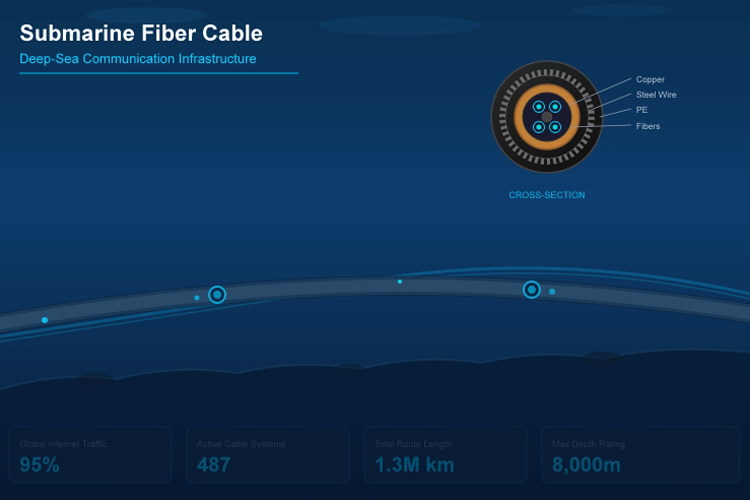 Submarine Fiber Cable: Deep Sea Communication Infrastructure Guide
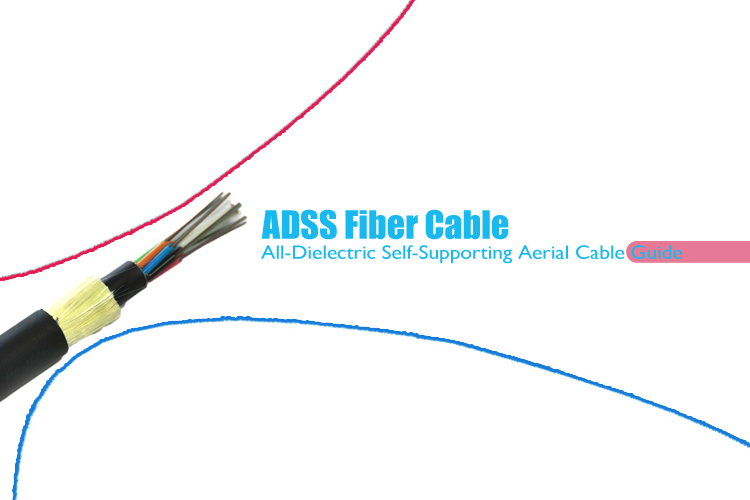 ADSS Fiber Cable: All-Dielectric Self-Supporting Aerial Cable Guide
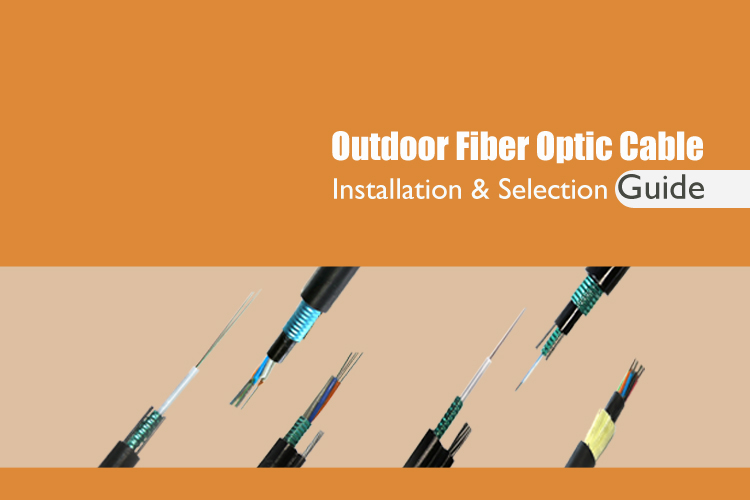 Outdoor Fiber Optic Cable: Installation & Selection Guide


