Introduction
This article is a guide to submarine optical cable products. At the beginning, it explains that the submarine optical cable carrying 95% of the international Internet traffic is the core infrastructure of global interconnection. At the same time, it introduces the deployment scale, market investment status and benchmark engineering cases of the current global submarine optical cable system.
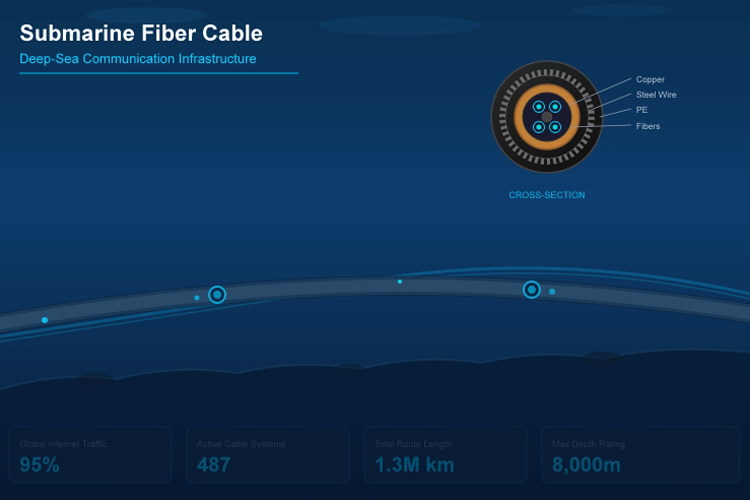
The Backbone of Global Connectivity
Submarine fiber optic cables carry approximately 95% of all international internet traffic — far exceeding satellite communications by bandwidth and latency. Every email you send internationally, every video call across oceans, every financial transaction between continents travels through submarine fiber optic cables lying on the ocean floor.
According to TeleGeography's Submarine Cable Map 2023, there are currently 487 active submarine cable systems with a total route length exceeding 1.3 million kilometers. The global submarine cable market invested $22 billion in new systems between 2019-2023, with an additional $8 billion planned through 2026 for new routes in Africa, Southeast Asia, and Pacific islands.
"Each new submarine cable system represents a generational infrastructure investment. Systems like 2Africa (45,000 km, 16 fiber pairs, 500 Tbps capacity) and Marea (6,600 km, 8 fiber pairs, 200 Tbps) represent the current state of the art in submarine fiber engineering." — TeleGeography, Submarine Cable Networks 2023*
Submarine Cable Categories by Depth
Landing Section (0-500m depth)
The most vulnerable zone — subject to fishing trawlers, anchors, and tidal forces.
| Type |
Application |
Armor |
Key Feature |
| Light Armored |
Beach landing, harbor |
Single steel wire braid + jute |
Easy handling, shore protection |
| Double Armored |
Shallow water ≤ 500m |
Double steel wire + bedding |
Trawler/anchor protection |
| Rock Armored |
Rocky seabed |
Extra armor layers + rock guard |
Abrasion resistance |
Why armor matters at landing:
Per IEC 60794-3-12, submarine cables in the first 500m from shore experience 10× more mechanical stress than deep-water sections due to fishing activity, anchoring, and wave action.
Deep Sea Section (500m-8,000m depth)
"Light-weight" cable design — armor removed for cost and weight efficiency.
| Parameter |
Specification |
| Cable Diameter |
17-25mm (typical) |
| Cable Weight (in air) |
1,200-1,800 kg/km |
| Cable Weight (in water) |
~700-1,000 kg/km (buoyant) |
| Fiber Count |
4-16 fiber pairs (up to 24 on newer systems) |
| Single Fiber Capacity |
10-40 Tbps (using SF-64G coherent optics) |
| System Capacity |
100-500 Tbps |
| Design Life |
25 years |
Submarine Cable Structure
Shallow Water / Landing Cable:
[Polypropylene (PP) inner sheath]
↓
[Steel wire armor (double layer, contra-helically wound)]
↓
[Bitumen / tar compound (anti-corrosion)]
↓
[Jute outer serving (fishing protection, seabed abrasion)]
↓
[Central steel tube (contain fibers) / loose tube (newer designs)]
↓
[Multiple fiber units, jelly-filled]
↓
[Fibers: G.652.D or G.654.C (cut-off shifted SMF for long-haul)]
Deep Sea Cable:
[Polyethylene (PE) outer sheath]
↓
[Copper conductor (power feeding) / all-dielectric options]
↓
[Steel tube (hermetic, pressure-resistant) containing fibers]
↓
[Fiber units: up to 12 fibers per tube]
↓
[Helium-filled (for long-haul systems)]
Submarine Cable Fiber Types
| Fiber Standard |
Application |
Key Characteristic |
| G.652.D |
Short-haul (< 100km) |
Standard single-mode |
| G.654.B/C/D |
Long-haul, ultra-long-haul |
Cut-off shifted, lower loss at 1550nm, larger effective area |
| G.655.C |
Medium-haul |
Non-zero dispersion shifted, DWDM-optimized |
G.654 — The Backbone Fiber:
The ITU-T G.654 standard (Cut-off Shifted Single-Mode Fiber) is specifically designed for submarine and long-haul terrestrial applications:
- Larger effective area: 110-130 μm² (vs 80 μm² for G.652.D) — reduces non-linear effects
- Lower attenuation at 1550nm: ≤ 0.19 dB/km
- Operating wavelength: 1530-1625nm (C-band and L-band)
"The transition from G.652 to G.654.C fiber in submarine systems has enabled a 40% increase in total system capacity with the same number of fiber pairs. For next-generation systems exceeding 400Gbps per wavelength, G.654 is mandatory." — SubOptic 2023 Technical Committee Report*
Procurement & Specification Guide (Landing / Shallow Water Cables)
For most international buyers outside the submarine cable consortium market, the relevant product is shallow-water armored cable for beach landings, harbor crossings, and lake crossings.
Key Specifications for Shallow Water Cable:
| Parameter |
Light Armored |
Double Armored |
| Depth Rating |
≤ 200m |
≤ 1,000m |
| Diameter |
20-28mm |
28-40mm |
| Weight (air) |
1,500-2,500 kg/km |
2,500-4,500 kg/km |
| Crush Strength |
≥ 3,000N/100mm |
≥ 5,000N/100mm |
| Armor Wire Diameter |
2.0-3.0mm |
3.0-4.5mm |
| Tensile Strength |
50-100 kN |
100-200 kN |
| Min. Bend Radius |
20×OD |
25×OD |
Standards:
- IEC 60794-3-12: Outdoor cables — submarine optical cables
- IEC 60793-2-50: G.654 fiber specifications
- ITU-T G.654: Cut-off shifted single-mode fiber
- IEEE 1402: Submarine power cables (for hybrid power+ fiber cables)
Application Scenarios for Shallow Water Cable
1. Island Connections
Connecting mainland networks to islands:
- Typical spans: 1-50km
- Depth: 0-200m
- Recommended: Light armored or double armored depending on fishing activity
- Example: Indonesian archipelago (17,000 islands), Philippines, Caribbean islands
2. Harbor and Port Crossings
Fiber connections under shipping channels:
- Depth varies from 10-50m
- Fishing and anchor threat high
- Recommended: Double armored
- Must coordinate with port authority for installation window
3. Lake and River Crossings
Major river crossings for national fiber backbones:
- Water current creates dynamic load
- Ice loading in cold climates
- Shallow depth variation
4. Coastal Protection and Military
Secure, hardened fiber links:
- Anti-tampering armored construction
- Surge protection for defense networks
Conclusion
This guide system sorts out the classification, structure, and fiber selection standards of submarine optical cables adapted to different depths, provides procurement parameter specifications, application scenarios, and checklists for shallow sea optical cables, and provides corresponding product selection references and actual deployment verification cases, providing a complete technical reference framework for the procurement and deployment of submarine optical cables, especially in shallow sea scenarios.
Sources and References
[1 ] Water depth and seabed conditions confirmed
[2 ] Cable type (light/double/rock armor) matches depth and threat
[3 ] Fiber type: G.654.C for long-haul (≥ 100km); G.652.D for shorter spans
[4 ] Fiber count: number of fiber pairs + spare pairs recommended
[5 ] System capacity requirements defined (per ITU-T G.654 bandwidth planning)
[6 ] Armor wire grade: galvanized steel or stainless steel (for corrosive seawater)
[7 ] Cathodic protection plan (to prevent galvanic corrosion of armor)
[8 ] Burial or surface placement confirmed (burial recommended in < 1,000m depth if possible)
[9 ] Power feeding equipment (PFE) compatibility for repeatered systems
[10 ] Landing point environmental study: seabed composition, tidal range, fishing activity
Frequently Asked Questions
Q1: What is the difference between submarine and standard outdoor fiber cable?
Submarine fiber cables are engineered for permanent underwater deployment with: (1) double-armor protection (two layers of steel wire armor) for mechanical protection from anchors, fishing nets, and seabed abrasion; (2) pressure-resistant gel and water-blocking layers rated for depths up to 8,000m; (3) polyethylene outer sheath resistant to seawater corrosion; (4) repeater-compatible fiber for long-haul undersea transmission. Standard outdoor cables cannot survive underwater deployment due to insufficient armor, water ingress, and pressure degradation.
Q2: What fiber types are used in submarine fiber optic cables?
Submarine cables use ultra-low-loss (ULL) single-mode fiber with attenuation of 0.17-0.18 dB/km at 1550 nm (vs 0.22 dB/km for standard G.652.D). Common types include: G.654.D (cut-off shifted fiber) optimized for C-band and L-band DWDM transmission at 1550 nm; and specialized submarine fibers from Corning (Vascade) and OFS (AllWave Fulfillment). The ultra-low loss enables unrepeatered spans of 150-300 km, significantly reducing the number of expensive submarine repeaters.
Q3: How are submarine fiber cables repaired when damaged?
Submarine cable repairs require a specialized repair vessel with dynamic positioning, Remotely Operated Vehicle (ROV), and fusion splicing equipment rated for 6,000m depth. The repair process: (1) locate the fault using OTDR from shore; (2) ROV or grapnel retrieves both cable ends; (3) cable ends are brought to the surface on the vessel; (4) fusion splice repairs the fiber (0.05 dB per splice, tested with OTDR); (5) splice housing (joint box) is applied and cable is re-laid to the seabed. A single submarine cable repair can cost $1-5 million depending on depth and location.
Related Guides

 OPGW Cable Selection Guide for High-Voltage Transmission Lines
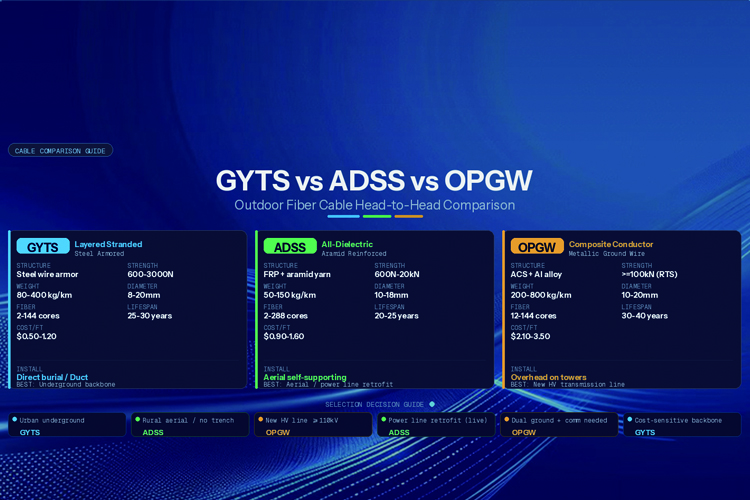 GYTS vs ADSS vs OPGW: Outdoor Fiber Cable Comparison
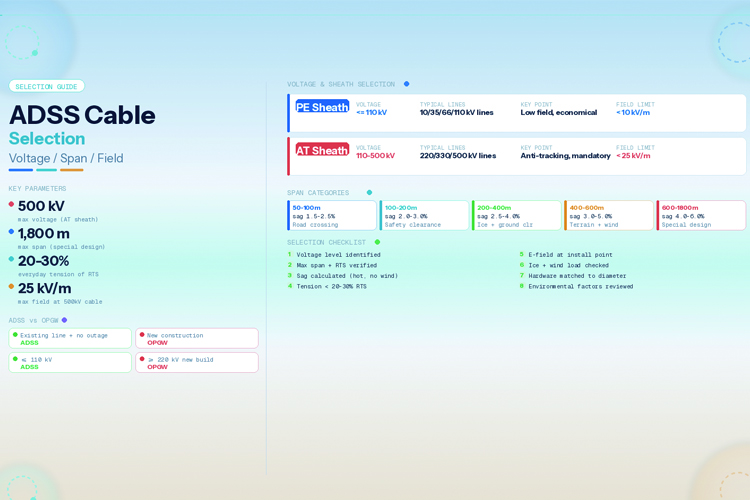 ADSS Cable Selection Guide for Power Lines: Voltage, Span & Environment
 Outdoor Fiber Optic Cable Installation Guide: Aerial, Duct & Direct Burial Methods


