Introduction: Why Comparing Cable Types Matters for Project Success
In fiber optic network deployment, selecting the wrong cable type is among the most expensive mistakes a project team can make. Unlike indoor patch cables that can be swapped in minutes, outdoor fiber cables are embedded in infrastructure — buried in trenches, suspended on poles, or integrated into transmission towers. A poor cable type choice can result in mechanical failure under environmental stress, excessive installation costs, or incompatibility with the deployment environment, leading to costly re-engineering and project delays.
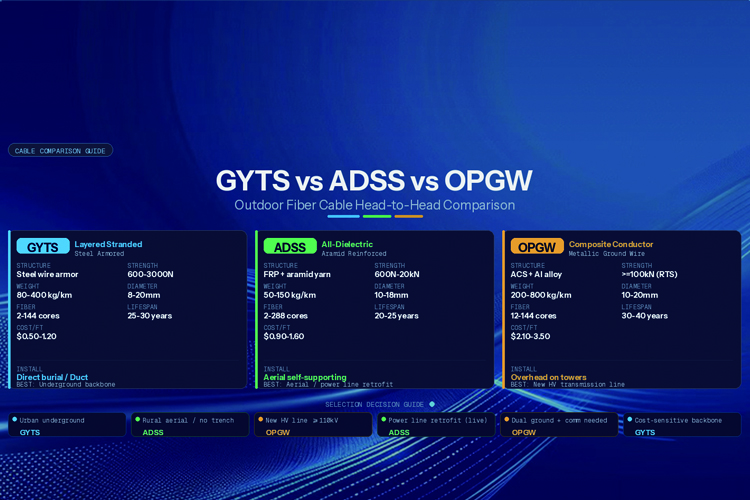
This article provides a detailed, head-to-head comparison of the three most widely used outdoor fiber optic cable types: GYTS, ADSS, and OPGW. Whether you are comparing GYTS vs ADSS for an underground-to-aerial transition, evaluating ADSS vs OPGW for a power line project, or weighing GYTS vs GYTA for a cost-sensitive backbone, this comparison covers the structural, mechanical, electrical, and economic differences that drive cable selection decisions.
For a broader overview of all outdoor fiber optic cable types, see our outdoor fiber optic cable types guide.
Structure Comparison: Inside GYTS, ADSS, and OPGW
Understanding the internal structure of each cable type is fundamental to understanding their performance differences. The three cables take radically different engineering approaches to the same challenge: protecting optical fibers in outdoor environments.
GYTS Structure
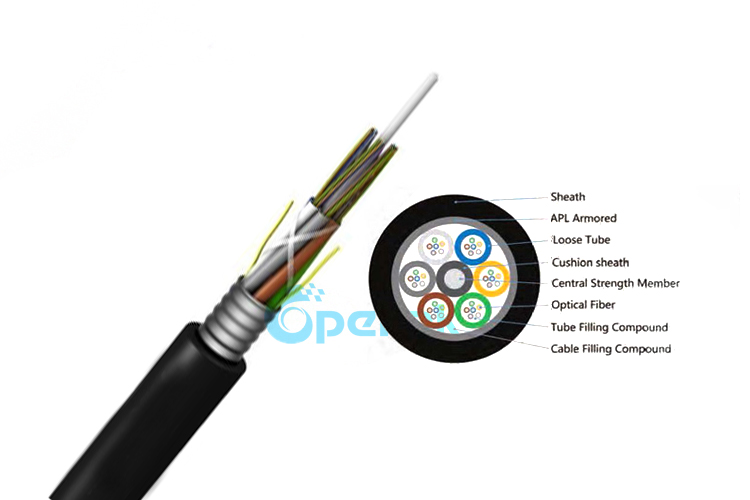
GYTS uses a layered stranded design optimized for underground mechanical protection:
- Central strength member: A phosphated steel wire (1.5–3.0mm diameter) provides the primary tensile reinforcement and serves as the stranding core
- Loose tubes: Multiple fiber-containing loose tubes (each holding up to 12 fibers) are stranded helically around the central member with a lay length of 80–120mm
- Water-blocking gel: Thixotropic gel fills each loose tube and the interstitial spaces between tubes, preventing longitudinal water migration
- Water-swellable tape: An optional layer of water-swellable tape wraps the stranded core for additional moisture protection
- Steel wire armor: A layer of galvanized steel wires (typically 0.15–0.30mm diameter) is applied helically over the core, providing crush resistance and rodent protection
- Outer sheath: A black polyethylene (PE) jacket extruded over the armor, UV-stabilized for direct sun exposure
Typical diameter: 8–20mm depending on fiber count. The steel armor makes GYTS the heaviest of the three per meter.
ADSS Structure
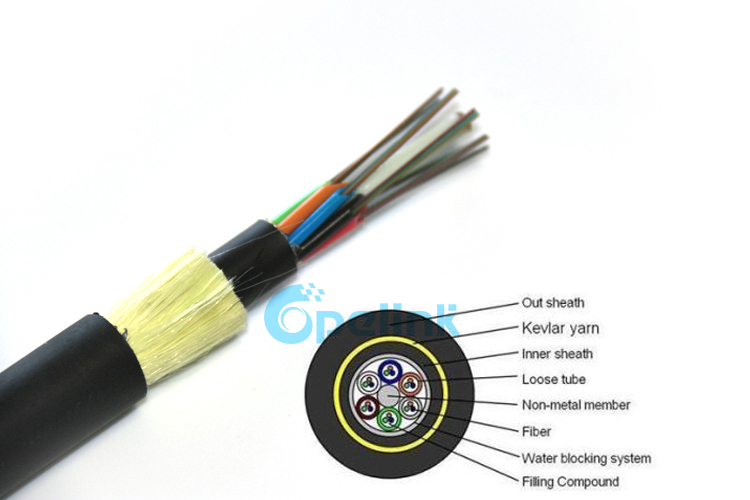
ADSS uses an all-dielectric design optimized for self-supporting aerial spans:
- Central strength member: A Fiber Reinforced Plastic (FRP) rod provides a non-conductive, lightweight core with moderate stiffness
- Loose tubes: Stranded around the FRP center, gel-filled for water blocking (same fiber protection approach as GYTS)
- Aramid yarn strength layer: Multiple layers of Kevlar (aramid yarn) are applied over the stranded core — this is the defining structural element of ADSS. The aramid yarn carries the entire tensile load of self-supporting spans, with breaking strengths ranging from 600N to 20kN depending on cable design
- Outer sheath:
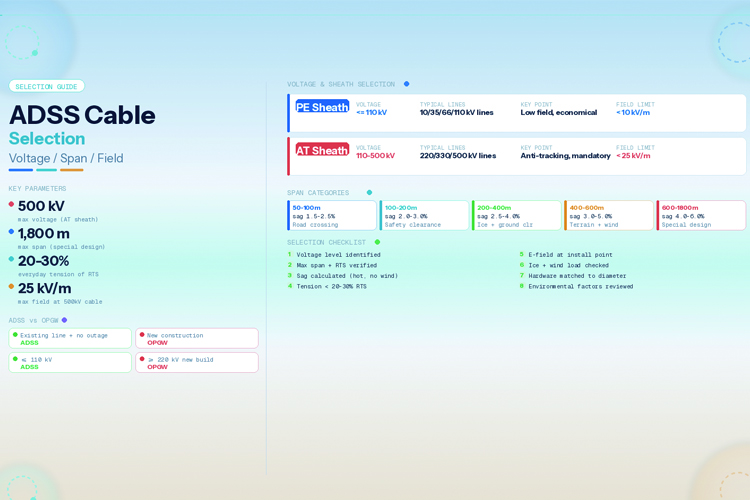
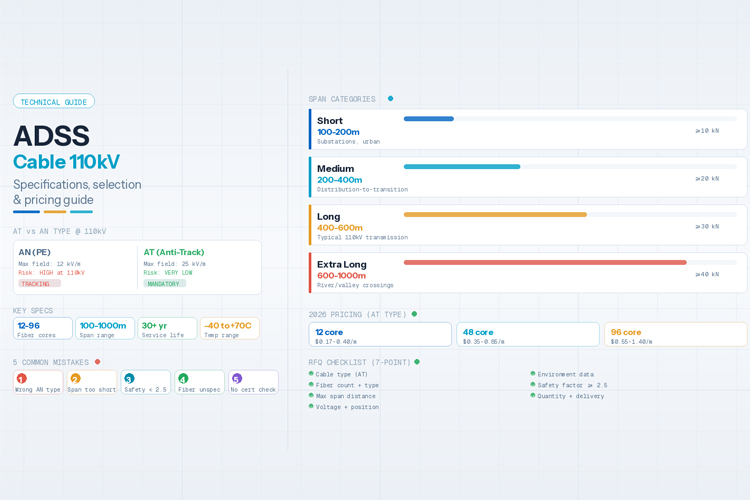
- PE (Polyethylene): Standard sheath for installations on poles up to 110kV
- AT (Aramid Tracking-resistant): Specialized sheath compound for installations on towers from 110kV to 500kV, formulated to resist dry-band arcing and electrical tracking
Typical diameter: 10–18mm. ADSS is lighter than GYTS due to the absence of steel armor, with the aramid yarn providing a high strength-to-weight ratio.
OPGW Structure
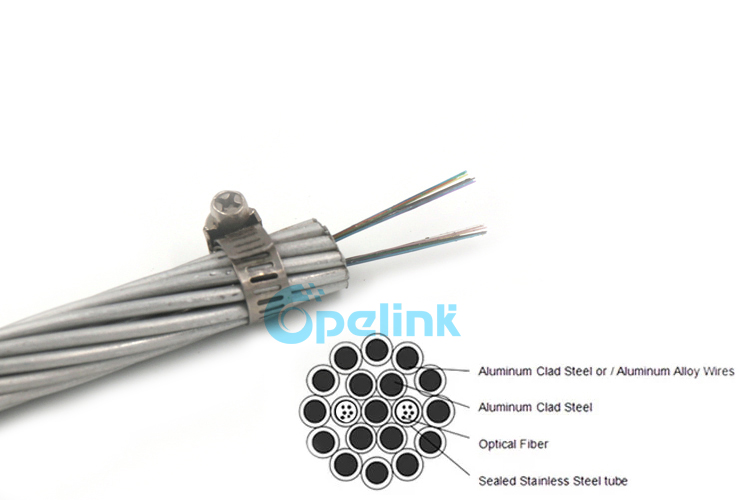
OPGW uses a composite conductor design that integrates optical fibers into a metallic ground wire:
- Optical unit: A seamless stainless steel tube (SST) containing the optical fibers and gel for water blocking. The SST typically has a wall thickness of 0.15–0.30mm and houses 12–144 fibers
- Aluminum-clad steel (ACS) wires: High-strength ACS wires (20% IACS conductivity) are stranded around the optical unit, providing the primary mechanical strength and electrical conductivity
- Aluminum alloy wires: Additional aluminum alloy wires (e.g., 6201 alloy) may be stranded in the outer layer to increase current-carrying capacity for short-circuit performance
- No outer sheath: Unlike GYTS and ADSS, OPGW has no polymer jacket — the metallic wires are the outer surface, making OPGW a bare conductor
Typical diameter: 10–20mm. OPGW is the heaviest of the three per meter due to the metallic construction, with weights ranging from 200–800 kg/km depending on design.
Comprehensive Comparison Table
The table below provides a side-by-side comparison of GYTS, ADSS, and OPGW across all critical parameters:
| Parameter |
GYTS |
ADSS |
OPGW |
| Structure |
Layered stranded, steel armored |
All-dielectric, aramid reinforced |
Composite conductor, metallic |
| Strength member |
Phosphated steel wire (center) |
FRP rod (center) + aramid yarn |
Aluminum-clad steel wires |
| Armor |
Galvanized steel wire |
None (aramid yarn replaces armor) |
None (metallic wires serve as armor) |
| Water blocking |
Gel-filled + swellable tape |
Gel-filled + swellable yarn |
Gel in stainless steel tube |
| Conductivity |
None (if non-metallic variant) |
None (all-dielectric) |
Yes (aluminum-clad steel + Al alloy) |
| Self-supporting |
No |
Yes |
Yes (as conductor on towers) |
| Typical fiber count |
2–144 cores |
2–288 cores |
12–144 cores |
| Diameter |
8–20mm |
10–18mm |
10–20mm |
| Weight |
80–400 kg/km |
50–150 kg/km |
200–800 kg/km |
| Tensile strength |
600–3000N |
600N–20kN |
≥100kN (RTS) |
| Temperature range |
-40°C to +70°C |
-40°C to +70°C |
-40°C to +80°C |
| Lifespan |
25–30 years |
20–25 years |
30–40 years |
| Outer sheath |
PE (UV-resistant) |
PE or AT |
None (bare conductor) |
| Installation method |
Direct burial / duct |
Aerial self-supporting |
Overhead on towers |
| Live-line installation |
N/A |
Yes |
No (requires outage) |
| Voltage compatibility |
N/A |
Up to 500kV (AT sheath) |
≥110kV |
| Max span |
N/A (continuous) |
Up to 1800m |
200–1000m+ (tower-dependent) |
| Cost per foot |
$0.50–1.20 |
$0.90–1.60 |
$2.10–3.50 |
GYTS vs ADSS: Detailed Head-to-Head
GYTS and ADSS represent two fundamentally different deployment philosophies: underground infrastructure vs. aerial self-supporting installation. The choice between them is often driven by site conditions and available infrastructure rather than cable performance alone.
Installation Method Comparison
GYTS requires a physical pathway — either a trench for direct burial or a pre-installed duct system. Direct burial involves trenching (typically 0.6–1.2m depth), sand bedding, cable placement, warning tape installation, and backfilling. Duct installation requires pulling the cable through pre-installed HDPE or PVC conduits using a pulling winch, with maximum pulling tension limited to the cable's rated tensile strength (600–3000N).
ADSS is installed aerially using existing pole or tower infrastructure. The cable is tensioned between support structures with appropriate sag to manage wind and ice loading. Installation requires only pole hardware (dead-end assemblies, suspension clamps, downlead clamps) — no trenching, ducts, or civil works. ADSS can be installed on energized lines (live-line installation), eliminating the need for power outages.
| Factor |
GYTS |
ADSS |
| Civil works required |
Yes (trenching or duct) |
No |
| Installation speed |
200–500m/day (trenching) |
1–3km/day (aerial) |
| Infrastructure dependency |
Requires duct or trench |
Requires poles/towers |
| Weather sensitivity |
Moderate (trenching in rain is difficult) |
High (aerial work in wind is dangerous) |
| Permits needed |
Right-of-way, digging permits |
Pole attachment agreements, aerial permits |
Cost Comparison
GYTS has a lower cable cost per meter but higher installed cost when civil works are included:
- Cable only: $0.50–1.20/ft
- Direct burial installed (including trenching): $2.00–5.00/ft
- Duct installed (duct already in place): $0.80–2.00/ft
ADSS has a higher cable cost but lower total installed cost when existing poles are available:
- Cable only: $0.90–1.60/ft
- Aerial installed (existing poles): $1.50–3.00/ft
- Aerial installed (new poles needed): $5.00–15.00/ft (pole cost dominates)
Key insight: If duct infrastructure already exists, GYTS in duct is typically cheaper. If poles already exist, ADSS aerial is typically cheaper. If neither exists, the civil works cost dominates the decision — and the choice depends on local terrain, permitting, and labor costs.
Best Use Cases
| Scenario |
Recommended Cable |
Rationale |
| Urban underground backbone |
GYTS in duct |
Duct infrastructure typically available; mechanical protection critical |
| Rural aerial distribution |
ADSS |
No trenching needed; faster deployment on existing poles |
| Power utility communication |
ADSS |
Designed for power line installation; live-line capable |
| Campus network (mixed) |
GYTS |
Consistent underground approach; easier maintenance access |
| Crossing difficult terrain |
ADSS |
Aerial avoids trenching through rock, wetlands, or rivers |
For detailed installation guidance for both cable types, see our GYTS direct burial and duct installation guide and ADSS cable selection guide for power lines.
ADSS vs OPGW: Detailed Head-to-Head
ADSS and OPGW both serve power line communication applications, but they differ fundamentally in function, installation requirements, and long-term performance. This is the most consequential comparison for utility and transmission projects.
Application and Function
ADSS is a communication-only cable. It carries optical fibers for data, voice, and control signals but serves no electrical function. It is an add-on to existing power infrastructure, installed below or alongside phase conductors.
OPGW is a dual-function cable. It replaces the traditional bare overhead ground wire at the tower peak, providing both lightning protection (primary function) and fiber optic communication (secondary function). This dual role means OPGW is integrated into the power system's electrical design, not merely attached to it.
Voltage Level Compatibility
| Voltage Level |
ADSS |
OPGW |
| ≤35kV (distribution) |
✅ PE sheath |
❌ Not typically used |
| 35kV–110kV (sub-transmission) |
✅ PE or AT sheath |
⚠️ Possible but uncommon |
| 110kV–220kV (transmission) |
✅ AT sheath required |
✅ Primary application |
| 220kV–500kV (HV transmission) |
✅ AT sheath, careful positioning |
✅ Standard application |
| ≥500kV (UHV) |
⚠️ Possible with special design |
✅ Designed for UHV |
Installation Comparison
| Factor |
ADSS |
OPGW |
| Outage required |
No (live-line installation possible) |
Yes (or install during new line construction) |
| Installation position |
Below phase conductors |
At tower peak (ground wire position) |
| Hardware required |
Dead-end + suspension assemblies |
Tension towers + suspension towers |
| Sag/tension design |
Based on wind/ice loading and span length |
Based on electrical and mechanical coordination |
| Installation time |
Faster (no outage coordination) |
Slower (requires outage window or new construction) |
| Retrofit feasibility |
Excellent (designed for retrofit) |
Poor (requires line modification or replacement) |
The live-line installation capability of ADSS is its most significant practical advantage. For utilities operating critical lines where outages are costly or difficult to schedule, ADSS enables fiber deployment without disrupting power delivery. OPGW, by contrast, is essentially a new-construction product — retrofitting OPGW requires removing the existing ground wire during an outage, which is rarely practical on operating transmission lines.
Cost Comparison
| Cost Factor |
ADSS |
OPGW |
| Cable cost per foot |
$0.90–1.60 |
$2.10–3.50 |
| Installation cost |
Lower (no outage, simpler hardware) |
Higher (outage coordination, specialized crews) |
| Initial total cost |
30–50% lower than OPGW |
Higher upfront investment |
| Lifespan |
20–25 years |
30–40 years |
| Lifecycle cost |
May require replacement sooner |
Longer service life offsets higher initial cost |
| Dual-function savings |
None (communication only) |
Eliminates separate ground wire cost |
Key insight: For new transmission line construction, OPGW is often the better choice because it replaces a separate ground wire — the incremental cost of OPGW over a bare ground wire is less than the cost of installing ADSS separately. For existing line retrofit, ADSS is almost always the better choice because it avoids the outage and ground wire replacement costs.
Maintenance Considerations
ADSS maintenance concerns:
- Dry-band arcing: On lines >110kV, contamination and moisture can cause dry-band arcing on the sheath, leading to tracking damage. AT sheath mitigates this but requires periodic inspection.
- Electric field stress: ADSS positioned in high electric field zones may experience sheath degradation over time. Proper installation positioning is critical.
- Wind and ice damage: Extreme weather can cause excessive sag or aeolian vibration, potentially damaging the cable or hardware.
OPGW maintenance concerns:
- Lightning damage: Direct lightning strikes can cause localized heating and potential fiber damage, though OPGW is designed to withstand typical lightning currents.
- Short-circuit damage: Fault currents can heat the metallic strands, potentially damaging the optical unit if the cable is not properly rated for the line's short-circuit current.
- Corrosion: Galvanic corrosion between aluminum and steel components can occur in polluted environments, requiring periodic inspection of tower connections.
For comprehensive guidance on both cable types, see our ADSS selection guide and OPGW selection guide.
GYTS vs OPGW: When Would You Choose Each?
GYTS and OPGW serve such different applications that direct comparison is rarely necessary — but understanding the boundary conditions helps clarify when each is appropriate.
Choose GYTS when:
- The project is a telecom or enterprise network with no connection to power infrastructure
- Underground installation is required for aesthetic, security, or reliability reasons
- The route follows roads, railways, or dedicated utility corridors with trenching access
- Cost per meter is the primary concern and civil works are manageable
- The cable needs to pass through urban areas where aerial installation is prohibited
Choose OPGW when:
- The project involves new high-voltage transmission line construction (≥110kV)
- The utility needs both grounding and communication on the same corridor
- Tower infrastructure is being built or upgraded (ground wire must be installed anyway)
- The line carries high fault currents that would damage ADSS
- Long-term reliability (30–40 years) is a primary requirement
The rare overlap: In some projects, a transmission corridor may include both overhead and underground sections (e.g., crossing a river or entering a substation). In these cases, OPGW is used on the overhead sections and GYTS (or a similar underground cable) is used for the underground sections, with splice closures at the transition points.
Selection Decision Matrix
| Project Scenario |
Voltage |
Installation |
Recommended Cable |
Alternative |
| New telecom underground backbone |
N/A |
Direct burial |
GYTS |
GYTA (if lower cost needed) |
| Telecom backbone in existing ducts |
N/A |
Duct |
GYTS |
GYXTW (short distances) |
| FTTH aerial distribution |
N/A |
Aerial on poles |
ADSS (PE) |
GYXTW (short spans) |
| Power distribution line retrofit |
≤35kV |
Aerial, live-line |
ADSS (PE) |
— |
| Sub-transmission line retrofit |
35–110kV |
Aerial, live-line |
ADSS (AT) |
— |
| Existing transmission line retrofit |
110–500kV |
Aerial, live-line |
ADSS (AT) |
— |
| New transmission line |
≥110kV |
Overhead, new construction |
OPGW |
ADSS + separate ground wire |
| New UHV transmission line |
≥500kV |
Overhead, new construction |
OPGW |
— |
| Submarine cable crossing |
N/A |
Underwater |
Submarine cable |
— |
| Industrial/mining environment |
N/A |
Various |
GYTS (armored) |
— |
Use this matrix to match your project scenario to the recommended cable type:
| Project Scenario |
Voltage |
Installation |
Recommended Cable |
Alternative |
| New telecom underground backbone |
N/A |
Direct burial |
GYTS |
GYTA (if lower cost needed) |
| Telecom backbone in existing ducts |
N/A |
Duct |
GYTS |
GYXTW (short distances) |
| FTTH aerial distribution |
N/A |
Aerial on poles |
ADSS (PE) |
GYXTW (short spans) |
| Power distribution line retrofit |
≤35kV |
Aerial, live-line |
ADSS (PE) |
— |
| Sub-transmission line retrofit |
35–110kV |
Aerial, live-line |
ADSS (AT) |
— |
| Existing transmission line retrofit |
110–500kV |
Aerial, live-line |
ADSS (AT) |
— |
| New transmission line |
≥110kV |
Overhead, new construction |
OPGW |
ADSS + separate ground wire |
| New UHV transmission line |
≥500kV |
Overhead, new construction |
OPGW |
— |
| Submarine cable crossing |
N/A |
Underwater |
Submarine cable |
— |
| Industrial/mining environment |
N/A |
Various |
GYTS (armored) |
— |
GYTS vs GYTA: A Common Sub-comparison
When GYTS is selected, a frequent follow-up question is whether to use GYTS or GYTA (aluminum tape armored instead of steel wire armored):
| Factor |
GYTS |
GYTA |
| Armor type |
Steel wire |
Aluminum tape |
| Crush resistance |
Higher |
Lower |
| Rodent resistance |
Better |
Moderate |
| Weight |
Heavier |
Lighter |
| Cost |
Slightly higher |
Slightly lower |
| Bending radius |
Larger |
Smaller |
| Best for |
Direct burial, rocky soil |
Duct installation, lighter loads |
Choose GYTS for direct burial in demanding soil conditions; choose GYTA for duct installation where crushing and rodent risks are lower and lighter weight aids pulling.
Common Mistakes in Cable Type Selection
Avoiding these common pitfalls can save significant cost and prevent performance issues:
1. Choosing ADSS Without AT Sheath on High-Voltage Lines
Installing ADSS with standard PE sheath on lines above 110kV is a critical error. Dry-band arcing will degrade the PE sheath, leading to tracking, erosion, and eventual cable failure. Always specify AT sheath for ADSS on lines above 110kV, and verify the installation position is outside the high electric field zone.
2. Using GYTS for Long Aerial Spans Without Support
GYTS is not self-supporting. Attempting to suspend GYTS aerially without a messenger wire will result in excessive sag, tensile failure, and cable damage. If aerial installation is required, either use ADSS (self-supporting) or install GYTS lashed to a messenger wire — but this adds cost and complexity that makes ADSS the better choice.
3. Specifying OPGW for Retrofit Without Considering Outage Requirements
OPGW installation requires either a line outage or new construction. Project planners who specify OPGW for existing line retrofit without accounting for outage coordination, system reliability impacts, and outage cost often face significant schedule delays and budget overruns. For retrofit, ADSS is almost always the more practical choice.
4. Underestimating Fiber Count Future Needs
Cable installation is dominated by labor and infrastructure costs, not cable material cost. Installing a 24-core cable when a 96-core cable could have been installed for a modest cost premium is a false economy. Specify fiber count based on 10-year projected needs, not current demand. This is especially important for OPGW, where upgrading fiber count after installation is extremely costly.
5. Ignoring Local Wind and Ice Loading Standards
For aerial installations (ADSS and OPGW), failing to calculate sag-tension based on local wind and ice loading conditions can lead to under-specified cables that fail during extreme weather. Always use local meteorological data and applicable standards (e.g., IEEE 1138 for OPGW, IEEE 1222 for ADSS) for mechanical design.
6. Overlooking Water Blocking Requirements
In areas with high water table or frequent flooding, gel-filled cables (GYTS) provide superior long-term protection compared to dry water-swellable designs. While "dry" cables are easier to splice, they may not provide adequate protection in consistently wet environments. Match the water blocking method to the actual environmental conditions.
Conclusion: Making the Right Cable Type Decision
The GYTS vs ADSS vs OPGW comparison ultimately resolves to three questions:
1. Where is the cable being installed? Underground → GYTS. Aerial on existing lines → ADSS. New transmission lines → OPGW.
2. What is the voltage environment? Non-power → GYTS or ADSS. Up to 500kV retrofit → ADSS with AT sheath. ≥110kV new construction → OPGW.
3. What is the total lifecycle cost? Consider not just cable cost, but installation, infrastructure, maintenance, and replacement costs over the design life.
Each cable type is optimized for its intended environment — there is no universally "best" cable, only the best cable for your specific project conditions. By understanding the structural, mechanical, and economic differences outlined in this comparison, you can make an informed decision that balances upfront cost, installation practicality, and long-term reliability.
For deeper guidance on specific cable types, explore our detailed selection guides:
- ADSS cable selection guide for power lines
- OPGW cable selection guide for transmission lines
- GYTS cable direct burial and duct installation
- Fiber optic cable cost and price analysis
Return to the main outdoor fiber optic cable types guide for the complete hub page with all cable types and selection tools.
Need Help Choosing the Right Cable Type?
Contact OPELINK for personalized cable type recommendations based on your project specifications. Our engineering team will help you:
- Evaluate GYTS, ADSS, and OPGW for your specific deployment scenario
- Calculate total installed cost including infrastructure and labor
- Select the optimal fiber type and count for current and future needs
- Provide detailed technical datasheets and installation guidance
- Deliver competitive pricing with fast lead times
Request a technical consultation today — our fiber optic cable specialists respond within 24 hours.
Frequently Asked Questions
Is ADSS cheaper than OPGW?
Yes, ADSS is typically 30–50% cheaper than OPGW on an initial installed cost basis. ADSS cable costs $0.90–1.60/ft compared to $2.10–3.50/ft for OPGW. However, for new transmission line construction, OPGW replaces a separate ground wire, so the incremental cost of adding fiber via OPGW may be less than installing ADSS separately. Over a 30–40 year lifecycle, OPGW's longer lifespan may also narrow the total cost gap.
Can GYTS be installed aerially?
GYTS is not designed for self-supporting aerial installation. It lacks the aramid yarn strength members that make ADSS self-supporting. However, GYTS can be installed aerially by lashing it to a separate messenger wire or suspending it in a figure-8 configuration with a support wire. This adds cost and complexity, making ADSS the preferred choice for aerial installations.
What is the lifespan difference between GYTS, ADSS, and OPGW?
GYTS typically has a design lifespan of 25–30 years in underground installations. ADSS has a lifespan of 20–25 years, with shorter life expectancy on high-voltage lines due to electrical stress on the sheath. OPGW has the longest lifespan at 30–40 years, as its metallic construction is highly resistant to environmental degradation. Actual lifespan depends heavily on installation quality, environmental conditions, and maintenance practices.
Which cable type is easiest to install?
Ease of installation depends on the deployment scenario. For aerial installation on existing poles, ADSS is easiest — it requires only pole hardware and can be installed live-line. For underground installation in existing ducts, GYTS is straightforward — it involves pulling the cable through the duct with a winch. OPGW is generally the most complex to install, requiring specialized crews, outage coordination, and tension stringing equipment for transmission towers.
Can I use the same fiber type in all three cable types?
Yes, all three cable types (GYTS, ADSS, OPGW) can be manufactured with either G.652D (standard single-mode) or G.657A2 (bend-insensitive) fiber. G.657A2 is increasingly preferred for ADSS and OPGW due to its superior bend performance under wind and ice loading conditions. Current G.657A2 fiber pricing is $33–35/km (March 2026). The fiber type choice is independent of the cable type choice — they can be specified separately.

 ADSS Cable Selection Guide for Power Lines: Voltage, Span & Environment
 Outdoor Fiber Optic Cable Installation Guide: Aerial, Duct & Direct Burial Methods
 Outdoor Fiber Optic Cable Types: GYTS, ADSS and OPGW Guide
 ADSS Cable for 110kV Power Line: Specifications, Selection & Pricing Guide


