Quick Summary: If you are specifying ADSS cable for a 110kV power line, this guide gives you the exact technical requirements, AT type selection criteria, span distance calculations, 2026 price benchmarks, and a ready-to-use RFQ checklist — everything you need to get an accurate quote in one round.
Why ADSS Cable Is the Standard for 110kV Power Line Communication
When a power utility needs to add fiber optic communication to an existing 110kV transmission line, ADSS (All-Dielectric Self-Supporting) cable is almost always the first choice. The reason is simple: ADSS can be installed on existing tower structures without taking the line out of service, and its all-dielectric construction eliminates any electrical interaction with the high-voltage conductors.
China alone has over 310,000 km of 110kV and above transmission lines, and a significant portion of these lines still lack fiber optic communication infrastructure. For retrofits on existing towers, ADSS is the go-to solution because:
- No tower reinforcement needed — ADSS is lightweight and self-supporting, adding minimal mechanical load to existing structures
- Live-line installation possible — ADSS can be installed without de-energizing the 110kV line, eliminating outage costs
- All-dielectric construction — no metallic components means no short-circuit risk, no grounding required, and no electrical interference
- Cost-effective vs OPGW — for retrofit scenarios, ADSS costs 40-60% less than replacing the existing ground wire with OPGW
- 30+ year service life in harsh outdoor environments with proper type selection
However, 110kV is the threshold voltage where ADSS type selection becomes critical. Choose the wrong type, and you risk jacket degradation from electrical tracking within months of installation.
Critical: AT Type Is Mandatory at 110kV (Not Optional)
This is the single most important specification decision when selecting ADSS cable for 110kV power lines. Getting it wrong is the #1 cause of premature ADSS failure worldwide.
The Electric Field Problem
When ADSS cable is installed on a 110kV tower, it is positioned in the electric field generated by the phase conductors. The field strength at the cable's position depends on:
- Voltage level of the line (110kV)
- Position of the cable relative to phase conductors (above, below, or between)
- Phase conductor arrangement and spacing
- Tower geometry and grounding configuration
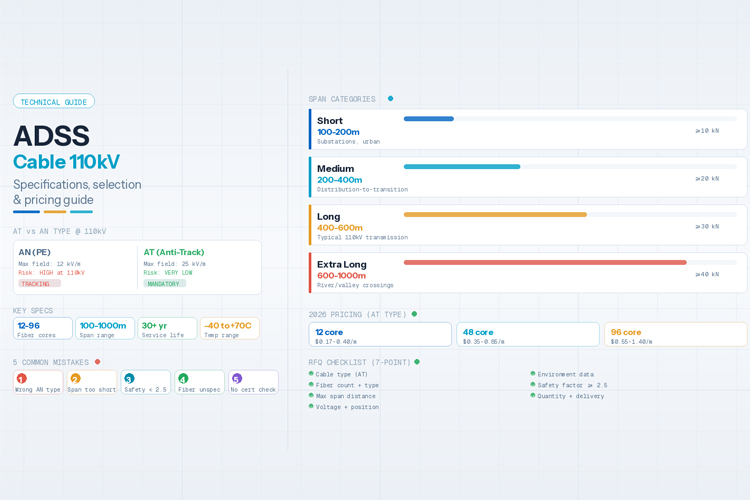
At 110kV, the induced electric field at typical ADSS mounting positions ranges from 8-25 kV/m. This crosses the critical 12 kV threshold that separates safe PE jacket operation from the danger zone where electrical tracking and dry-band arcing can occur.
AN vs AT Type at 110kV: The Decision Is Clear
| Parameter |
AN Type (PE Jacket) |
AT Type (Anti-Tracking Jacket) |
| Jacket material |
Standard PE (Polyethylene) |
AT-PE (Anti-tracking modified PE) |
| Max electric field |
≤ 12 kV/m |
≤ 25 kV/m |
| Suitable for 110kV? |
⚠️ Only if field < 12 kV/m |
✅ Yes, all positions |
| Cost difference |
Baseline (1.0×) |
1.15–1.30× vs AN |
| Failure risk at 110kV |
High (tracking, arcing) |
Very low |
Recommendation: For 110kV power lines, always specify AT type ADSS unless you have a detailed electric field calculation proving the mounting position experiences < 12 kV/m. The 15-30% cost premium of AT type is negligible compared to the cost of cable failure and re-installation on an energized line.
Key Specifications for 110kV ADSS Cable
When specifying ADSS cable for a 110kV power line project, these are the parameters your supplier needs to provide an accurate quote. Missing any of them will result in back-and-forth clarification or, worse, an incorrect quotation.
| Specification |
Typical Value for 110kV |
Why It Matters |
| Cable type |
ADSS-AT (anti-tracking) |
Mandatory at 110kV; prevents electrical tracking |
| Fiber count |
12–96 cores (24, 48 common) |
Determines cable diameter and weight |
| Fiber type |
G.652.D (standard SMF) |
Universal compatibility; G.655 for DWDM systems |
| Span/distance |
100–600 m (typical) |
Determines aramid yarn count and tensile rating |
| Max span |
600–1000 m |
Longer spans need higher tensile strength |
| Safety factor |
≥ 2.5 |
Required by power utility standards (CSG, State Grid) |
| Operating temp |
-40°C to +70°C |
Covers extreme climate conditions |
| Jacket material |
AT-PE (black, anti-tracking) |
Resists electrical tracking at 110kV field |
| Attenuation |
≤0.36 dB/km @1310nm, ≤0.22 dB/km @1550nm |
Ensures signal quality over long spans |
| Service life |
> 30 years |
Matches transmission line design life |
| Standards |
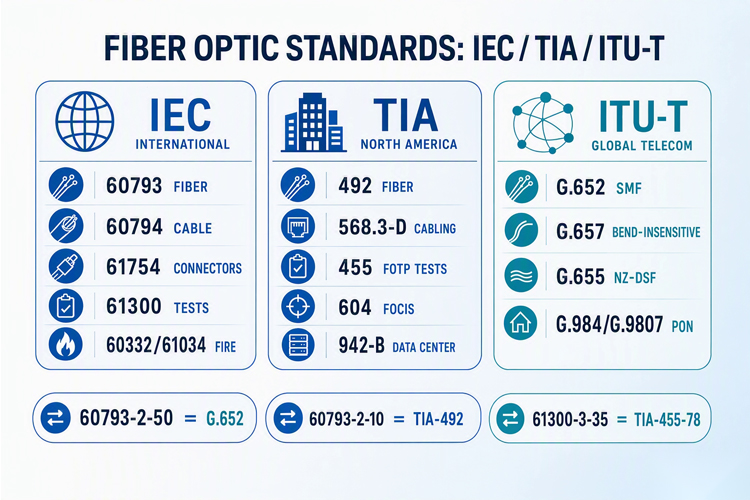
IEEE 1222-2004, IEC 60794, GB/T 7424 |
Compliance required for utility procurement |
Span Distance & Sag Considerations for 110kV Lines
Span distance is the second most critical parameter after cable type. It directly determines the tensile strength rating of the ADSS cable, which in turn affects the aramid yarn count, cable diameter, weight, and ultimately the price.
Span Categories for 110kV ADSS
| Span Category |
Distance Range |
Typical Application |
Tensile Rating (RTS) |
| Short span |
100–200 m |
Substations, urban sections |
≥ 10 kN |
| Medium span |
200–400 m |
Distribution-to-transition |
≥ 20 kN |
| Long span |
400–600 m |
Typical 110kV transmission |
≥ 30 kN |
| Extra long span |
600–1000 m |
River/valley crossings |
≥ 40 kN |
Sag calculation: The maximum sag under worst-case loading (max wind + max ice) must not exceed the ground clearance requirements for the 110kV line. A safety factor of ≥ 2.5 is standard for Chinese power utilities (both State Grid and Southern Power Grid). This means the Rated Tensile Strength (RTS) of the cable must be at least 2.5× the maximum expected mechanical load.
Installation Requirements for 110kV Power Lines
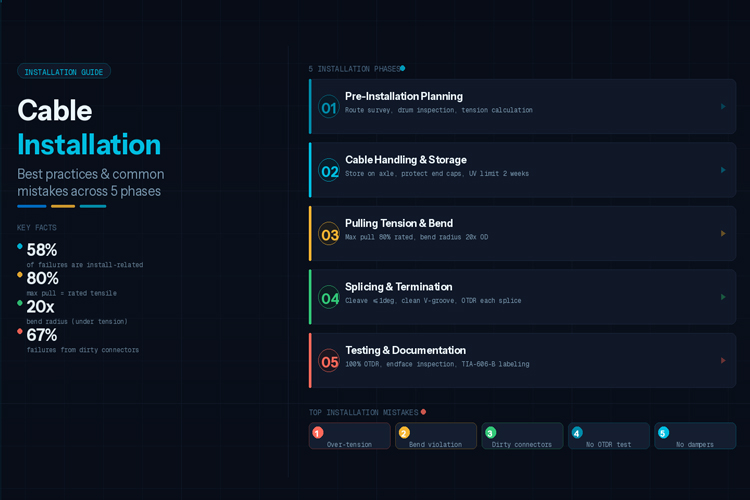
ADSS installation on 110kV lines requires specialized techniques and safety protocols. Key requirements include:
- Live-line installation: ADSS can be installed without de-energizing the 110kV line using specialized installation equipment and trained crews. This eliminates outage costs but requires strict safety protocols.
- Mounting position: ADSS is typically installed below the phase conductors on the tower. The exact position must be calculated to minimize electric field exposure while maintaining ground clearance.
- Tensioning and sag: Initial tension must be calculated based on span length, temperature range, wind/ice load, and safety factor. Over-tensioning reduces service life; under-tensioning causes excessive sag.
- Hardware: Use only manufacturer-approved suspension and tension clamps. Incorrect hardware can damage the cable jacket or create stress points.
- Joint boxes: Splice closures must be rated for the voltage environment and installed at tower positions with adequate clearance from phase conductors.
- Minimum bending radius: During installation, never bend ADSS below 20× cable diameter. Excessive bending causes fiber attenuation and structural damage.
2026 Price Reference: ADSS Cable for 110kV
The following price ranges are based on 2026 market data from Chinese manufacturers. Actual prices vary by fiber count, span rating, jacket type, order quantity, and manufacturer. Use these as budgeting reference only — request a formal quote for exact pricing.
| Fiber Count |
AT Type (Short Span) |
AT Type (Long Span) |
Typical MOQ |
| 12 cores |
$0.17–0.25/m |
$0.28–0.40/m |
500 m |
| 24 cores |
$0.22–0.35/m |
$0.35–0.55/m |
500 m |
| 36 cores |
$0.28–0.45/m |
$0.45–0.70/m |
500 m |
| 48 cores |
$0.35–0.55/m |
$0.55–0.85/m |
500 m |
| 72 cores |
$0.45–0.70/m |
$0.70–1.10/m |
500 m |
| 96 cores |
$0.55–0.90/m |
$0.90–1.40/m |
1000 m |
Price factors: AT type adds 15-30% over AN type. Longer span ratings require more aramid yarn, increasing cost. Higher fiber counts need larger cable diameter and more loose tubes. Volume orders (≥5 km) typically receive 10-20% discount. Prices are FOB China factory; add shipping and import duties for destination country.
How to Specify ADSS for 110kV in Your RFQ
Use this 7-point checklist to prepare your Request for Quotation. Providing all seven parameters in your initial inquiry eliminates 90% of clarification rounds and gets you an accurate quote faster.
- Cable type: ADSS-AT (specify AT explicitly — do not leave type ambiguous)
- Fiber count and type: e.g., "48 cores G.652.D" (add G.655 if DWDM needed)
- Maximum span distance: e.g., "max span 400m, average span 250m"
- Operating voltage and mounting position: "110kV line, below phase conductors"
- Environmental conditions: wind zone, ice load, temperature range (e.g., "25 m/s wind, 5mm ice, -40°C to +70°C")
- Safety factor required: "≥ 2.5" (or per your utility standard)
- Quantity and delivery: total km required, delivery timeline, destination port
5 Common Mistakes When Selecting ADSS for 110kV
Mistake 1: Using AN type to save 15-30% on jacket cost
This is the most expensive "saving" you can make. AN type PE jacket degrades rapidly in the 110kV electric field through electrical tracking. Cable failure typically occurs within 12-24 months, requiring full re-installation on an energized line — at 5-10× the original cost premium of AT type.
Mistake 2: Underestimating the maximum span
Specifying a 300m max span when the line has a 450m river crossing means the cable will be under-rated for that section. The aramid yarn count is insufficient, leading to excessive sag or cable breakage under wind/ice loading.
Mistake 3: Ignoring the safety factor
Some projects use a safety factor of 1.5 or 2.0 to reduce cable cost. This is below the ≥2.5 standard for power utilities and dramatically increases the risk of cable failure during extreme weather events.
Mistake 4: Not specifying fiber type
Defaulting to "single mode fiber" without specifying G.652.D vs G.655 can lead to compatibility issues with existing network equipment. G.652.D is standard for most applications; G.655 is needed for DWDM systems.
Mistake 5: Choosing the cheapest supplier without certification check
ADSS for 110kV is safety-critical infrastructure. Always verify IEEE 1222-2004 compliance, IEC 60794 test reports, and manufacturer quality certifications (ISO 9001, telecom grade) before placing the order.
→Browse more fiber optic cable products
Frequently Asked Questions
Q: Can I use AN type ADSS on a 110kV line?
A: Only if a detailed electric field calculation shows the mounting position experiences less than 12 kV/m. In practice, most 110kV tower positions exceed this threshold, making AT type the safe default. The cost savings of AN type (15-30%) are not worth the risk of premature failure.
Q: What is the maximum span for ADSS on 110kV lines?
A: Standard ADSS for 110kV is rated for spans up to 600m. Special high-tensile designs can reach 1000m for river or valley crossings. Longer spans require more aramid reinforcement, which increases cable diameter, weight, and cost.
Q: How much does ADSS cable for 110kV cost per meter?
A: In 2026, AT type ADSS for 110kV ranges from $0.17/m (12-core, short span) to $1.40/m (96-core, long span). The most common configuration — 24-48 cores, medium span — costs $0.35-0.55/m. Volume orders above 5 km typically receive 10-20% discount.
Q: Can ADSS be installed on a live 110kV line?
A: Yes. ADSS is designed for live-line installation using specialized equipment and trained crews. This is one of its key advantages over OPGW, which requires de-energizing the line. However, strict safety protocols must be followed, and the installation crew must be certified for live-line work.
Q: What standards apply to ADSS cable for 110kV?
A: Key standards include IEEE 1222-2004 (ADSS standard), IEC 60794 (optical cable test methods), and GB/T 7424 (Chinese national standard). For utility procurement in China, additional requirements from State Grid or Southern Power Grid technical specifications apply, including safety factor ≥ 2.5.
Q: How long does ADSS cable last on a 110kV line?
A: Properly specified AT type ADSS has a design service life of 30+ years. The main factors affecting longevity are correct type selection (AT for 110kV), proper installation tension, adequate safety factor, and environmental conditions. Regular inspection of jacket condition and fiber attenuation is recommended.
Related Resources

 Fiber Cable Installation Best Practices & Common Mistakes
 How to Read Fiber Optic Cable Specifications: Complete Guide
 Fiber Loss, Bandwidth & Attenuation: Technical Deep Dive
 Fiber Optic Cable Standards: IEC/TIA/ITU Complete Guide


