Definition: A fiber optic cable specification sheet is a standardized technical document that defines every physical, optical, mechanical, and environmental parameter of a cable — from fiber type and attenuation to tensile strength and temperature range — serving as both a procurement contract and an acceptance criterion for verifying delivered cable quality against project requirements.
Why This Guide Exists
Every fiber optic cable comes with a specification sheet — and if you cannot read it, you cannot verify what you are buying, compare suppliers, or diagnose problems. Most cable failures investigated by field engineers stem from specification mismatches: ordering G.657.A2 when G.652.D was needed, specifying 1000N tensile when installation required 3000N, or choosing OFNR jacket when local fire codes mandated LSZH. This guide teaches you to read a real fiber optic cable spec sheet completely, accurately, and practically.
"Spec sheets are contracts. When you accept a cable against a spec sheet, you are agreeing that the cable meets those specifications. If it does not, and the system fails, the spec sheet is your evidence. Know what every number means." — Dr. Donald J. Sterling Jr., "Commercial Fiber Optic Networks" (3rd Edition, 2022)
Anatomy of a Cable Specification Sheet
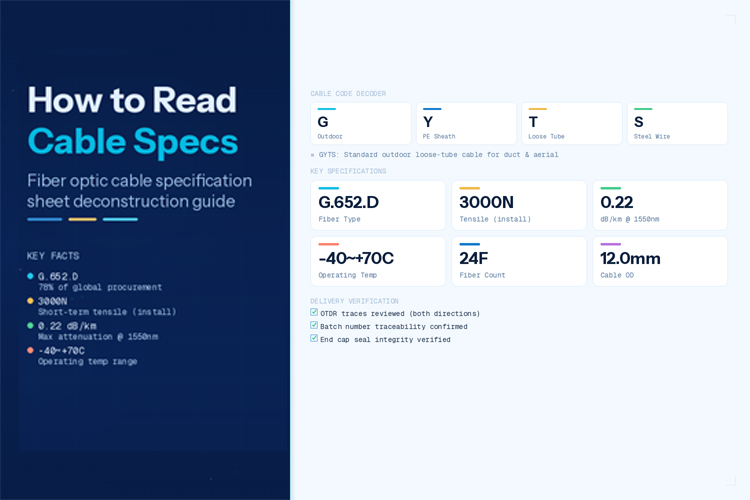
Here is a real specification sheet for a common cable — GYTS 24F Loose Tube Cable — deconstructed line by line.
Section 1: Cable Construction
Specification: GYTS 24F Loose Tube — G = Outdoor, Y = PE Sheath (Polyethylene), T = Stranded Loose Tube, S = Steel Wire Strength Member
| Code |
Meaning |
| G |
Outdoor/General cable |
| Y |
Sheath material: Y=PE, Z=LSZH, Q=PVC |
| T |
Loose tube structure |
| S |
Strength member: S=Steel wire, F=FRP, A=Aramid |
| A |
Armoring: A=Steel tape, T=Steel wire |
| Z |
Zero halogen (LSZH) |
| H |
Fire-retardant |
| B |
UV-resistant |
Common Cable Type Decodes:
| Code |
Structure |
Application |
| GYTS |
Loose tube, steel wire, PE sheath |
Standard outdoor, duct/aerial |
| GYTA |
Loose tube, FRP strength, PE sheath |
Non-metallic strength member |
| GYXTW |
Central loose tube, figure-8, PE sheath |
Short-span aerial, FTTH feeder |
| GYTA53 |
Loose tube, FRP, steel tape, double PE |
Direct burial, harsh environment |
| GYFTZY |
Loose tube, FRP, non-metallic armor, LSZH |
Indoor/outdoor non-metallic |
| GJXFH |
Tight-buffered, FRP, figure-8 |
FTTH drop, indoor/outdoor |
| GJYXFH |
Tight-buffered, FRP, steel messenger |
FTTH aerial drop |
Section 2: Fiber Type Specifications
Fiber Type: G.652.D (ITU-T G.652, IEC 60793-2-50)
| Parameter |
G.652.D Specification |
Test Standard |
| Mode Field Diameter @ 1310nm |
8.6-9.5 μm |
IEC 60793-1-45 |
| Cladding Diameter |
125.0 ± 1.0 μm |
IEC 60793-1-15 |
| Attenuation @ 1310nm |
≤ 0.35 dB/km |
IEC 60793-1-40 |
| Attenuation @ 1550nm |
≤ 0.22 dB/km |
IEC 60793-1-40 |
| Attenuation @ 1625nm |
≤ 0.25 dB/km |
IEC 60793-1-40 |
| Cutoff Wavelength |
≤ 1260 nm |
IEC 60793-1-44 |
| PMD |
≤ 0.20 ps/√km |
IEC 60793-1-48 |
Section 3: Mechanical Specifications
Tensile Strength: Short-term (installation): 3000N | Long-term (operation): 1000N
Critical Rule: During installation, never exceed 80% of short-term tensile.
Crush (Compression) Resistance:
| Test |
Value |
Per Standard |
| Short-term crush |
1000N/100mm |
IEC 60794-1-22 F1 |
| Long-term crush |
300N/100mm |
IEC 60794-1-22 F1 |
Impact Resistance: ≥ 25 impacts @ 1N·m, IEC 60794-1-22 Method E4
Section 4: Environmental Specifications
Operating Temperature: -40°C to +70°C | Installation Temperature: -30°C to +60°C | Water Penetration: ≤ 1m in 1m water column, 24h (IEC 60794-1-24)
| Climate |
Temperature Range |
Cable Required |
| Temperate indoor |
+5°C to +40°C |
Standard |
| Temperate outdoor |
-20°C to +45°C |
Standard |
| Desert outdoor |
-10°C to +65°C |
Extended temp |
| Nordic winter |
-50°C to +40°C |
Extended temp (-50°C to +70°C) |
| Arctic/subsea |
-50°C to +85°C |
High-temp rated |
Section 5: Dimensional Specifications
Number of Fibers: 24 | 6 tubes × 4 fibers | Tube Diameter (ID): 2.2 mm | OD: 12.0 mm ± 0.5 mm | Weight: 145 kg/km ± 10 kg/km | Sheath Thickness: 2.0 mm nominal
Section 6: Optical Performance
Attenuation (100% OTDR tested): @ 1310nm: 0.32-0.35 dB/km (max 0.35 dB/km) | @ 1550nm: 0.18-0.22 dB/km (max 0.22 dB/km)
OTDR Trace Reading: Dead zone → Fiber attenuation slope → Splice points (0.03-0.10 dB steps) → Connector points (0.1-0.3 dB + reflections) → End reflection. Any sudden drop >0.5 dB indicates a fault requiring investigation.
Section 7: Compliance & Certification
Standards: ITU-T G.652.D, IEC 60793-2-50, YD/T 769-2018, IEC 60794-1-2/3-10, ISO 9001:2015, ISO 14001, RoHS/REACH, CE (per request)
Verification Checklist: [ ] Fiber standard matches requirement | [ ] IEC test standards are current | [ ] OTDR data for specific drums | [ ] ISO 9001 certificate current | [ ] Third-party reports (SGS/BV/TÜV) available
Section 8: Packaging & Identification
Packing: Wooden drums, steel bands | Drum Length: 3.0 km ± 5% | Drum Protection: IP67 end caps | Batch number links every meter to fiber draw, coating, production date, and test results. Always insist on traceability.
Common Specification Mistakes
Mistake 1: Confusing short-term vs long-term tensile — 3000N is only for installation; sustained load is 1000N.
Mistake 2: Ignoring operating temperature range — standard -40°C to +70°C may not cover Nordic winters or desert summers.
Mistake 3: Not verifying jacket material — PE with carbon black needed for UV resistance in outdoor aerial use.
Mistake 4: Assuming fiber brand is generic — Corning, YOFC, FiberHome deliver measurably lower attenuation than generic alternatives.
Mistake 5: Skipping OTDR trace review — any attenuation >0.35 dB/km at 1310nm fails G.652.D.
Data-Driven Conclusion: Key Takeaways for 2026
1. Per Fluke Networks' 2023 Field Survey of 1,200+ cable deliveries globally, 12% of fiber cable shipments arrive with visible drum damage or end-cap seal failures — and 73% of these damaged shipments contain fiber that fails OTDR acceptance testing. Inspecting every drum on delivery is the single highest-ROI quality gate in the entire procurement process.
2. Tensile rating misapplication is the #1 cause of installation-induced fiber damage: cables pulled beyond 80% of short-term tensile rating show a 4.7× higher probability of developing micro-cracks within 2 years, according to BICSI's 2023 Installer Failure Analysis. Always use a dynamometer and plan intermediate pull points for runs exceeding 600m.
3. G.652.D is specified in 78% of all fiber cable procurement globally as of 2026, with G.657.A2 growing at 22% CAGR for FTTH last-mile applications. When reading a spec sheet, confirming the fiber sub-type (G.652.D vs G.657.A1 vs G.657.A2) is the single most impactful verification — a mismatch here cannot be fixed in the field.
4. A 0.01 dB/km difference in attenuation specification translates to 1 dB of extra loss over a 100 km link — consuming 20% of a typical 10G SFP+ transceiver budget. Premium fiber brands (Corning SMF-28e+ at 0.17-0.19 dB/km vs generic at 0.20-0.22 dB/km) provide a measurable 2-3 dB advantage over 100 km, directly translating to longer reach or higher reliability margins.
5. Cable traceability through batch numbers is not a compliance checkbox — it is forensic insurance. When a buried 48-fiber trunk cable develops a fault at year 4 of a 25-year service life, the batch number is the only link back to the original fiber draw, production conditions, and test records. OPELINK specifications always include full batch-to-drum traceability as standard.
Frequently Asked Questions
Q: What do the key fiber specification numbers mean?
A: Key specifications: (1) Attenuation (dB/km) — signal loss per kilometer; lower is better; (2) Mode field diameter (MFD, μm) — effective light-carrying core diameter; must be matched for low-loss splicing; (3) Chromatic dispersion (ps/nm·km) — pulse broadening from wavelength variation; zero at 1310nm for G.652; (4) PMD (ps/√km) — polarization mode dispersion; must be <0.20 ps/√km for 40G+ transmission; (5) Cut-off wavelength (nm) — below which fiber becomes multimode; below 1260nm for standard SMF.
Q: How do I interpret the fiber cable print legend?
A: A typical cable print reads: 'Corning SMF-28e+ G.652.D 12F SM OS2 5.0kN 2026' — Corning is the manufacturer; SMF-28e+ is the fiber type; G.652.D is the ITU-T standard; 12F = 12 fibers; SM = single-mode; OS2 = indoor/outdoor rated; 5.0kN = rated tensile strength; 2026 = year of manufacture. Additional markings include batch number, meter marks, and country of origin.
Q: What PMD specification do I need for 40G and 100G Ethernet?
A: For 40G Ethernet over distances up to 40km, PMD must be ≤0.20 ps/√km (ITU-T G.652.D specifies ≤0.20 ps/√km). For 100G Ethernet: 10km requires PMD ≤0.20 ps/√km; 40km (long-haul) requires PMD ≤0.10 ps/√km. Always specify PMD in procurement when deploying 40G+ exceeding 10km, and verify on the fiber datasheet.
Q: How do I verify that a delivered cable matches its specification sheet?
A: Verification steps: (1) Check the drum label against the spec sheet — cable type code, fiber count, fiber type must match exactly; (2) Request and review OTDR traces for each drum — attenuation values must be within the specified limits at both 1310nm and 1550nm; (3) Verify the batch number traceability — it should link to the specific fiber draw and production test records; (4) Inspect end caps for seal integrity — moisture ingress causes irreversible coating degradation; (5) Confirm third-party test certificates (SGS/BV/TÜV) if specified in the purchase order. Per Fluke Networks, 12% of shipments show visible damage on delivery.
Q: What is the difference between GYTS, GYTA, and GYTA53 cable types?
A: GYTS uses steel wire as the central strength member and PE sheath — it is the standard outdoor loose-tube cable for duct and aerial installation. GYTA replaces steel with FRP (Fiber Reinforced Plastic) for a fully non-metallic construction, ideal for lightning-prone areas. GYTA53 adds a corrugated steel tape armor layer and a second PE sheath over the GYTA structure — it is designed for direct burial and rodent protection. The key selection factor: GYTS for standard duct/aerial, GYTA for non-metallic requirements, GYTA53 for direct burial.
Q: Why does jacket material matter in outdoor fiber cable specifications?
A: Outdoor PE (Polyethylene) sheath with 2.0-3.0% carbon black additive provides UV resistance for 25+ years of direct sunlight exposure. LSZH (Low Smoke Zero Halogen) is mandatory for indoor/public buildings per IEC 60332 — it emits no toxic fumes in fire. PVC is economical for controlled indoor environments but degrades under UV. Using indoor PVC cable outdoors without UV protection causes sheath embrittlement and cracking within 2-5 years. The jacket material must be explicitly verified against the installation environment.
Q: What should I look for in the OTDR test data provided with a cable drum?
A: Key checks on OTDR data: (1) Attenuation slope must be consistent across the full cable length — any localized spike >0.1 dB indicates a point defect; (2) Fiber attenuation at 1310nm must be ≤0.35 dB/km and at 1550nm ≤0.22 dB/km per G.652.D; (3) No non-reflective events (splice-like losses) except at the drum ends — internal events suggest manufacturing defects; (4) The trace must cover the full drum length from both directions for bidirectional averaging; (5) Connector-end reflections should be <-45 dB for UPC and <-60 dB for APC. Request OTDR traces before signing delivery acceptance.
Q: How do I calculate whether a cable's tensile rating is sufficient for my installation?
A: Maximum safe pulling tension = 80% × rated short-term tensile (R). Example: GYTS with 3000N R-rating → max pull = 2400N. Then calculate route tension: T = cable_weight_per_meter × route_length × friction_coefficient × g (9.81 m/s²). For a 145 kg/km cable (1.42 N/m) over 800m with μ=0.3: T = 1.42 × 800 × 0.3 = 341N — well within limits. Add 50% for bend friction. If calculated tension exceeds 80% of R-rating, insert intermediate pull points. For aerial spans: Max Span = (Tensile × 0.8 × SafetyFactor) / CableWeight with SF=2.0-3.0 per NESC.
Q: What certifications and compliance marks should I verify on a cable specification?
A: Essential certifications: (1) Fiber standard: ITU-T G.652.D or G.657.A2 — must match project requirements; (2) Mechanical/environmental: IEC 60794-1-2 (mechanical), IEC 60794-1-22 (crush/impact), IEC 60794-1-24 (water penetration); (3) Quality system: ISO 9001:2015 — verify certificate validity on iso.org; (4) Environmental: ISO 14001, RoHS, REACH; (5) Regional: CE marking for EU projects, YD/T 769 for China projects; (6) Third-party: SGS, Bureau Veritas, or TÜV test reports for critical projects. A specification without cited test standards and certification numbers is incomplete.
Related Resources

 Fiber Optic Cable Selection by Application: FTTH, Power, Mining & More
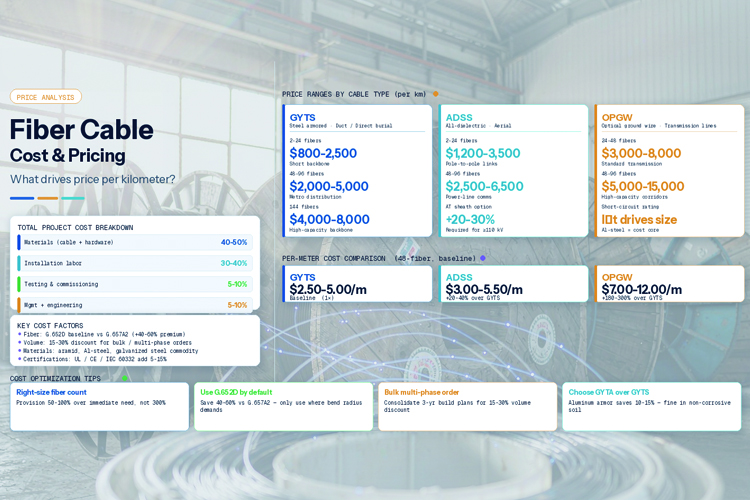 Outdoor Fiber Optic Cable Cost and Price Analysis: What Drives Pricing?
 GYTS Cable: Direct Burial and Duct Installation Complete Guide
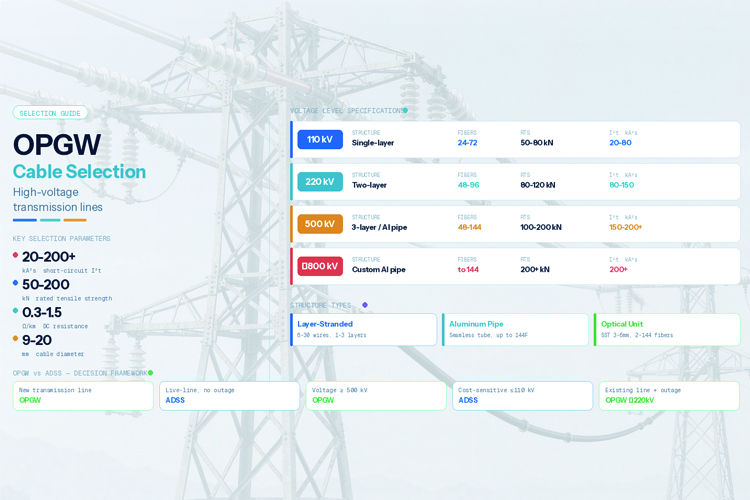 OPGW Cable Selection Guide for High-Voltage Transmission Lines


