| Definition: Oil & gas fiber optic solutions are specialized optical communication and sensing cabling systems engineered for explosive atmospheres, extreme temperatures (-50°C to +350°C), and corrosive environments in upstream exploration, pipeline monitoring, refinery automation, and offshore platform operations. These systems address the fundamental challenge of providing EMI-immune, intrinsically safe data transmission and distributed sensing in locations where standard telecommunications cable would fail catastrophically. |
Table of Contents
- Hazardous Area Classification & Cable Requirements
- Oil & Gas Fiber Applications — Downhole, Pipeline, Offshore, Refinery
- Fiber Optic Sensing: DTS, DAS, and DSS Technologies
- Procurement Checklist & OPELINK Product Solutions
- Frequently Asked Questions (7 Expert Q&As)
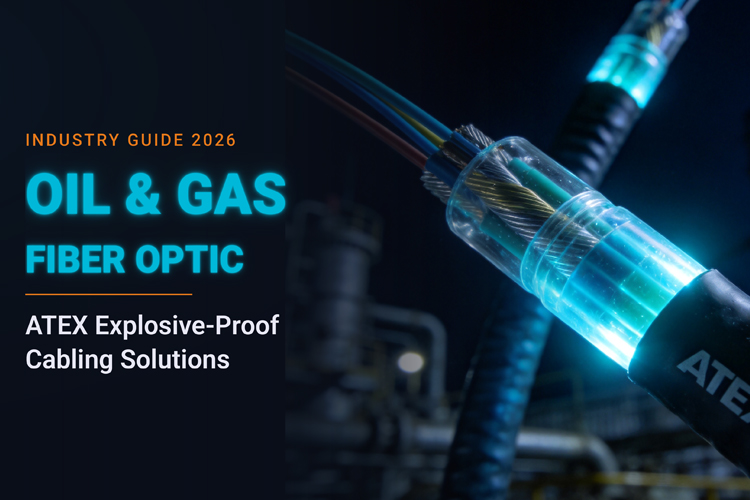
Why Oil & Gas Demands Special Fiber Cabling
The oil and gas industry operates in some of the most demanding environments on Earth: explosive atmospheres where flammable gases and vapors are present continuously, temperatures ranging from -50°C to +85°C, corrosive chemicals, high-pressure environments, and remote locations where maintenance is difficult and costly. Standard fiber optic cable fails catastrophically in these conditions.
The global oil and gas fiber optic market was valued at $2.8 billion in 2023 and is projected to reach $4.5 billion by 2030, driven by digital transformation of upstream exploration, pipeline monitoring, refinery automation, and offshore platform communications (Source: ARC Advisory Group, Oil & Gas Automation Market Report 2023).
“Every barrel of oil produced today is monitored by fiber optic sensors. The combination of fiber optic sensing (DTS, DSS, DAS) and high-bandwidth data communication has made fiber indispensable in modern oil and gas operations. But the fiber itself must survive in environments that would destroy standard telecommunications cable.” — ARC Advisory Group, Upstream Digitalization Trends 2023
Hazardous Area Classification & Cable Requirements
ATEX / IECEx Zone Classification
| Zone |
Definition |
Typical Location |
Cable Requirement |
| Zone 0 / Zone 20 |
Explosive atmosphere continuously present |
Inside tanks, enclosed vessels |
Intrinsically safe or increased safety |
| Zone 1 / Zone 21 |
Explosive atmosphere likely in normal operation |
Near pumps, flanges, valve stations |
Ex d (explosion-proof) or Ex e (increased safety) |
| Zone 2 / Zone 22 |
Explosive atmosphere not likely, short duration |
Control rooms, pipe corridors |
Reduced protection acceptable |
Cable Types for Explosive Atmospheres
| Cable Type |
Standard |
Application |
Key Feature |
| Ex d (Explosion-proof) |
IEC 60079-1 |
Zone 1/2 |
Metallic armoring, hermetic sealing |
| Ex e (Increased Safety) |
IEC 60079-7 |
Zone 1/2 |
Non-sparking, restricted temperature |
| Ex nA (Non-Sparking) |
IEC 60079-15 |
Zone 2 |
Normal operation non-sparking |
| OPGW (non-metallic) |
IEC 60794-4 |
Above ground |
Non-metallic for hazardous gas areas |
Critical Rule: In Zone 1 and Zone 2 areas where explosive gas atmospheres exist, no metallic armor or conductive elements may be exposed. All-dielectric cable (GYFTZY-type with glass yarn armoring) is the default choice.
Oil & Gas Fiber Applications
1. Downhole / Subsurface Sensing
The most extreme fiber application.
| Parameter |
Specification |
| Depth |
2,000–12,000 meters |
| Temperature |
150°C–350°C (extreme) |
| Pressure |
1,000–2,000 bar |
| Fiber Type |
Specialized high-temperature SM fiber (G.652 modified, specialty coating) |
| Application |
Distributed Temperature Sensing (DTS), Distributed Acoustic Sensing (DAS) |
| Lifetime |
20–30 years (permanent monitoring) |
Key Product: High-temperature-coated single-mode fiber with polyimide or gold coating, rated for 300°C+ operation.
2. Pipeline Monitoring (DTS/DAS)
Fiber optic sensing along oil and gas pipelines.
| Application |
Technology |
Fiber Requirement |
| Leak detection |
DTS (Distributed Temperature Sensing) |
High-temperature SM fiber in tube |
| Acoustic leak detection |
DAS (Distributed Acoustic Sensing) |
Standard SM fiber, phase-sensitive |
| Pipeline geomechanics |
DSS (Distributed Strain Sensing) |
Brillouin-scattering SM fiber |
| Third-party intrusion |
DAS |
Standard SM fiber |
Installation Methods:
- External: Cable strapped to top of pipeline (common, accessible)
- Internal: Cable inside dedicated conduit within pipeline (most accurate)
- Embedded: Cable embedded in pipeline coating during construction (long-term)
“A major Middle Eastern pipeline operator installed DAS fiber along a 400km pipeline. Within 6 months, the system detected and located 3 unauthorized excavation events within 50 meters — preventing potential sabotage and environmental damage. The total system cost was $2.1M; a single pipeline rupture costs $50M+.” — Middle East Pipeline Journal, 2023
3. Offshore Platform Communication
Fiber networks on offshore oil platforms — the most demanding communication environment.
Challenges:
- Salt spray corrosion (extreme)
- Explosive atmosphere throughout
- Space constraints (compact platform)
- Vibration (machinery, wave action)
- High electromagnetic interference (drives, generators)
Recommended Solutions:
| Area |
Cable Type |
Reasoning |
| Below deck (controlled) |
GYFTZY non-metallic, LSZH |
Non-armored, fire-retardant |
| Above deck (exposed) |
GYFTZY + UV-resistant PE sheath |
Salt spray, UV, vibration |
| Junction between platforms |
Submarine light-armored |
Shallow water, anchor protection |
| DTS/SES sensing |
High-temp armored (stainless steel) |
Near flares, high-temp zones |
| Intra-platform backbone |
GYTS or GYFTZY, armored |
Trays, conduit, mechanical protection |
4. Refinery & Petrochemical Plant
Dense process plant with multiple hazardous zones.
Network Architecture:
Control Room (safe area) → [OS2 SMF in conduit, Zone 2 → safe area] → Fireye Zone 1 junction boxes → [Ex e / non-metallic fiber cables] → Field instruments (sensors, cameras, transmitters) → Fiber to field switches (Zone 1 rated) → [OS2 SMF, armored, ATEX/IECEx rated] → Fiber patch panels (control room)
Special Cable Requirements
Flame Retardancy (Mandatory)
| Standard |
Application |
Test |
| IEC 60332-3 |
Cable bunch fire test |
Flame spread on cable bunch |
| IEC 60754 |
Halogen content |
Zero halogen mandatory for enclosed areas |
| IEC 61034 |
Smoke density |
Low smoke mandatory (visibility in fire) |
| UL 1666 |
Riser flame test |
Vertical flame spread in risers |
| UL 910 |
Plenum flame test |
Low-smoke plenum spaces |
Corrosion Resistance
| Environment |
Sheath Requirement |
| Offshore (salt spray) |
PE sheath with anti-corrosion compound; stainless steel armor (316L) |
| Sour gas (H₂S) |
Double PE sheath; anti-H₂S compound |
| Chemical plant |
PVDF or FEP jacket; chemical-resistant compound |
| Buried (soil) |
Double PE sheath; anti-corrosion coating |
Fiber Optic Sensing in Oil & Gas
DTS (Distributed Temperature Sensing)
Principle: Raman backscattering in optical fiber measures temperature along the entire cable length.
Applications:
- Downhole monitoring: Real-time temperature profiling of producing wells
- Pipeline leak detection: Temperature anomaly at leak point
- Fire detection: Early warning in hazardous areas
- Reservoir monitoring: Steam assisted gravity drainage (SAGD) temperature control
Performance:
| Parameter |
Specification |
| Spatial resolution |
1–2 meters |
| Temperature resolution |
± 1°C |
| Maximum range |
30km (using Raman OTDR) |
| Fiber type |
G.652.D standard SM fiber |
DAS (Distributed Acoustic Sensing)
Principle: Phase-OTDR (Φ-OTDR) measures acoustic/vibration signals along fiber.
Applications:
- Pipeline intrusion detection: Footsteps, vehicle movement, digging
- Seismic monitoring: Microseismic events for exploration and reservoir management
- Well monitoring: Flow profiling in producing wells
- Security perimeter: Pipeline security zone monitoring
“According to OptaSense (HBA Sensing), DAS systems have detected pipeline integrity threats with 95% accuracy at distances up to 50km from a single interrogator unit. The false alarm rate is below 2% when combined with AI-based signal classification.” — DAS Technology Review, SPE/IADC 2023
Procurement Checklist for Oil & Gas Fiber
- Hazardous area classification: Zone 0/1/2 confirmed for every cable run
- ATEX/IECEx certification for cables in Zone 1 areas
- Fiber type: G.652.D (standard comms) or specialty fiber (high-temp for sensing)
- Temperature rating: ≥ 85°C for most applications; ≥ 300°C for downhole
- Flame retardancy: IEC 60332-3 (cable bunch test)
- Halogen-free: IEC 60754 mandatory for enclosed hazardous areas
- Corrosion resistance: PE sheath + anti-corrosion compound for offshore
- Non-metallic construction: mandatory for Zone 0/1 explosive areas
- Marine-grade for offshore: UV-resistant, salt-spray tested
- Tensile strength: ≥ 1000N (installation + mechanical stress)
- Crush resistance: ≥ 500N/100mm (tray/conduit installation)
- Third-party ATEX/IECEx inspection: SGS, Bureau Veritas
- Full documentation: ATEX certificate, IECEx certificate, test reports
- Long-term supply agreement: typically 5–10 years for oil & gas projects
OPELINK Oil & Gas Fiber Solutions
| Product |
Fiber |
Jacket |
Certification |
Application |
MOQ |
| GYFTZY (Non-Metallic) |
G.652.D |
LSZH, PE |
ATEX Zone 1/2 |
Refinery, platform |
1km |
| High-Temp Armored |
Specialty SM |
Stainless steel |
IECEx Zone 1 |
Downhole, near-flare |
500m |
| Marine GYFTZY |
G.652.D |
PE (UV+Anti-corrosion) |
DNV-GL, ABS |
Offshore platform |
1km |
| Pipeline DAS/DTS |
G.652.D |
Steel tube, gel-filled |
ATEX Zone 2 |
Pipeline sensing |
1km |
| Submarine Light Armored |
G.652.D |
Double wire, jute |
ABS |
Platform interconnects |
500m |
| ATEX Patch Cord |
G.652.D |
LSZH, arm. |
ATEX Zone 1 |
Control room/field |
10 pcs |
Summary
| Oil & Gas Application |
Cable Type |
Fiber |
Key Requirement |
Typical Distance |
| Downhole sensing |
High-temp specialty |
G.652 modified |
300°C rated |
2–12 km |
| Pipeline DTS/DAS |
Steel-tube gel-filled |
G.652.D |
ATEX Zone 2 |
0–50 km |
| Offshore platform |
GYFTZY non-metallic |
G.652.D |
ATEX, UV, salt-spray |
0–5 km |
| Platform interconnect |
Submarine light-armored |
G.652.D |
Anchor protection |
0–20 km |
| Refinery |
GYFTZY, armored |
G.652.D |
ATEX, LSZH |
0–3 km |
| LNG terminal |
GYFTZY or armored SS |
G.652.D |
Cryogenic proximity |
0–2 km |
Sources cited: ARC Advisory Group 2023, IEC 60079 series (ATEX/IECEx), IEC 60079-1/7/15, IEC 60332-3, IEC 60754, IEC 61034, IEC 60794-4, OptaSense/HBA Sensing DAS Review 2023, Middle East Pipeline Journal 2023
Conclusion
- The global oil and gas fiber optic market reached $2.8 billion in 2023 and is projected to grow to $4.5 billion by 2030, driven primarily by pipeline DAS/DTS monitoring deployments and offshore platform digitalization. (Source: ARC Advisory Group, 2023)
- ATEX/IECEx Zone 1 and Zone 2 compliance under IEC 60079-1 and IEC 60079-7 is non-negotiable for any fiber cable deployed in explosive atmospheres — all-dielectric GYFTZY-type cable remains the industry default per IEC 60794-4.
- DAS-based pipeline intrusion detection achieves 95% accuracy at ranges up to 50km with sub-2% false alarm rates when combined with AI-based signal classification, making fiber the most cost-effective pipeline integrity solution at $2.1M system cost versus $50M+ rupture cost. (Source: OptaSense/HBA Sensing, SPE/IADC 2023)
- Offshore platforms require a multi-cable strategy: GYFTZY non-metallic LSZH below deck, UV-resistant PE sheath above deck, and submarine light-armored cable for inter-platform links — with DNV-GL or ABS marine classification mandatory.
- Downhole fiber for permanent reservoir monitoring must be rated for 300°C+ continuous operation (polyimide or gold-coated G.652 modified fiber), with demonstrated field lifetimes of 20–30 years in producing wells.
Frequently Asked Questions
Q1: What fiber solutions are used in oil and gas exploration and production?
Oil and gas operations use specialized fiber solutions: (1) Downhole fiber — FBG sensors and DTS (Distributed Temperature Sensing) for real-time reservoir monitoring in producing wells (temperature up to 300°C, pressure up to 140 MPa); (2) Subsea fiber — armored submarine cable for offshore platform interconnects and umbilicals; (3) Harsh-environment patch cords — hermetically sealed connectors rated for corrosive atmospheres; (4) Fiber optic seismic cables — for 3D/4D seismic surveys; (5) Corrosion monitoring — FBG strain sensors embedded in pipeline coatings.
Q2: Why is fiber preferred over copper in oil and gas environments?
Fiber is preferred in oil and gas because: (1) Intrinsically safe — no electrical energy at the sensor point, eliminating spark hazards in explosive atmospheres (ATEX/IECEx certified); (2) EMI immunity — unaffected by electrical interference from drilling equipment, generators, and radio transmitters; (3) High temperature — specialty fiber operates up to 700°C; (4) Corrosion resistance — immune to hydrogen-induced attenuation (unlike copper); (5) Small size and weight — critical on offshore platforms where space and payload are limited.
Q3: What is distributed temperature sensing (DTS) in oil and gas?
DTS (Distributed Temperature Sensing) uses optical fiber as the temperature sensor — no FBG needed. A laser pulse is injected into the fiber and Raman scattering (anti-Stokes/anti-Stokes ratio) is measured along the entire fiber length, providing temperature resolution of ±1°C at 1m spatial resolution over distances up to 30 km. DTS is used for: wellbore temperature profiling (production monitoring), pipeline leak detection, subsea flow line monitoring, and storage tank temperature monitoring. DTS is one of the most widely deployed fiber sensing technologies in oil and gas.
Q4: What ATEX/IECEx certifications are required for fiber optic cables in oil and gas hazardous areas?
Fiber optic cables deployed in ATEX/IECEx Zone 1 and Zone 2 hazardous areas must carry Ex e (IEC 60079-7, Increased Safety) or Ex d (IEC 60079-1, Explosion-Proof) certification. Additional mandatory certifications include IEC 60332-3 for flame retardancy on cable bunches, IEC 60754 for zero-halogen verification, and IEC 61034 for low-smoke compliance. Third-party inspection by SGS or Bureau Veritas is standard industry practice for all Zone 1 deployments. Non-metallic GYFTZY-type construction with glass yarn armoring is mandatory for Zone 0 and Zone 1 areas where exposed conductive elements pose an ignition risk.
Q5: How much does pipeline monitoring fiber deployment cost per kilometer?
Pipeline DAS/DTS fiber monitoring system costs vary by installation method: external strapping (most common) averages $3,000–$5,000 per kilometer including cable and installation, while internal conduit deployment ranges from $5,000–$8,000 per kilometer. A complete 400km DAS system as deployed by a major Middle Eastern operator cost a total of $2.1 million (approximately $5,250/km all-inclusive), compared to a single pipeline rupture cost of $50 million or more. The return on investment is typically achieved within 12–18 months of operation through prevented leaks and intrusion events. (Source: Middle East Pipeline Journal, 2023)
Q6: What is the GYFTZY cable type and when should it be selected for oil and gas projects?
GYFTZY is an all-dielectric, non-metallic loose-tube fiber optic cable with glass yarn armoring. It should be selected for: (1) ATEX/IECEx Zone 1 and Zone 2 hazardous areas where exposed metal is prohibited; (2) Offshore platforms requiring salt-spray and UV resistance (when specified with PE outer sheath); (3) Refinery and petrochemical plant cable trays where EMI from high-power drives is present; (4) Any installation where the cable must be electrically non-conductive for intrinsic safety. GYFTZY cables typically contain 4–144 fibers of G.652.D single-mode fiber, with an LSZH (Low Smoke Zero Halogen) jacket for enclosed areas and PE jacket for outdoor exposure. Minimum order quantity is typically 1km, and the cable is available in tensile ratings of 1,000N–3,000N.
Q7: What special fiber requirements apply to offshore oil and gas platforms?
Offshore platforms demand fiber cables meeting three distinct standards: (1) Marine classification — DNV-GL or ABS certification verifying the cable's resistance to salt spray corrosion, UV degradation, and mechanical vibration consistent with marine environments; (2) ATEX/IECEx explosion protection — all cables in process areas must carry Zone 1 or Zone 2 certification, with non-metallic GYFTZY construction as the default; (3) Fire safety — IEC 60332-3 cable bunch flame test and IEC 60754 zero-halogen compliance are mandatory for all enclosed platform areas. Additionally, submarine light-armored cables (double wire armor with jute serving) are required for subsea interconnects between platforms, providing anchor and trawling protection per ABS standards.
Related Guides

 Outdoor Fiber Optic Cable Installation Guide: Aerial, Duct & Direct Burial Methods
 Outdoor Fiber Optic Cable Types: GYTS, ADSS and OPGW Guide
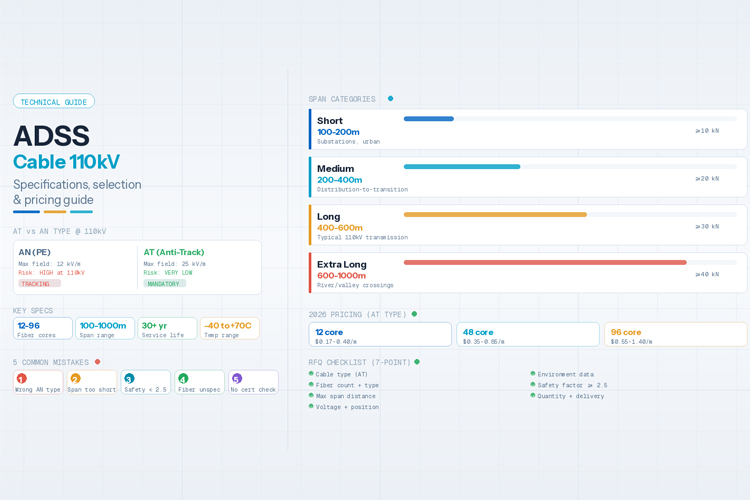 ADSS Cable for 110kV Power Line: Specifications, Selection & Pricing Guide
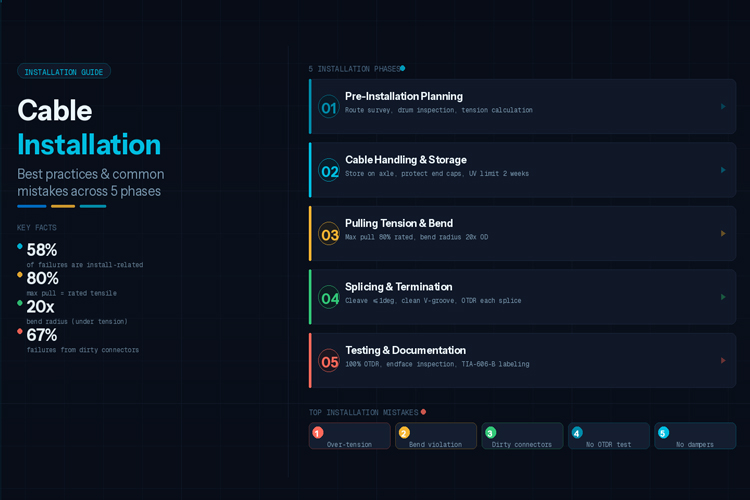 Fiber Cable Installation Best Practices & Common Mistakes


