English
Welcome to opelink.com
Fiber Optic Product Introduction

Quality Assurance of Optical WDM: Ensuring a Flawless Network

Views : 1582
Update time : 2024-03-11 09:26:51
Have you ever tried to stream a video or download a large file only to find that your internet connection is too slow? Frustrating, isn't it? With the rise of the internet and the demand for high-speed data transmission, telecommunication companies have had to step up their game in providing faster and more reliable networks. One such advancement in the field of optical networking is the Wavelength Division Multiplexing (WDM) technology. But how can we ensure the quality of an optical WDM network? In this article, we will examine the measures telecommunications companies implement to ensure a flawless optical WDM network.
 
What is Optical WDM?
Optical WDM is a technology that enables data transmission over multiple wavelengths of light. To understand the concept better, let us use a metaphor: imagine that the available bandwidth is a highway with multiple lanes. Conventional networks can only transmit data through one lane, while an optical WDM network can transmit data through several lanes at the same time. Each lane represents a wavelength, and the different wavelengths carry various types of data. This technology has greatly increased the transmission capacity and speed of data networks, making it popular in long-distance and high-capacity telecommunications systems.
 
Quality Assurance Measures for Optical WDM
As with any technology, quality assurance is crucial in ensuring that the system runs smoothly and efficiently. Quality assurance in optical WDM involves several measures to ensure that the network is working correctly, is reliable, and is scalable.
 
Testing and Certification
Testing and certification are the primary quality assurance measures for optical WDM networks. The system undergoes rigorous testing before deployment to ensure that it meets the required standards. Certification is necessary to ensure that the components of the network comply with the industry standards and regulations. This includes verifying the wavelength accuracy, power levels, signal-to-noise ratio, and other critical parameters.
 
Maintenance
Regular system maintenance is crucial to ensure the network's long-term reliability. A typical maintenance schedule involves monitoring the system's performance, cleaning components, replacing worn-out parts, and updating software.
 
Fault Diagnosis and Troubleshooting
Even with regular maintenance and testing, faults can still occur in an optical WDM network. Telecommunication companies implement fault diagnosis and troubleshooting procedures to isolate and resolve any issues that may arise. These procedures involve monitoring the system performance, detecting faults, and taking corrective measures to restore the network's functionality.
 
Conclusion
Optical WDM technology has revolutionized the telecommunications industry by providing faster and more efficient networks. However, to ensure the quality and reliability of these networks, telecommunications companies must implement quality assurance measures, such as testing and certification, regular maintenance, and fault diagnosis and troubleshooting. By doing this, they can provide their customers with a network that they can rely on, regardless of the data transmission requirements.
 
FAQs
Q1. What is the difference between optical WDM and conventional networks?
The main difference is that conventional networks can transmit data through one lane or wavelength, while optical WDM networks can transmit data through multiple wavelengths simultaneously.
 
Q2. What are the benefits of optical WDM technology?
The main benefits of optical WDM include increased transmission speed, higher capacity, and scalability.
 
Q3. What are the critical parameters for testing an optical WDM network?
The critical parameters for testing an optical WDM network include wavelength accuracy, power levels, signal-to-noise ratio, and other parameters that affect the system's performance and reliability.
 
Q4. Can faults occur even with regular maintenance and testing?
Yes, faults can still occur in an optical WDM network despite regular maintenance and testing. Telecommunication companies implement fault diagnosis and troubleshooting procedures to isolate and resolve any issues that may arise.
 
Q5. How can I ensure that my optical WDM network is reliable?
You can ensure that your optical WDM network is reliable by ensuring that it undergoes regular maintenance and testing, and that the components of the network comply with the industry standards and regulations.

 
Related News
Read More >>
Fiber Optic Cable Standards: IEC/TIA/ITU Complete Guide Fiber Optic Cable Standards: IEC/TIA/ITU Complete Guide
Aug .18.2026
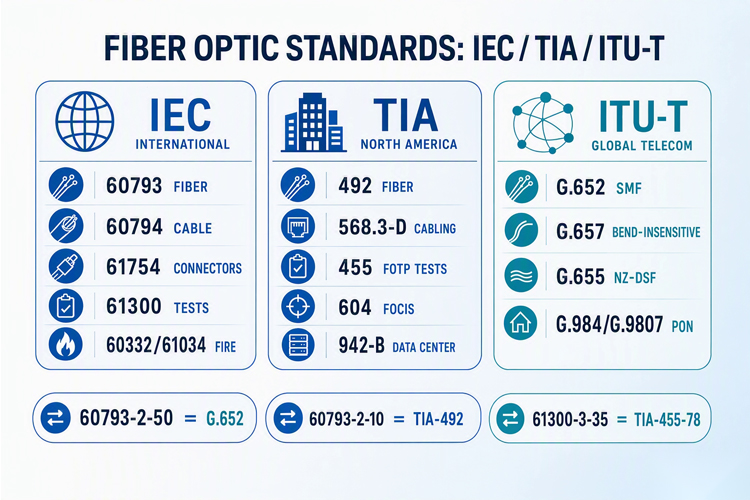
2026 fiber optic cable standards reference: IEC 60793, TIA-568.3-D, ITU-T G.652-G.657 specifications for single-mode and multimode fiber, cable construction standards, connector interfaces, and testing methods.
Fiber Optic for CCTV & Security: Long-Distance Surveillance Guide Fiber Optic for CCTV & Security: Long-Distance Surveillance Guide
Aug .11.2026
2026 guide to fiber optic CCTV & security surveillance: long-distance architecture, 4K/8K bandwidth planning, fiber cable selection, city-wide deployment strategies, and NDAA-compliant equipment selection.
Railway & Mass Transit Fiber Communication Systems Guide Railway & Mass Transit Fiber Communication Systems Guide
Aug .03.2026
Railway fiber optic communication systems for CBTC/ERTMS train control, trackside GYTC8S cable installation, metro fiber backbones, and high-speed rail networks. Covers EN 50128 fire safety and UIC 303 standards.

Oil & Gas Fiber Optic: Explosive-Proof Cabling Solutions Guide Oil & Gas Fiber Optic: Explosive-Proof Cabling Solutions Guide
Jul .21.2026
ATEX/IECEx fiber optic cables for oil and gas hazardous areas: downhole DTS/DAS sensing, pipeline leak detection, offshore platform networking, and GYFTZY non-metallic cable selection. Explore OPELINK's 2026 explosive-proof fiber solutions guide.