English
Welcome to opelink.com
Fiber Optic Product Introduction

Toneable Flat Drop Cable: Enhancing FTTH Deployments with Traceable, Durable Connectivity Solutions

Views : 1664
Update time : 2026-03-10 09:59:44
In the rapidly evolving landscape of telecommunications, where Fiber to the Home (FTTH) networks are the backbone of high-speed internet, reliable last-mile connectivity is non-negotiable. As urban expansion and rural broadband initiatives push the boundaries of infrastructure deployment, traditional drop cables often fall short in challenging environments—buried under soil, strung across poles, or navigating dense urban conduits. Enter the Toneable Flat Drop Cable, a specialized fiber optic solution designed for precision, durability, and ease of management.

This innovative cable combines the slim, flexible profile of a flat drop design with an integrated traceable conductor—typically a copper wire—that allows technicians to locate and trace it using standard toning tools. Ideal for aerial, duct, and direct-buried applications, toneable flat drop cables address key pain points in FTTH rollouts: accurate placement, minimal disruption, and long-term maintenance efficiency. For telecom operators, network engineers, and installation contractors, understanding this cable's features, benefits, and deployment strategies is crucial to optimizing performance and reducing operational costs.

This comprehensive guide explores the toneable flat drop cable from a professional standpoint, delving into its construction, advantages over conventional alternatives, installation best practices, real-world applications, and future-proofing considerations. Whether you're planning a large-scale FTTH expansion or troubleshooting existing networks, this article equips you with the insights needed to leverage this technology for superior connectivity.


Understanding the Toneable Flat Drop Cable: Design and Core Features
 
At its heart, the toneable flat drop cable is engineered for the demanding realities of last-mile fiber optic delivery. Unlike bulkier round cables, its flat profile—typically 2-3 mm thick and 5-6 mm wide—facilitates easy routing through tight spaces, such as building entries or aerial lashings. The "toneable" aspect introduces a game-changing feature: an embedded, insulated metallic tracer wire (often 18-24 AWG copper) that runs parallel to the optical fibers. This wire enables electromagnetic toning, allowing field technicians to generate an audible signal and pinpoint the cable's location without invasive digging or extensive documentation.


Construction Breakdown
 
A standard toneable flat drop cable consists of several layered components, each optimized for protection and performance:
.Optical Fibers: Usually 1-12 single-mode (G.657A2 for bend-insensitivity) or multimode fibers, protected by colored buffer tubes to prevent microbending losses. These fibers support high-bandwidth applications like GPON (Gigabit Passive Optical Networks) up to 2.5 Gbps symmetric speeds.
 
.Strength Members: Aramid yarns (Kevlar-like) or glass-reinforced plastics (GRP) on both sides provide tensile strength (up to 600N pull force) and crush resistance (500-1000 N/10 cm), essential for aerial spans or burial under traffic loads.
 
.Tracer Wire: The copper conductor is sheathed in a low-friction material to avoid signal interference with the fibers. It supports toning frequencies from 512 Hz to 33 kHz, compatible with common tools like the Fluke Networks IntelliTone or Tempo Communications locators.
 
.Outer Jacket: Made from UV-stabilized, low-smoke zero-halogen (LSZH) polyethylene or PVC, rated for outdoor exposure (IEC 60794-1 standards). The jacket's ripcord and flat design aid in quick stripping during termination.

This construction ensures the cable meets rigorous standards like Telcordia GR-20 and ITU-T G.657, with an operational temperature range of -40°C to +70°C and attenuation below 0.35 dB/km at 1310/1550 nm. In professional deployments, these specs translate to reliable signal integrity over distances up to 20 km without amplification, making it a staple for FTTH drops from distribution points to end-users.


Why Traceability Matters in Modern Networks
 
In an industry where 70% of network faults stem from localization challenges (per industry reports from the Fiber Broadband Association), the toneable feature is a standout. Traditional non-traceable cables rely on GPS mapping or manual records, which degrade over time due to construction or environmental changes. The tracer wire mitigates this by enabling non-destructive locates, reducing excavation risks by up to 80% and complying with utility locate regulations like 811 in the U.S. For engineers, this means faster fault isolation—critical in service-level agreements (SLAs) demanding 99.99% uptime.


Advantages of Toneable Flat Drop Cable in FTTH and Beyond
 
The true value of toneable flat drop cables shines in their multifaceted advantages, positioning them as a superior choice for telecom professionals seeking efficiency, safety, and scalability.

Durability and Environmental Resilience
 
Flat drop cables inherently resist environmental stressors better than round variants. Their low-profile design minimizes wind loading on aerial installations (sag under 1% in 100 km/h winds) and reduces soil displacement in buried setups. The integrated toneable wire adds no bulk, preserving this slimness while enhancing utility.

Professionally, this resilience cuts long-term maintenance costs. In coastal or seismic zones, the cable's flexibility absorbs vibrations without fiber micro-cracks, extending lifespan to 25-30 years. Compared to non-toneable flat drops, the traceable element prevents accidental cuts during parallel utility digs— a common issue costing operators $10,000+ per incident in repairs and downtime.

Cost Efficiency and Installation Speed
 
From a CapEx perspective, toneable flat drop cables offer upfront savings through simplified logistics. Their lightweight construction (under 20 kg/km) allows manual handling without heavy machinery, speeding installations by 30-50% in residential or multi-dwelling units (MDUs). Pre-connectorized ends (SC/APC or LC) further reduce splicing time, with field terminations achievable in under 5 minutes per drop.
 
OpEx benefits accrue from the toning capability: Locating a buried drop for upgrades or repairs avoids exploratory digs, saving 40-60% on labor. For large-scale FTTH projects, like those under the U.S. BEAD program allocating $42 billion for broadband, this efficiency scales network builds without ballooning budgets.

Enhanced Safety and Compliance
 
Safety is paramount in telecom fieldwork. The toneable feature supports "call-before-you-dig" protocols by providing verifiable locates, reducing strike risks to below 1% in proactive deployments. The LSZH jacket minimizes toxic emissions in case of fire, aligning with building codes like NFPA 70.

In professional audits, these cables score high on sustainability metrics—recyclable materials and reduced excavation lower carbon footprints by 25% versus traditional buried options. This appeals to eco-conscious operators pursuing green certifications.

Performance in High-Demand Scenarios
 
Supporting up to 10 Gbps per fiber with low polarization mode dispersion (PMD <0.1 ps/√km), toneable flat drops excel in bandwidth-intensive apps. Their bend radius tolerance (15 mm minimum) suits tight corner routing in homes or poles, maintaining return loss above 55 dB for clean OTDR readings.
 

Installation Best Practices for Toneable Flat Drop Cable
 
Successful deployment hinges on meticulous planning and execution. Professional installers follow these steps to maximize the cable's potential:

Pre-Installation Planning
 
Assess site conditions: For aerial drops, evaluate pole spans (up to 100 m) and lash to existing messengers using stainless steel bands. In underground scenarios, use 1-2 inch ducts or direct burial with warning tapes. Always verify tracer wire integrity with a continuity tester before laying.

Route planning incorporates toning access—leave slack loops (1-2 m) at endpoints for future locates. Software tools like AutoCAD or Bentley Comms integrate GIS data to map drops, ensuring traceability from day one.
 
Step-by-Step Installation Process
 
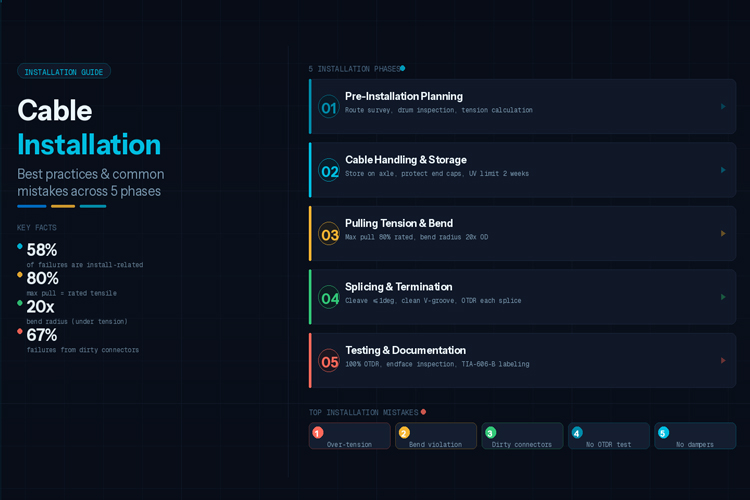
1.Preparation: Unspool the cable gently to avoid kinks, using payoff stands for tension control (<100N).
 
2.Aerial Installation: Lash to poles with figure-8 configurations, securing with dead-end grips. Employ tensioners for even distribution, and test toning signal post-install to confirm 100 m range.
 
3.Underground/Direct Burial: Trench to 0.6-1 m depth, bedding in sand for protection. For duct pulls, use lubricant and fish tapes; the flat shape eases bends (radius >10x cable width).
 
4.Termination: Strip the jacket 50-300 mm, cleave fibers, and fuse or connect to ONTs (Optical Network Terminals). Seal entries with heat-shrink for moisture resistance.
 
5.Testing and Documentation: Conduct OTDR, power meter, and toning tests. Log locations in asset management systems like NetAlly or IBM Maximo for perpetual traceability.

Common pitfalls include over-tensioning (causing attenuation spikes) or ignoring water-blocking tapes in wet areas—always adhere to manufacturer specs from brands like Corning or Prysmian.


Conclusion: Securing the Future with Toneable Flat Drop Cable
 
The toneable flat drop cable represents a pinnacle of innovation in FTTH infrastructure, blending durability, traceability, and efficiency to meet the demands of a hyper-connected world. From its robust construction and installation advantages to its proven applications in urban, rural, and hybrid scenarios, this cable empowers telecom professionals to deliver reliable, high-speed connectivity with minimal risk and cost.

As broadband penetration targets 100% in developed nations and expands globally, adopting toneable flat drop solutions isn't optional—it's a strategic imperative. By prioritizing traceability and resilience, operators can future-proof their networks, reduce operational headaches, and enhance customer satisfaction. Embrace this technology to illuminate the path to seamless digital access.

 
Related News
Read More >>
Enterprise LAN Fiber Network: Planning & Implementation Guide Enterprise LAN Fiber Network: Planning & Implementation Guide
Jul .07.2026
2026 enterprise LAN fiber network guide covering 400G/800G campus migration, OM4/OM5/OS2 selection, TIA-568 structured cabling, Wi-Fi 7 readiness, AI-driven bandwidth planning, and procurement best practices.
Smart City Fiber Network Deployment Guide Smart City Fiber Network Deployment Guide
Jun .30.2026
Smart city fiber infrastructure isn't optional in 2026. This complete guide covers three-layer fiber architecture, XGS-PON deployment strategies, regional policy deep dives (US/EU/China), and a procurement checklist for city planners and system integrator
Data Center Fiber Cabling: 400G/800G Migration Guide Data Center Fiber Cabling: 400G/800G Migration Guide
Jun .23.2026
Complete guide to data center fiber cabling for 40G to 800G migration. Covers 400GBASE-SR8/DR4/FR4, single-mode vs multimode fiber selection, AI cluster connectivity, IEEE 802.3df 800G standards, and structured cabling best practices with 2025 market data
Telecom Fiber Infrastructure Solutions | FTTH, 5G & Rural Telecom Fiber Infrastructure Solutions | FTTH, 5G & Rural
Jun .16.2026
Complete guide to telecom fiber infrastructure: FTTH, 5G backhaul & rural deployment solutions. market data, cost analysis & OEM qualification requirements.