
English
Welcome to opelink.com
Fiber Optic Product Introduction

FWDM vs. CWDM vs. DWDM: A Technical Deep Dive into Optical Networking Choices

Views : 2526
Author : goodvin
Update time : 2025-10-07 09:54:03
The relentless demand for bandwidth continues to drive innovation in optical networking technologies. Among the contenders vying for dominance in this space are Filter Wavelength Division Multiplexing (FWDM), Coarse Wavelength Division Multiplexing (CWDM), and Dense Wavelength Division Multiplexing (DWDM). Each technology offers a unique balance of cost, capacity, and performance, making the selection process a critical decision for network operators. This article delves into a detailed comparative analysis of these technologies, outlining their respective advantages and disadvantages to provide a clear understanding of their suitability for various applications.

Understanding the Fundamentals

Before we embark on a head-to-head comparison, it’s essential to grasp the underlying principles of each technology:

.FWDM (Filter Wavelength Division Multiplexing): FWDM is a wavelength division multiplexing technique that utilizes optical filters to selectively combine and separate different wavelengths of light onto a single optical fiber. These filters are designed to pass specific wavelengths while reflecting others, effectively multiplexing and demultiplexing the optical signals. FWDM systems typically support fewer wavelengths than DWDM but more than CWDM, placing them in a mid-range position in terms of capacity and cost.
.CWDM (Coarse Wavelength Division Multiplexing): CWDM is characterized by its wider channel spacing, typically 20 nm, allowing for the use of less expensive, uncooled lasers. This wider spacing limits the number of channels that can be supported on a single fiber, typically up to 18 channels across the entire optical spectrum. CWDM is primarily used for short-haul applications and scenarios where cost-effectiveness is paramount.
.DWDM (Dense Wavelength Division Multiplexing): DWDM is the high-capacity workhorse of long-haul optical networks. It utilizes tightly spaced wavelengths, often with channel spacing as narrow as 0.4 nm (50 GHz grid) or even 0.2 nm (25 GHz grid), enabling the transmission of a significantly larger number of channels (80, 96, or even more) on a single fiber. DWDM systems employ sophisticated technologies like cooled lasers and optical amplifiers to overcome signal degradation over long distances.


FWDM: Advantages and Disadvantages

Advantages:

1.Cost-Effectiveness: FWDM offers a good balance between capacity and cost. While not as inexpensive as CWDM, it’s significantly more affordable than DWDM. This makes it a suitable option for applications where moderate capacity growth is expected without the need for high-end DWDM infrastructure.
2.Lower Power Consumption: Compared to DWDM systems that require cooled lasers and complex amplification schemes, FWDM systems generally consume less power. This can lead to significant operational savings, particularly in large-scale deployments.
3.Simplified Network Management: FWDM systems are typically less complex to manage than DWDM systems. The fewer number of channels and less stringent performance requirements simplify network planning, provisioning, and maintenance.
4.Scalability: While not as scalable as DWDM, FWDM systems offer a degree of scalability beyond CWDM. The ability to add or remove channels as needed provides some flexibility in adapting to changing network demands.
5.Smaller Footprint: FWDM equipment often requires a smaller physical footprint compared to DWDM, making it advantageous in space-constrained environments like metropolitan area networks (MANs) or data centers.


Disadvantages:

1.Limited Capacity: Compared to DWDM, FWDM offers a significantly lower capacity. The number of channels supported is limited by the filter technology and the available optical spectrum. This can be a constraint in high-bandwidth applications.
2.Distance Limitations: FWDM signals can experience significant attenuation and dispersion over long distances. This limits the reach of FWDM systems, typically making them suitable for short-to-medium haul applications.
3.Filter Performance Degradation: Optical filters used in FWDM systems can degrade over time due to environmental factors or component aging. This can lead to signal degradation and reduced system performance. Regular monitoring and maintenance are required to mitigate this issue.
4.Wavelength Drift: Changes in temperature can cause wavelength drift in the optical filters, potentially leading to signal interference or loss. Temperature control mechanisms may be necessary to stabilize filter performance.
5.Less Flexible than ROADM-Based DWDM: In comparison to ROADM (Reconfigurable Optical Add-Drop Multiplexer)-based DWDM systems, FWDM offers less flexibility in dynamically reconfiguring the network. Adding or removing channels may require manual intervention.


CWDM: Advantages and Disadvantages

Advantages:

1.Lowest Cost: CWDM is the most cost-effective WDM technology, primarily due to its use of uncooled lasers and simpler optical components. This makes it an attractive option for cost-sensitive applications like short-haul links and access networks.
2.Lower Power Consumption: The use of uncooled lasers in CWDM systems results in significantly lower power consumption compared to DWDM. This can lead to substantial energy savings in large deployments.
3.Small Footprint: CWDM equipment typically has a compact footprint, making it ideal for space-constrained environments like data centers and access nodes.
4.Simplicity: CWDM systems are relatively simple to design, deploy, and manage. This reduces operational complexity and lowers maintenance costs.
5.Ease of Upgrade: Upgrading existing fiber infrastructure with CWDM can be a relatively straightforward process, particularly for adding capacity to short-haul links.


Disadvantages:

1.Limited Capacity: CWDM offers the lowest capacity among WDM technologies. The wide channel spacing limits the number of channels that can be supported on a single fiber.
2.Short Distance: CWDM signals experience significant attenuation and dispersion over longer distances, limiting its reach to a few tens of kilometers.
3.No Optical Amplification: CWDM systems typically do not support optical amplification, further restricting their reach.
4.Limited Scalability: The limited number of channels and lack of amplification make CWDM less scalable than FWDM or DWDM.
5.Wider Channel Spacing: The wider channel spacing makes CWDM more susceptible to chromatic dispersion effects, which can degrade signal quality over longer distances.


DWDM: Advantages and Disadvantages

Advantages:

1.Highest Capacity: DWDM offers the highest capacity among WDM technologies, enabling the transmission of a large number of channels on a single fiber. This is essential for long-haul networks and high-bandwidth applications.
2.Long Distance: DWDM signals can be transmitted over thousands of kilometers with the aid of optical amplifiers and dispersion compensation techniques.
3.Scalability: DWDM is highly scalable, allowing network operators to increase capacity as needed by adding or upgrading channels.
4.Flexibility: DWDM systems, particularly those based on ROADM technology, offer a high degree of flexibility in dynamically reconfiguring the network and managing wavelengths.
5.Mature Technology: DWDM is a mature and well-established technology with a wide range of vendors and solutions available.


Disadvantages:

1.Highest Cost: DWDM is the most expensive WDM technology due to its use of cooled lasers, sophisticated optical components, and complex amplification schemes.
2.High Power Consumption: DWDM systems consume significantly more power than CWDM or FWDM due to the need for cooled lasers and optical amplifiers.
3.Complexity: DWDM systems are complex to design, deploy, and manage. This requires specialized expertise and increases operational costs.
4.Larger Footprint: DWDM equipment typically has a larger physical footprint compared to CWDM or FWDM, which can be a constraint in space-limited environments.
5.Wavelength Stability Requirements: DWDM systems require highly stable wavelengths to prevent signal interference. This necessitates precise temperature control and sophisticated wavelength management techniques.

Comparative Table: FWDM vs. CWDM vs. DWDM

Application Scenarios and Considerations
 
The choice between FWDM, CWDM, and DWDM depends heavily on the specific requirements of the network and the application.
 
.CWDM: Best suited for short-haul links, access networks, and scenarios where cost is the primary concern. Examples include connecting data centers within a metropolitan area or providing bandwidth to residential subscribers.
.FWDM: A good compromise between cost and capacity for metro area networks, enterprise networks, and applications requiring moderate bandwidth growth. Examples include connecting business campuses or providing backhaul for mobile networks.
.DWDM: The technology of choice for long-haul networks, core networks, and high-bandwidth applications. Examples include transcontinental fiber optic cables, backbone networks for internet service providers, and high-capacity data center interconnects.


Beyond the Basics: Emerging Trends

The landscape of optical networking is constantly evolving, with several emerging trends impacting the selection and deployment of WDM technologies:
.Disaggregation and Open Optical Networking: The trend towards disaggregated optical networking, where network operators can mix and match equipment from different vendors, is gaining momentum. This allows for greater flexibility and cost savings.
.Silicon Photonics: Silicon photonics is emerging as a disruptive technology that promises to lower the cost and power consumption of optical transceivers. This could make DWDM more affordable for a wider range of applications.
.Coherent Optics: Coherent detection and modulation techniques are enabling higher data rates and longer reach in DWDM systems. These technologies are essential for meeting the ever-increasing bandwidth demands.
.Software-Defined Networking (SDN): SDN is revolutionizing network management by providing centralized control and automation. SDN can be used to optimize the performance of WDM networks and simplify wavelength provisioning.
.Artificial Intelligence (AI) and Machine Learning (ML): AI and ML are being used to improve network monitoring, fault diagnosis, and capacity planning in WDM networks. These technologies can help network operators optimize performance and reduce operational costs.
 

Conclusion

The selection of FWDM, CWDM, or DWDM depends on a complex interplay of factors, including cost, capacity, distance, scalability, and application requirements. CWDM offers the lowest cost and simplest implementation for short-haul applications, while DWDM provides the highest capacity and longest reach for core networks. FWDM occupies a middle ground, offering a balance of cost and capacity for metro area networks and enterprise applications. As technology evolves and new trends emerge, network operators must carefully evaluate their options to choose the WDM technology that best meets their specific needs and enables them to deliver high-bandwidth services efficiently and cost-effectively.


FAQs
 
1. What are the key factors to consider when choosing between FWDM, CWDM, and DWDM?
When selecting between FWDM, CWDM, and DWDM, several critical factors warrant careful consideration. First and foremost is the bandwidth requirement of the network, dictating the necessary capacity and channel density. Distance constraints are equally important, as each technology has limitations regarding signal reach and attenuation. Budgetary considerations play a pivotal role, influencing the choice between cost-effective CWDM and higher-capacity DWDM. The scalability of the network is also crucial, determining whether the chosen technology can accommodate future growth. Finally, the existing infrastructure must be taken into account, ensuring compatibility with the new system and potentially influencing the choice based on integration ease and cost.
 
2. How does the channel spacing differ between FWDM, CWDM, and DWDM, and why is it significant?
Channel spacing, or the separation between individual wavelengths in a WDM system, is a fundamental aspect differentiating FWDM, CWDM, and DWDM. CWDM employs the widest channel spacing, typically 20 nm, which simplifies laser requirements and reduces costs but limits the number of channels. FWDM offers an intermediate approach with channel spacing usually ranging from 8 to 12 nm, providing a balance between capacity and cost. DWDM utilizes the tightest channel spacing, often as narrow as 0.4 nm (50 GHz grid) or 0.8 nm (100 GHz grid), enabling a significantly higher channel count and capacity. The significance lies in the trade-off between capacity and cost. Tighter channel spacing allows for more channels and higher capacity but requires more expensive and precise optical components, ultimately increasing the overall system cost.
  
3. What role do optical amplifiers play in DWDM systems, and why are they generally not used in CWDM systems?
Optical amplifiers are integral to DWDM systems, enabling the transmission of signals over long distances by compensating for signal attenuation. These amplifiers, typically Erbium-Doped Fiber Amplifiers (EDFAs), boost the power of optical signals without converting them to electrical signals, allowing DWDM systems to span thousands of kilometers. CWDM systems generally do not utilize optical amplifiers due to their shorter transmission distances and wider channel spacing. Amplifying CWDM signals can introduce cross-talk and noise that degrade the signal quality due to the broader spectral width of the channels. Moreover, the cost-effectiveness of CWDM is partly derived from the absence of expensive amplifiers, making them an impractical addition for typical CWDM deployments.
 
4. How does ROADM technology enhance the flexibility of DWDM networks compared to traditional fixed DWDM systems?
ROADM (Reconfigurable Optical Add-Drop Multiplexer) technology significantly enhances the flexibility and agility of DWDM networks compared to traditional fixed DWDM systems. Traditional fixed DWDM systems require manual intervention to reconfigure the network, making it time-consuming and costly to add or drop wavelengths. ROADM systems allow for dynamic and remote reconfiguration of wavelengths, enabling network operators to quickly adapt to changing bandwidth demands and service requirements. ROADMs enable the dynamic addition or removal of wavelengths at intermediate nodes without requiring physical intervention, facilitating faster service provisioning, improved network resilience, and optimized bandwidth utilization. This flexibility is particularly crucial in dynamic environments such as metro area networks and data center interconnects.
 
5. What are some emerging trends in optical networking that could impact the future adoption of FWDM, CWDM, and DWDM?
Several emerging trends in optical networking are poised to shape the future adoption of FWDM, CWDM, and DWDM technologies. Silicon photonics is gaining traction as a cost-effective alternative to traditional optical components, potentially reducing the cost of DWDM systems and expanding their reach. Coherent optics are enabling higher data rates and longer distances in DWDM systems, addressing the ever-increasing bandwidth demands. Disaggregated optical networking promotes interoperability between different vendor's equipment, offering greater flexibility and cost savings for network operators. Software-Defined Networking (SDN) is simplifying network management and automation, allowing for dynamic provisioning and optimization of WDM networks. Finally, Artificial Intelligence (AI) and Machine Learning (ML) are being applied to enhance network monitoring, fault diagnosis, and capacity planning, improving efficiency and reliability. These trends are expected to drive innovation and reshape the landscape of optical networking, influencing the adoption of various WDM technologies in different application scenarios.
 

Keywords: FWDM, CWDM, DWDM, Optical Networking, Wavelength Division Multiplexing, Network Capacity, Network Cost, Bandwidth, Optical Amplifiers, ROADM, Silicon Photonics, Coherent Optics, SDN, Disaggregation, WDM Technologies, Fibre Optic.

 
Related News
Read More >>
Fiber Optic Cable Selection by Application: FTTH, Power, Mining & More Fiber Optic Cable Selection by Application: FTTH, Power, Mining & More
Nov .17.2026
Choose the right fiber optic cable for your application: FTTH networks, power transmission, mining, submarine and more with specific cable recommendations.
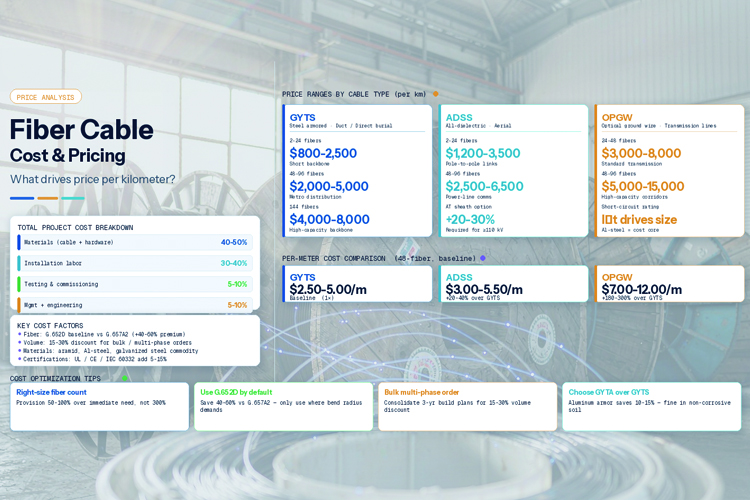
Outdoor Fiber Optic Cable Cost and Price Analysis: What Drives Pricing? Outdoor Fiber Optic Cable Cost and Price Analysis: What Drives Pricing?
Nov .03.2026
Understand outdoor fiber optic cable pricing: cost factors, price ranges by type, and how to estimate total project costs for GYTS, ADSS and OPGW.
GYTS Cable: Direct Burial and Duct Installation Complete Guide GYTS Cable: Direct Burial and Duct Installation Complete Guide
Oct .27.2026
Complete guide to GYTS fiber optic cable installation: direct burial and duct methods, specifications, best practices and common pitfalls.
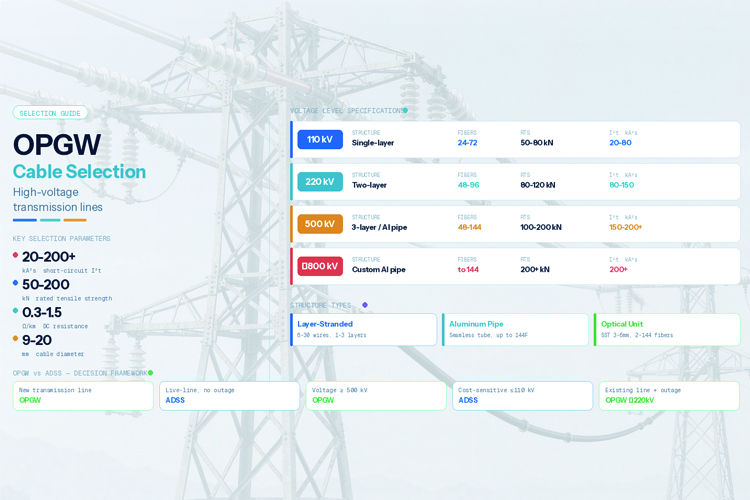
OPGW Cable Selection Guide for High-Voltage Transmission Lines OPGW Cable Selection Guide for High-Voltage Transmission Lines
Oct .20.2026
Complete OPGW cable selection guide: short circuit current capacity, voltage ratings, structure types, installation requirements and comparison with ADSS.