Product Overview
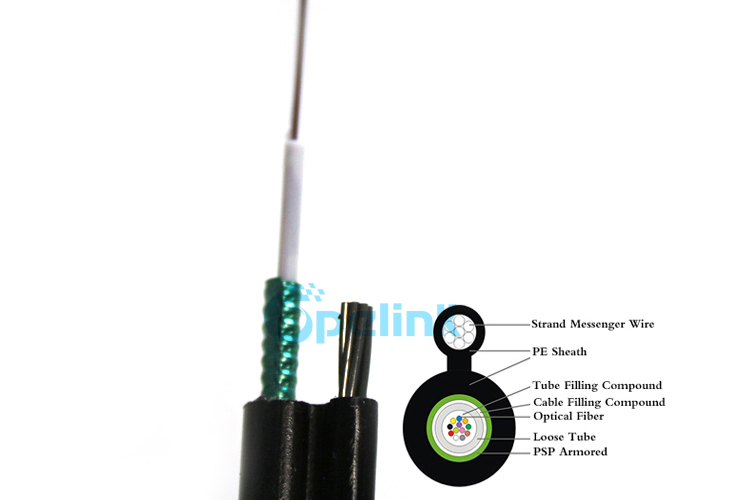
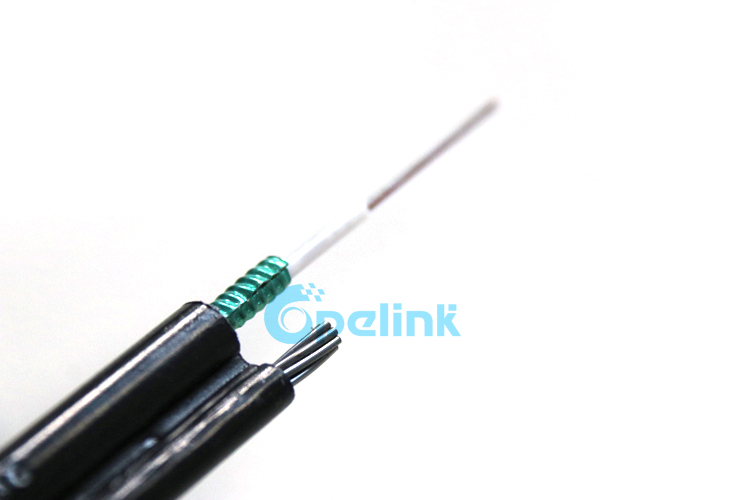
The GYXTC8S is a self-supporting armored figure-8 fiber optic cable designed for aerial installation without the need for a separate messenger wire. The cable features a compact figure-8 cross-section where the optical fiber unit and the stranded steel wire messenger are integrated into a single PE sheath structure. This design eliminates the need for lashing wire and reduces installation time and cost significantly.
Single-mode (G.652D) or multimode fibers are housed in a central loose tube made of high-modulus PBT plastic, filled with thixotropic water-blocking gel. A corrugated steel tape (PSP) is longitudinally applied around the loose tube for crush resistance and moisture barrier protection. Water-blocking materials are distributed into interstices to ensure the cable core remains watertight. The stranded steel wires serve as the self-supporting messenger member, providing high tensile strength for long-span aerial deployment.
Opelink supplies GYXTC8S cables from 2 to 24 fiber cores in standard configurations, with custom designs available for higher core counts. The cable complies with YD/T 1155-2001 and IEC 60794-1 standards, and is suitable for long-distance communication, local area networks, and FTTX deployments.
GYXTC8S vs. Other Self-Supporting Cables
| Feature |
GYXTC8S |
GYTC8S |
ADSS |
GYXTC8Y |
| Structure |
Figure-8, central tube |
Figure-8, stranded tubes |
All-dielectric, round |
Figure-8, non-metallic |
| Armor |
Corrugated steel tape |
Corrugated steel tape |
None (aramid) |
None (FRP) |
| Messenger |
Stranded steel wire |
Stranded steel wire |
Aramid yarn |
FRP rod |
| Fiber Count |
2-24 (standard) |
2-144 |
2-288 |
2-24 |
| Max. Span |
~100m typical |
~100m typical |
~150m (varies) |
~80m typical |
| Application |
Aerial self-supporting |
Aerial self-supporting |
Aerial/duct |
Aerial self-supporting |
| Rodent Protection |
Good (steel armor) |
Good (steel armor) |
Poor |
Poor |
| Moisture Resistance |
Excellent (PSP+gel) |
Excellent (PSP+gel) |
Good (gel only) |
Good (gel only) |
GYXTC8S is ideal for short to medium span aerial installations where steel armor provides crush resistance and rodent protection. For longer spans or all-dielectric requirements near high-voltage lines, ADSS is preferred. For higher fiber counts, GYTC8S with stranded loose tubes offers up to 144 cores.
Application Scenarios
- Aerial self-supporting installation on utility poles for long-distance communication networks
- Local area network (LAN) outdoor backbone links between buildings or campuses
- FTTX / FTTH distribution network aerial drops where underground ducting is impractical
- Rural and suburban broadband deployment spanning poles along roads or pathways
- Temporary or emergency network restoration requiring rapid aerial deployment
- Industrial campus networks connecting warehouses, factories, and office buildings
- Railway and highway communication signaling systems along transportation corridors
- CCTV and surveillance network backbones for security infrastructure along perimeters
- Mobile base station fronthaul/backhaul links where fiber to the tower is required via aerial route
Frequently Asked Questions
Q1: What is the difference between GYXTC8S and GYTC8S?
GYXTC8S has a central loose tube design (all fibers in one tube), supporting 2-24 cores. GYTC8S uses stranded loose tubes, allowing higher fiber counts up to 144 cores. GYXTC8S is more compact and economical for lower core counts, while GYTC8S is preferred for high-density applications.
Q2: What is the maximum span length for GYXTC8S aerial installation?
The typical span length is 40-80 meters between poles, depending on wind load, ice load conditions, and local utility regulations. The stranded steel messenger provides tensile strength up to 6000N (short-term). For longer spans, a larger messenger wire or alternative cable types like ADSS may be required.
Q3: Can GYXTC8S be installed in ducts or direct buried?
GYXTC8S is primarily designed for aerial self-supporting installation. While the steel tape armor provides crush resistance, the figure-8 structure is not optimal for duct or direct buried applications. For duct installation, consider GYTA or GYFTY cables. For direct burial, consider GYTA53 or GYXTW cables.
Q4: What fiber types are available?
Standard configuration uses ITU-T G.652D single-mode fiber. Multimode fibers (OM1 62.5/125, OM2 50/125, OM3 50/125) are also available. For bend-insensitive applications, G.657A1 or G.657A2 can be supplied on request. Fiber brands include Corning, YOFC, Draka, and Fujikura.
Q5: How does the figure-8 structure work?
The cable has a figure-8 cross-section where the upper portion contains the optical fiber unit (loose tube with fibers, steel tape armor, and PE sheath) and the lower portion contains the stranded steel messenger wire, both sharing a common PE sheath. This eliminates the need for a separate messenger wire and lashing during installation.
Q6: What is the lead time and MOQ?
MOQ is 1 km for standard configurations. Lead time is 7-15 working days for standard types and 15-25 working days for custom designs. Rush production is available for urgent projects. Daily production capacity is 200 km.
Q7: Is the cable rodent-resistant?
Yes. The corrugated steel tape armor provides good mechanical protection against rodents and small animals. For severe rodent environments, additional protection such as steel wire armor (GYXTC8S33) or corrugated steel tape with extra thickness can be provided.
Q8: What testing is performed before shipment?
Each drum undergoes OTDR testing for attenuation and continuity, mechanical tensile test, visual inspection, and fiber continuity verification. Test reports are provided with each shipment. Type tests per IEC 60794-1 are available for new designs.
Q9: Can I get a sample for testing?
Yes, sample lengths (typically 10-50 meters) are available for testing and evaluation. Contact our sales team with your specific requirements and destination for sample arrangement and quotation.