Product Overview
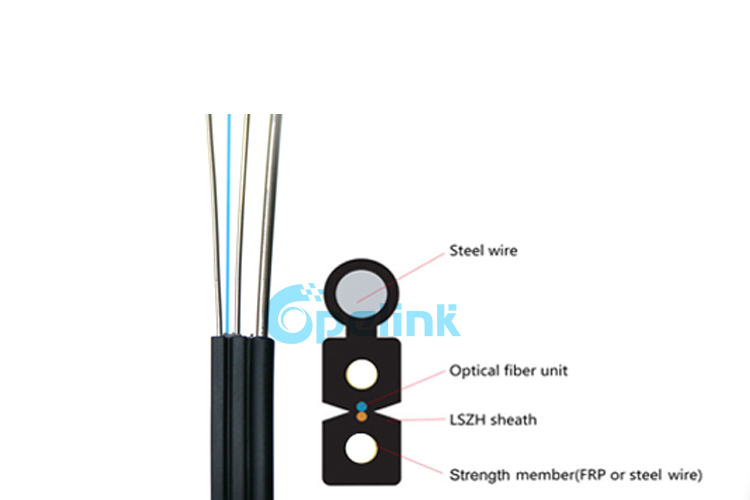
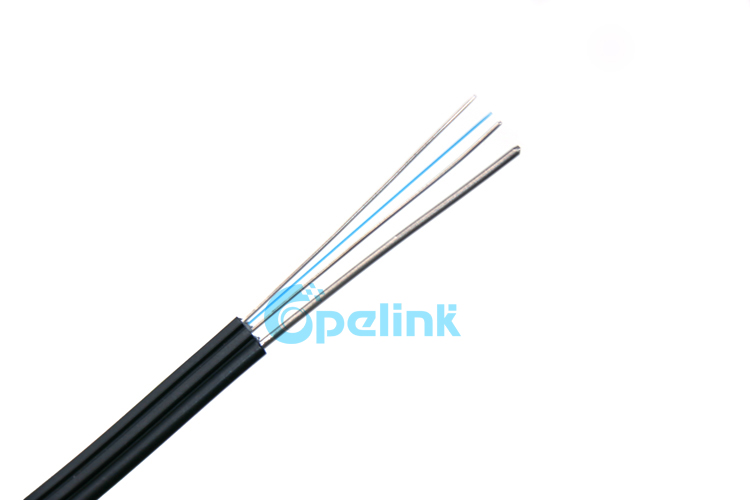
The GJYXCH is a bow-type (flat) FTTH drop cable with a self-supporting design, engineered for the final drop section between the distribution point and the subscriber. Its flat profile and integrated strength member allow aerial suspension without a separate messenger wire, while remaining flexible enough for indoor routing.
Available with a steel wire or KFRP-steel strength member and a choice of LSZH or PVC sheath, the GJYXCH balances tensile performance, fire safety and installation convenience. It is fully tested to IEC 60794-1-2 mechanical and environmental methods, ensuring stable optical performance in long-term field use.
Key Features
- Self-supporting bow-type profile for aerial drop installation without messenger wire
- Metal strength member options: 1.1 mm steel wire or 0.52/0.45 mm KFRP-steel wire
- Compact flat dimension of 2.0 x 5.2 mm for easy handling and termination
- LSZH and PVC sheath options for indoor, outdoor, and fire-sensitive environments
- Wide operating temperature range of -40 to +70 C
- Tensile strength 600/300 N and crush resistance 1000/500 N per 100 mm (short/long term)
- Qualified to IEC 60794-1-2 E1, E3, E4, E6 and F1 test methods
- Attenuation change within 0.4 dB/km at 1550 nm after mechanical and environmental tests
Applications
- FTTH (fiber to the home) drop cable sections from distribution point to subscriber
- FTTO (fiber to the office) and FTTB (fiber to the building) last-mile connections
- Aerial installation between poles in residential and rural areas
- Duct and indoor routing where flat, bend-tolerant drop cable is preferred
- Upgrade paths for existing copper-based access networks
FAQ
What is the difference between self-supporting and non-self-supporting bow-type drop cables?
A self-supporting drop cable integrates a strength member such as a steel wire or FRP into the flat bow-type profile, allowing it to be suspended aerially between poles without a separate messenger wire. Non-self-supporting versions rely on an external support system and are typically used in duct or indoor sections where aerial tension is not applied.
Which scenarios is the GJYXCH cable designed for?
The GJYXCH is built for FTTH (fiber to the home) drop sections, and is also suitable for FTTO (fiber to the office) and FTTB (fiber to the building) installations. Its flat bow-type construction handles aerial, duct, and indoor routing with small bending radii.
How do I choose between steel wire and KFRP strength members?
Steel wire provides maximum tensile capacity for long aerial spans and is the most economical choice. KFRP / steel wire hybrid and pure KFRP options reduce or eliminate metallic content, which helps where lightning resistance, electromagnetic interference immunity, or fully dielectric installation is preferred. OPELINK offers 1.1 mm steel wire and 0.52/0.45 mm KFRP-steel configurations.
What do the IEC 60794-1-2 test items mean?
IEC 60794-1-2 defines the mechanical and environmental test methods for optical fiber cables. E1 covers tensile strength, E3 crush resistance, E4 impact, E6 repeated bending, and F1 temperature cycling. The GJYXCH cable is tested under these methods, with attenuation change kept within the required limits after each test.
Should I choose LSZH or PVC sheath?
LSZH (low smoke zero halogen) is recommended for indoor, tunnel, and confined spaces where fire safety matters, as it emits low smoke and no halogen gases when burned. PVC offers robust mechanical protection and cost efficiency for outdoor or less fire-critical environments. OPELINK supplies both sheath options for the GJYXCH.