By goodvin | 13 August 2026 | 0 Comments
Optical Switch Applications in 5G Fronthaul Networks: C-RAN and Midhaul
Introduction
This article explores the application of optical switches in 5G fronthaul/mid-range networks, with a focus on two fronthaul schemes based on wavelength and optical switches under the C-RAN architecture, as well as the key roles of WSS/ROADM in wavelength tuning, fiber protection, dynamic load balancing, and Massive MIMO beamforming.
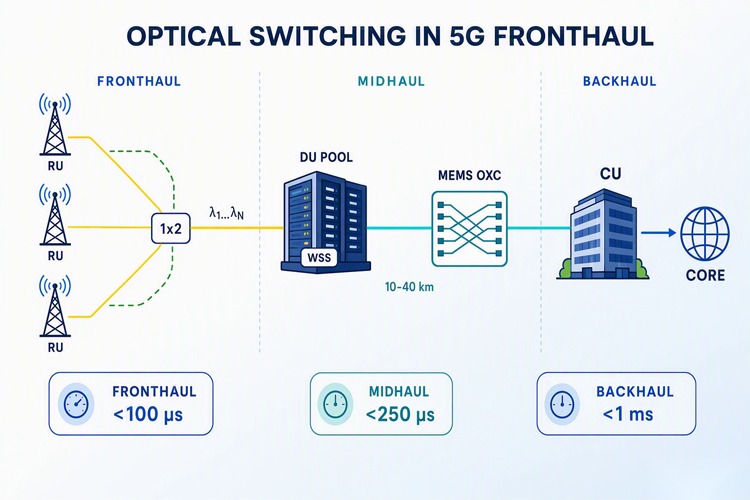
5G Fronthaul: The Challenge
5G NR (New Radio) requires unprecedented bandwidth and extremely low latency in the fronthaul network connecting the RU (Radio Unit) at the cell site to the DU (Distributed Unit) in the central office. A single 5G macro cell generates 10–40 Gbps of fronthaul traffic. In C-RAN (Cloud Radio Access Network) architectures, hundreds of RUs are concentrated at a central DU pool — requiring massive fronthaul bandwidth and millisecond latency.
C-RAN Architecture with Optical Switching
Two fronthaul architectures use optical switches:Wavelength-based fronthaul: Each RU transmits on a unique wavelength (λ1, λ2, ..., λN). A WSS at the DU pool independently routes each wavelength to the correct DU port. Wavelength allocation can be changed remotely — enabling dynamic load balancing between DUs.
Switch-based fronthaul: Multiple RUs share a wavelength via TDM (Time Division Multiplexing). A 1×N optical switch at the cell site selects which RU is active on the shared wavelength. This reduces wavelength count but increases latency (TDM overhead).
CPRI vs. eCPRI: Protocol Considerations
Protocol: CPRI: CPRI (Common Public Radio Interface) | eCPRI: eCPRI (enhanced CPRI)Data rate per RU: CPRI: 4.9–24.3 Gbps (3GPP Release 8–10) | eCPRI: 2.5–25 Gbps (3GPP Release 15+)
Functional split: CPRI: Option 8: fully split at antenna | eCPRI: Option 7-2x: split at PHY layer
Bandwidth efficiency: CPRI: Lower (more fronthaul bandwidth) | eCPRI: Higher (30–50% less bandwidth)
Latency requirement: CPRI: <100 μs one-way (critical) | eCPRI: <100 μs one-way (same)
Optical switching: CPRI: Wavelength switching (WSS-based ROADM) | eCPRI: WSS or OXC (wavelength or fiber-layer switching)
Optical Switch Applications in 5G Fronthaul
Fiber Protection for 5G Fronthaul: 1×2 mechanical switches protect critical fronthaul links with <50 ms failover. In dense urban deployments where fiber cuts are common (construction), protection switching is essential for maintaining 5G coverage. 1+1 protection is used for macro cell sites; 1:1 for small cells.Wavelength Provisioning with WSS: WSS-based ROADM at the DU pool enables remote provisioning of new 5G wavelengths. When a new cell site is activated, the network operator provisions a wavelength without sending a technician to the DU. WSS enables 5G capacity to be added in hours instead of weeks.
Dynamic Load Balancing: During peak hours (sports events, concerts), traffic from adjacent cells can be dynamically rerouted to DUs with spare capacity. WSS enables wavelength-level rerouting without affecting other cells on the same fiber.
Beamforming in Massive MIMO: Massive MIMO (64T64R) requires coordination between antenna elements. Some architectures use optical switching to route partial beamforming data (PBCH) to specialized processing units. 1×N optical switches select between beamforming processing paths.
5G Midhaul (DU-to-CU): The midhaul connects the DU to the CU (Central Unit) over longer distances (10–40 km). OXC at the midhaul hub enables wavelength-level switching between DUs and CUs, supporting flexible functional splits and dynamic service provisioning.
5G Transport Network Architecture
A typical metro 5G transport network uses optical switching at three layers:Fronthaul (DU pool): WSS-based ROADM or 1×N switches for wavelength provisioning and protection. 1×2 switches at cell sites for fiber protection. Latency budget: <100 μs.
Midhaul (DU-to-CU): OXC (MEMS-based) for fiber-layer switching. WSS for wavelength routing. Latency budget: <250 μs.
Backhaul (CU-to-Core): Standard DWDM with OXC and electrical IP routers. Latency budget: <1 ms (5G URLLC requires <1 ms one-way).
Key Technical Requirements for 5G Fronthaul Switches
Latency: Switching time: <50 μs for fronthaul (WSS/LC); <1 ms for midhaul. Any switch-induced latency adds directly to the 100 μs budget.Wavelength range: C-band (1528–1561 nm) for DWDM fronthaul. Full band (1260–1650 nm) for some CPRI implementations.
Port density: High port count WSS (1×32) for metro hub with many cell sites
Open interfaces: OpenConfig/YANG support for SDN-controlled wavelength provisioning. NETCONF for automated network configuration.
Timing: IEEE 1588v2 PTP (Precision Time Protocol) transparency — switch must not add excessive packet delay variation (PDV) to timing packets.
Conclusion
In 5G fronthaul networks, optical switches (especially WSS and OXC) are the core components for achieving ultra-low latency of<100 μ s, remote wavelength tuning, and dynamic load balancing. When combined with DWDM, they can reduce the fiber usage in dense urban areas from 200 cores/km ² to 4-8 cores/km ², making them a key enabling technology for large-scale deployment of 5G transmission networks.Frequently Asked Questions
Q1: Can existing DWDM infrastructure support 5G fronthaul?
Yes, in most cases. 5G fronthaul wavelengths (typically 10G, 25G CPRI/eCPRI) can be added to existing DWDM systems as additional wavelengths. A DWDM system with 80×100G channels can add 10–20× 10G fronthaul wavelengths without impacting existing traffic. WSS-based ROADM is the ideal infrastructure for 5G fronthaul because it can provision new wavelengths remotely without physical reconfiguration. However, legacy fixed OADM systems may require hardware upgrades to support eCPRI.Q2: Why is 100 μs latency critical for 5G fronthaul?
The 100 μs one-way latency budget for 5G fronthaul (CPRI/eCPRI) comes from the air interface timing: 5G NR uses TDD (Time Division Duplexing) with 0.5–1 ms radio frames. The fronthaul link must not add latency that reduces the time available for baseband processing in the DU. If the fronthaul consumes more than 100 μs, the DU cannot process and retransmit in the required time slot, causing coverage gaps. This is why OXC (fiber-layer switching, <1 μs) is preferred over electrical switching (10–100 μs) for 5G fronthaul.Q3: What is the fiber count requirement for 5G fronthaul?
A single 5G macro cell (4T4R) requires 2 fibers minimum (TX and RX). In C-RAN with wavelength multiplexing, each fiber can carry multiple wavelengths — so 1–2 fibers per cell site are sufficient if DWDM is deployed. A 64T64R massive MIMO cell may require 4–8 wavelengths (2×2 for normal operation + 2×2 for protection), still fitting in 1–2 fibers with DWDM. A dense urban area with 100 cell sites per km² requires careful fiber count planning: 200 fibers per km² (without DWDM) vs. 4–8 fibers per km² (with DWDM + WSS).Related Guides
Optical switch specifications
Smart city fiber network
WSS in 5G transport network
Optical switch standards
Single-mode fiber
Leave a Reply
Your email address will not be published.Required fields are marked. *