By goodvin | 06 August 2026 | 0 Comments
1xN Fiber Optic Switch: Selection Guide for Test Automation and Sensing Applications
Introduction
This article serves as a comprehensive selection guide for 1×N Fiber optic switches, detailing key specifications such as insertion loss, switching time, and other critical parameters for standard configurations ranging from 1×2 to 1×128. It also covers their applications in three core scenarios: automated fiber optic testing, FBG fiber sensing demodulation, and broadcast video distribution.
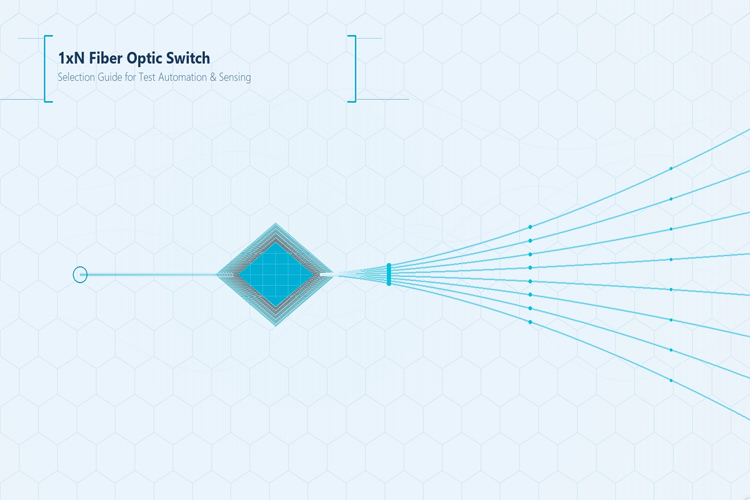
1×N switches are the workhorse of optical test and sensing systems. They enable automated fiber testing, multi-point FBG sensor interrogation, and broadcast signal distribution — reducing equipment costs by 80% compared to dedicated instruments for each fiber.
1×4: Small-scale test automation, 4-channel FBG sensor arrays, signal distribution. Good balance of port count and insertion loss. Common in laboratory and R&D applications.
1×8: Medium-scale test automation, 8-channel FBG sensing (bridges, pipelines), broadcast signal routing. Most popular configuration for FBG interrogation systems.
1×16: Fiber cable TV (CATV) distribution, medium-scale OTDR testing, multi-point sensing. Common in FTTH network monitoring (16 PON ports per OLT card).
1×32: Large-scale fiber plant monitoring, 32-channel FBG sensing arrays, automated OTDR testing. Typical for OSP (Outside Plant) fiber monitoring cabinets.
1×64: Very large-scale test automation, utility-scale FBG sensing (dams, tunnels), FTTH network management (32 PON OLT × 2 directions). Insertion loss: 2.5–4.0 dB.
1×128: Utility-scale applications: power grid monitoring (high-voltage transmission lines), large campus fiber management, carrier network monitoring. Requires careful power budget planning.
Loss Uniformity: ≤0.5 dB across all ports (important for FBG sensing where all channels must be balanced). Poor uniformity causes channel-to-channel measurement bias.
Switching Time: 5–20 ms for mechanical; 100 μs–5 ms for MEMS. For OTDR testing, <50 ms total (switch + OTDR) is acceptable. For FBG interrogation with 100+ Hz sampling, specify <1 ms switching time.
Isolation: ≥50 dB for test automation; ≥60 dB for DWDM signal routing. For FBG sensing, ≥40 dB is sufficient.
Operating Wavelength: C-band (1550 nm) for telecom; 1310/1550 nm for FTTH testing; broadband (1260–1650 nm) for FBG sensing (which uses 1510–1590 nm range).
Fiber Type: SMF-28 (G.652.D) for telecom; G.657.A1/A2 for FTTH testing; PCF (Photonic Crystal Fiber) for sensing. Specify the correct fiber type for your application.
1. Connect OTDR output to switch input
2. Connect each fiber under test to switch outputs (N fibers per switch)
3. Control system commands the switch to connect each port sequentially
4. OTDR measures each fiber automatically; software analyzes traces for faults
5. Results are logged and alarms generated for any fiber exceeding loss thresholds
A 1×64 switch with OTDR can test 64 fibers per instrument. In a 10,000-fiber network, this reduces OTDR equipment cost from $250,000 (156 instruments) to ~$15,000 (156 switches + 3 instruments), an 94% cost reduction.
Configuration: One FBG interrogator (4 channels) + four 1×8 switches = 32 FBG sensor locations from one instrument. Each switch connects to a different fiber, each fiber carries 8 FBG sensors at different wavelengths. The interrogator sweeps through all wavelengths sequentially, the switch cycles through all 8 fibers, giving you 32 measurement points per instrument.
This is the standard configuration for structural health monitoring of large infrastructure: bridges (32–64 sensors), dams (64–128 sensors), pipelines (32–64 sensors per segment), and wind turbine foundations (16–32 sensors per turbine).
This article serves as a comprehensive selection guide for 1×N Fiber optic switches, detailing key specifications such as insertion loss, switching time, and other critical parameters for standard configurations ranging from 1×2 to 1×128. It also covers their applications in three core scenarios: automated fiber optic testing, FBG fiber sensing demodulation, and broadcast video distribution.
What Is a 1×N Fiber Optic Switch?
A 1×N fiber optic switch has one input fiber and N output fibers (N = 2, 4, 8, 16, 32, 64, 128). The switch sequentially connects the input to any selected output port, enabling one optical instrument (OTDR, power meter, interrogator) to test or monitor N fibers without manual reconnection.1×N switches are the workhorse of optical test and sensing systems. They enable automated fiber testing, multi-point FBG sensor interrogation, and broadcast signal distribution — reducing equipment costs by 80% compared to dedicated instruments for each fiber.
Standard Configurations
1×2: Fiber protection, redundant path switching, bypass switching. The most common configuration — also called the fiber protection switch. Standard component in FPU (Fiber Protection Unit) systems.1×4: Small-scale test automation, 4-channel FBG sensor arrays, signal distribution. Good balance of port count and insertion loss. Common in laboratory and R&D applications.
1×8: Medium-scale test automation, 8-channel FBG sensing (bridges, pipelines), broadcast signal routing. Most popular configuration for FBG interrogation systems.
1×16: Fiber cable TV (CATV) distribution, medium-scale OTDR testing, multi-point sensing. Common in FTTH network monitoring (16 PON ports per OLT card).
1×32: Large-scale fiber plant monitoring, 32-channel FBG sensing arrays, automated OTDR testing. Typical for OSP (Outside Plant) fiber monitoring cabinets.
1×64: Very large-scale test automation, utility-scale FBG sensing (dams, tunnels), FTTH network management (32 PON OLT × 2 directions). Insertion loss: 2.5–4.0 dB.
1×128: Utility-scale applications: power grid monitoring (high-voltage transmission lines), large campus fiber management, carrier network monitoring. Requires careful power budget planning.
Key Specifications for 1×N Selection
Insertion Loss per Port: 1×4: 0.8–1.2 dB. 1×8: 1.0–1.5 dB. 1×16: 1.5–2.0 dB. 1×32: 2.0–2.5 dB. 1×64: 2.5–4.0 dB. Specify worst-case port (typically port 1 and port N have slightly higher loss).Loss Uniformity: ≤0.5 dB across all ports (important for FBG sensing where all channels must be balanced). Poor uniformity causes channel-to-channel measurement bias.
Switching Time: 5–20 ms for mechanical; 100 μs–5 ms for MEMS. For OTDR testing, <50 ms total (switch + OTDR) is acceptable. For FBG interrogation with 100+ Hz sampling, specify <1 ms switching time.
Isolation: ≥50 dB for test automation; ≥60 dB for DWDM signal routing. For FBG sensing, ≥40 dB is sufficient.
Operating Wavelength: C-band (1550 nm) for telecom; 1310/1550 nm for FTTH testing; broadband (1260–1650 nm) for FBG sensing (which uses 1510–1590 nm range).
Fiber Type: SMF-28 (G.652.D) for telecom; G.657.A1/A2 for FTTH testing; PCF (Photonic Crystal Fiber) for sensing. Specify the correct fiber type for your application.
Application 1: Automated OTDR Testing
In large FTTH networks with thousands of fibers, manual OTDR testing is impractical. A 1×N switch matrix enables automated OTDR testing:1. Connect OTDR output to switch input
2. Connect each fiber under test to switch outputs (N fibers per switch)
3. Control system commands the switch to connect each port sequentially
4. OTDR measures each fiber automatically; software analyzes traces for faults
5. Results are logged and alarms generated for any fiber exceeding loss thresholds
A 1×64 switch with OTDR can test 64 fibers per instrument. In a 10,000-fiber network, this reduces OTDR equipment cost from $250,000 (156 instruments) to ~$15,000 (156 switches + 3 instruments), an 94% cost reduction.
Application 2: FBG Fiber Optic Sensor Interrogation
FBG (Fiber Bragg Grating) sensors are multiplexed along a single fiber using wavelength-division multiplexing. When you have more sensors than the FBG interrogator has channels, a 1×N switch extends the channel count:Configuration: One FBG interrogator (4 channels) + four 1×8 switches = 32 FBG sensor locations from one instrument. Each switch connects to a different fiber, each fiber carries 8 FBG sensors at different wavelengths. The interrogator sweeps through all wavelengths sequentially, the switch cycles through all 8 fibers, giving you 32 measurement points per instrument.
This is the standard configuration for structural health monitoring of large infrastructure: bridges (32–64 sensors), dams (64–128 sensors), pipelines (32–64 sensors per segment), and wind turbine foundations (16–32 sensors per turbine).
Application 3: Broadcast Video Distribution
In CATV and broadcast systems, a 1×N switch distributes a single optical video feed to multiple receiving locations. When combined with an optical amplifier (EDFA), the 1×N switch enables one video source to reach 8–32 locations with minimal signal loss. Common in stadium broadcasting, campus video networks, and cable television headends.Conclusion
The 1×N optical fiber switch is an indispensable core component in optical testing and sensing systems. Proper selection can significantly reduce equipment costs (e.g., saving approximately 94% of OTDR investment in a multi-fiber FTTH network). However, port count, insertion loss, switching speed, and power budget must be balanced based on specific application scenarios. For scenarios exceeding 64 ports, a single-stage 1×64 or 1×128 switch is recommended over cascaded solutions.
Frequently Asked Questions
Q1: How do I calculate the power budget for an OTDR test system with a 1xN switch?
Total loss = Switch IL (from spec) + Connector loss (2 × 0.3 dB per connector) + Fiber loss (length × 0.22 dB/km). Example: 1×64 switch IL = 2.5 dB, 2 connectors (0.6 dB), 20 km fiber (4.4 dB). Total = 7.5 dB. The OTDR must have ≥7.5 dB dynamic range remaining after accounting for the launch cable loss (typically 1–3 dB). Always specify the switch IL at 1550 nm and test all ports — port 1 and port N often have 0.3–0.5 dB higher loss than middle ports.Q2: What is the difference between a 1xN switch and an Nx1 switch?
A 1×N switch has one input and N outputs (used for test signal routing, FBG interrogation). An N×1 switch has N inputs and one output (used for combining multiple sensor signals, redundant input selection). Some switches are bidirectional — they work as both 1×N and N×1 — but always verify the isolation specification for the reverse direction.Q3: Can I cascade 1xN switches to increase port count?
Yes, but with a power budget penalty. Cascading two 1×8 switches gives 64 ports (8×8 = 64), but total insertion loss = Switch 1 IL + Switch 2 IL. Two 1×8 switches each at 1.2 dB give 2.4 dB total. For OTDR testing this is acceptable; for FBG sensing (where the signal is already weak), cascading more than 2 stages is not recommended. For >64 ports, specify a single-stage 1×64 or 1×128 switch.Related Guides
Optical switch classification
Optical switch specifications
Fiber Optic Switch Comprehensive Guide
Leave a Reply
Your email address will not be published.Required fields are marked. *