By goodvin | 15 May 2025 | 0 Comments
SC, LC, ST, MTP/MPO Connectors: Key Differences and Deployment Scenarios
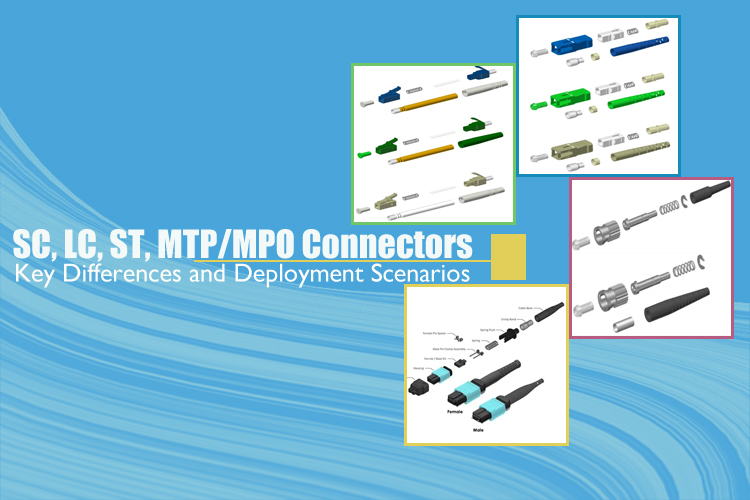
Fiber Optic connectors are essential components in fiber optic communication systems, allowing for the connection of fiber optic cables to various network devices. Each type of connector has unique characteristics, advantages, and applications. Here's an overview of four common types of Fiber optic connectors: SC, LC, ST, and MTP/MPO.
1. SC Connector
Overview:
The SC (Subscriber Connector or Square Connector) is a popular single-fiber connector characterized by its push-pull locking mechanism and rectangular shape. It was developed in the 1980s and has since become a standard connector in many fiber optic applications.
Advantages:
Ease of Use: The push-pull design allows for easy handling and quick connections.
Low Insertion Loss: SC connectors provide low signal loss due to precise alignment in the connection.
Stable Performance: They are known for their reliability and stable performance over time.
Applications:
Telecommunications: SC connectors are widely used in telecom networks due to their optimal performance and low loss.
Data Centers: They are common in high-density fiber patch panels in data centers for connecting servers and networking equipment.
LANs: Often found in local area networks for reliable connections to switches and routers.
2. LC Connector
Overview:
The LC (Lucent Connector) is a compact Fiber optic connector that uses a smaller form factor than SC connectors. It employs a latch mechanism for connection and is designed for high-density applications.
Advantages:
High Density: The small size allows more connectors to be installed in a smaller area, conserving space in patch panels and equipment.
Excellent Performance: LC connectors provide low insertion and return loss, ensuring high-quality signal transmission.
Standardization: LCs have become the standard in many modern telecommunications and data center installations.
Applications:
Data Centers: Due to their compact design, LC connectors are prevalent in data centers where space is at a premium.
Fiber-to-the-Home (FTTH): LC connectors are utilized in residential applications, connecting homes to fiber networks.
Telecom Networks: Often employed in central offices and communication hubs for efficient connectivity.
3. ST Connector
Overview:
The ST (Straight Tip) connector is an older style of Fiber optic connector that uses a bayonet-style coupling mechanism. It is primarily a multimode connector commonly used for both single-mode and multimode applications.
Advantages:
Durability: The bayonet-style design allows for a secure connection, making it less susceptible to accidental disconnection.
Versatility: ST connectors are compatible with both single-mode and multimode fibers, making them versatile in various applications.
Ease of Use: The simple design and secure locking mechanism facilitate easy connections and disconnections.
Applications:
Legacy Systems: ST connectors are often found in older telecom systems and networking equipment.
Industrial Applications: They are frequently used in industrial settings where ruggedness and durability are essential.
Academic and Research Institutions: Commonly used in laboratory settings for fiber optic sensors and testing equipment.
4. MTP/MPO Connector
Overview:
MTP (Multi-fiber Termination Push-on) and MPO (Multi-fiber Push-On) are high-density multi-fiber connectors that can carry multiple fibers in one connector. They are designed for high-speed networks and optimized for high-density applications.
Advantages:
High Density: MTP/MPO connectors can contain 12, 24, or even more fibers in a single connector, allowing for ultra-high-density connections.
Fast Installation: MTP/MPO connectors can simplify installation processes, particularly in patch panels where multiple fibers are being managed.
Efficient Space Utilization: Ideal for data centers and environments where maximizing space while maintaining high performance is crucial.
Applications:
Data Centers: MTP/MPO connectors are frequently used to connect switches and routers in high-performance data centers.
High-Speed Networks: They are essential in applications requiring high data rates, such as 40G and 100G networks.
Telecommunication Infrastructure: Used in backbone networks and high-density wiring environments.
Comparison Summary
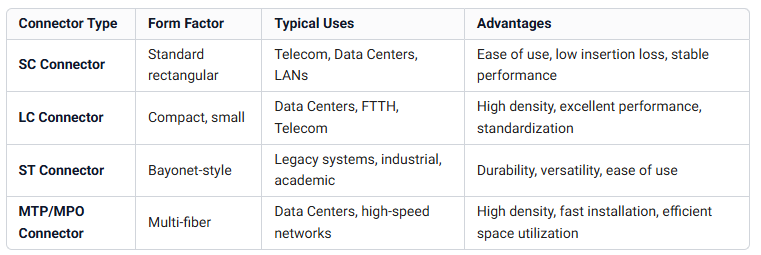
Connector Type Form Factor Typical Uses Advantages
SC Connector Standard rectangular Telecom, Data Centers, LANs Ease of use, low insertion loss, stable performance
LC Connector Compact, small Data Centers, FTTH, Telecom High density, excellent performance, standardization
ST Connector Bayonet-style Legacy systems, industrial, academic Durability, versatility, ease of use
MTP/MPO Connector Multi-fiber Data Centers, high-speed networks High density, fast installation, efficient space utilization
Conclusion
Understanding the differences between SC, LC, ST, and MTP/MPO connectors enables network designers and engineers to make informed decisions when planning and deploying optical fiber networks. Each connector has its place in a system, depending on factors like application, space constraints, and performance requirements. By selecting the appropriate Fiber optic connectors, organizations can ensure reliable, high-performance fiber optic connectivity tailored to their specific networking needs.
FAQs
1. Can SC and LC connectors be used interchangeably?
No, SC and LC connectors cannot be used interchangeably due to differences in size, form factor, and coupling methods. They require different patch panels and are designed for different applications.
2. What are the primary factors to consider when selecting an Fiber optic connector?
When selecting an Fiber optic connector, consider the following factors:
Application: What are you connecting (telecom, data center, etc.)?
Space Requirements: Is space limited (requiring a high-density connector)?
Performance Needs: Required bandwidth, distance, and signal quality.
Ease of Installation: Ease of handling and compatibility with existing systems.
3. How does the performance of single-mode connectors compare to multimode connectors?
Single-mode connectors generally provide better performance over longer distances due to lower loss and reduced modal dispersion. They support higher bandwidth and longer distances compared to multimode connectors, which are better suited for shorter distances with potentially higher loss.
4. Are MTP/MPO connectors suitable for all types of networks?
MTP/MPO connectors are particularly well-suited for high-speed and high-density networks, such as those found in data centers. They may not be necessary for smaller installations with lower data requirements, where traditional single-fiber connectors like SC or LC might be sufficient.
5. What maintenance is required for Fiber optic connectors?
Regular maintenance for Fiber optic connectors includes:
Cleaning: Use appropriate cleaning methods to remove dust and contaminants from connector ends to avoid signal loss.
Inspection: Periodically inspect connectors for physical damage and signs of wear.
Testing: Routinely test connections using appropriate equipment to ensure optimal performance and identify potential issues early.
Keywords: Fiber optic connectors, SC connector, LC connector, ST connector, MTP/MPO connector, fiber optic connectivity, telecommunications, data centers, networking applications.
1. SC Connector
Overview:
The SC (Subscriber Connector or Square Connector) is a popular single-fiber connector characterized by its push-pull locking mechanism and rectangular shape. It was developed in the 1980s and has since become a standard connector in many fiber optic applications.
Advantages:
Ease of Use: The push-pull design allows for easy handling and quick connections.
Low Insertion Loss: SC connectors provide low signal loss due to precise alignment in the connection.
Stable Performance: They are known for their reliability and stable performance over time.
Applications:
Telecommunications: SC connectors are widely used in telecom networks due to their optimal performance and low loss.
Data Centers: They are common in high-density fiber patch panels in data centers for connecting servers and networking equipment.
LANs: Often found in local area networks for reliable connections to switches and routers.
2. LC Connector
Overview:
The LC (Lucent Connector) is a compact Fiber optic connector that uses a smaller form factor than SC connectors. It employs a latch mechanism for connection and is designed for high-density applications.
Advantages:
High Density: The small size allows more connectors to be installed in a smaller area, conserving space in patch panels and equipment.
Excellent Performance: LC connectors provide low insertion and return loss, ensuring high-quality signal transmission.
Standardization: LCs have become the standard in many modern telecommunications and data center installations.
Applications:
Data Centers: Due to their compact design, LC connectors are prevalent in data centers where space is at a premium.
Fiber-to-the-Home (FTTH): LC connectors are utilized in residential applications, connecting homes to fiber networks.
Telecom Networks: Often employed in central offices and communication hubs for efficient connectivity.
3. ST Connector
Overview:
The ST (Straight Tip) connector is an older style of Fiber optic connector that uses a bayonet-style coupling mechanism. It is primarily a multimode connector commonly used for both single-mode and multimode applications.
Advantages:
Durability: The bayonet-style design allows for a secure connection, making it less susceptible to accidental disconnection.
Versatility: ST connectors are compatible with both single-mode and multimode fibers, making them versatile in various applications.
Ease of Use: The simple design and secure locking mechanism facilitate easy connections and disconnections.
Applications:
Legacy Systems: ST connectors are often found in older telecom systems and networking equipment.
Industrial Applications: They are frequently used in industrial settings where ruggedness and durability are essential.
Academic and Research Institutions: Commonly used in laboratory settings for fiber optic sensors and testing equipment.
4. MTP/MPO Connector
Overview:
MTP (Multi-fiber Termination Push-on) and MPO (Multi-fiber Push-On) are high-density multi-fiber connectors that can carry multiple fibers in one connector. They are designed for high-speed networks and optimized for high-density applications.
Advantages:
High Density: MTP/MPO connectors can contain 12, 24, or even more fibers in a single connector, allowing for ultra-high-density connections.
Fast Installation: MTP/MPO connectors can simplify installation processes, particularly in patch panels where multiple fibers are being managed.
Efficient Space Utilization: Ideal for data centers and environments where maximizing space while maintaining high performance is crucial.
Applications:
Data Centers: MTP/MPO connectors are frequently used to connect switches and routers in high-performance data centers.
High-Speed Networks: They are essential in applications requiring high data rates, such as 40G and 100G networks.
Telecommunication Infrastructure: Used in backbone networks and high-density wiring environments.
Comparison Summary
Connector Type Form Factor Typical Uses Advantages
SC Connector Standard rectangular Telecom, Data Centers, LANs Ease of use, low insertion loss, stable performance
LC Connector Compact, small Data Centers, FTTH, Telecom High density, excellent performance, standardization
ST Connector Bayonet-style Legacy systems, industrial, academic Durability, versatility, ease of use
MTP/MPO Connector Multi-fiber Data Centers, high-speed networks High density, fast installation, efficient space utilization
Conclusion
Understanding the differences between SC, LC, ST, and MTP/MPO connectors enables network designers and engineers to make informed decisions when planning and deploying optical fiber networks. Each connector has its place in a system, depending on factors like application, space constraints, and performance requirements. By selecting the appropriate Fiber optic connectors, organizations can ensure reliable, high-performance fiber optic connectivity tailored to their specific networking needs.
FAQs
1. Can SC and LC connectors be used interchangeably?
No, SC and LC connectors cannot be used interchangeably due to differences in size, form factor, and coupling methods. They require different patch panels and are designed for different applications.
2. What are the primary factors to consider when selecting an Fiber optic connector?
When selecting an Fiber optic connector, consider the following factors:
Application: What are you connecting (telecom, data center, etc.)?
Space Requirements: Is space limited (requiring a high-density connector)?
Performance Needs: Required bandwidth, distance, and signal quality.
Ease of Installation: Ease of handling and compatibility with existing systems.
3. How does the performance of single-mode connectors compare to multimode connectors?
Single-mode connectors generally provide better performance over longer distances due to lower loss and reduced modal dispersion. They support higher bandwidth and longer distances compared to multimode connectors, which are better suited for shorter distances with potentially higher loss.
4. Are MTP/MPO connectors suitable for all types of networks?
MTP/MPO connectors are particularly well-suited for high-speed and high-density networks, such as those found in data centers. They may not be necessary for smaller installations with lower data requirements, where traditional single-fiber connectors like SC or LC might be sufficient.
5. What maintenance is required for Fiber optic connectors?
Regular maintenance for Fiber optic connectors includes:
Cleaning: Use appropriate cleaning methods to remove dust and contaminants from connector ends to avoid signal loss.
Inspection: Periodically inspect connectors for physical damage and signs of wear.
Testing: Routinely test connections using appropriate equipment to ensure optimal performance and identify potential issues early.
Keywords: Fiber optic connectors, SC connector, LC connector, ST connector, MTP/MPO connector, fiber optic connectivity, telecommunications, data centers, networking applications.
Leave a Reply
Your email address will not be published.Required fields are marked. *